




The wide spread between the implied volatility indices (DVOL) of Ethereum and Bitcoin may be “unjustified,” as expectations for a spot ETH-ETF are overly optimistic. This is according to a report by CoinDesk, citing Amberdata.
The gap between the 30-day DVOL of the two largest cryptocurrencies has been widening since April in favor of Ether. Analysts report that the current figure stands at about 17%.


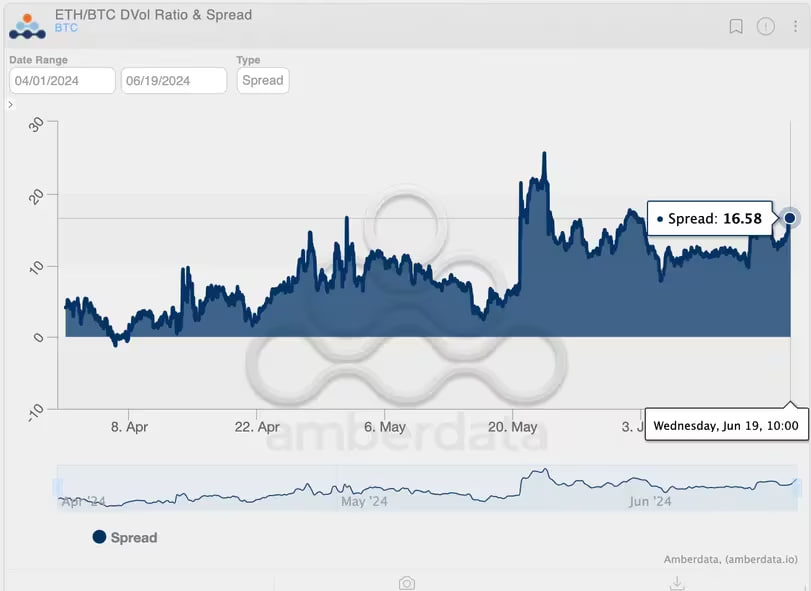
This indicates that for the past two months, options market investors have anticipated greater price swings in ETH compared to digital gold.
Greg Magadini, Director of Derivatives at Amberdata, remains skeptical about the continuation of this trend:
“A lot of cold water has been poured on the BTC-ETF inflow narrative, given the assumption that funds are merely trading Bitcoin’s basis rather than taking on direct ETF risks.”
He believes much of the hype surrounding spot Ethereum-ETFs is likely tied to expectations of significant institutional inflows, similar to what occurred following the launch of a comparable Bitcoin-based product.
According to SoSoValue, since its debut in January, spot funds based on the first cryptocurrency in the US have attracted a total of $14.81 billion.
The price of Bitcoin rose alongside the inflow of funds into ETFs. However, the momentum has stalled, as most inflows into these instruments are driven by arbitrage strategies like Cash & Carry or basis trading. Such factors may temper the bullish narrative from exchange-traded funds, Magadini noted.
“In the long term, I still believe in Ethereum. There is likely an opportunity now to trade only under conditions of ‘immediate’ relative price volatility,” he warned.
Another sign of the market’s “concern” regarding new ETFs is the open interest (OI) in ETH and BTC futures on the Chicago Mercantile Exchange (CME) — $1.6 billion and $10 billion, respectively. The significant gap indicates that Ethereum has yet to gain widespread institutional recognition as digital gold.
“The answer to the question [of consistently elevated ETH volatility] will come when we see actual ETF inflows and volumes. If they resemble the OI on CME for Bitcoin and Ether futures, I think the latter won’t experience the strong positive effect that the first cryptocurrency recorded [after fund launches],” said Magadini.
Overall Market Condition
According to Santiment, nearly all major cryptocurrencies have entered the “undervalued” zone.
? The lower a cryptocurrency’s 30-day MVRV is, the higher the likelihood we see a short-term bounce:
Bitcoin: -4.0% (Mild Bullish)
Ethereum: -4.3% (Mild Bullish)
XRP: -3.5% (Mild Bullish)
Dogecoin: -16.7% (Very Bullish)
Toncoin: -0.6% (Neutral)
Cardano: -12.6% (Very Bullish) pic.twitter.com/zHGg4t3qo1— Santiment (@santimentfeed) June 19, 2024
“The lower the 30-day MVRV, the higher the likelihood of a short-term rebound,” analysts suggested.
Researchers also noted that Bitcoin’s decline occurred despite the rise of the S&P 500 index.
? Bitcoin’s plummet has come in spite of the S&P 500 continuing to roll. This split between sectors has been a surprisingly rare occurrence ever since the dust settled following the FTX collapse in late 2022. In most circumstances, crypto has seen a relief bounce to catch up. pic.twitter.com/Y0JxShFtGu
— Santiment (@santimentfeed) June 18, 2024
The divergence between the stock and crypto markets has been a rare occurrence since the industry recovered from the FTX collapse in late 2022, Santiment noted. In most such cases, digital assets have shown a rebound to catch up.
Technical analyst Ali highlighted the accumulation of over 700,000 ETH worth $2.45 billion by whales over the past three weeks.
#Ethereum whales have bought over 700,000 $ETH in the past three weeks, totaling approximately $2.45 billion! pic.twitter.com/sfmXnkqD49
— Ali (@ali_charts) June 15, 2024
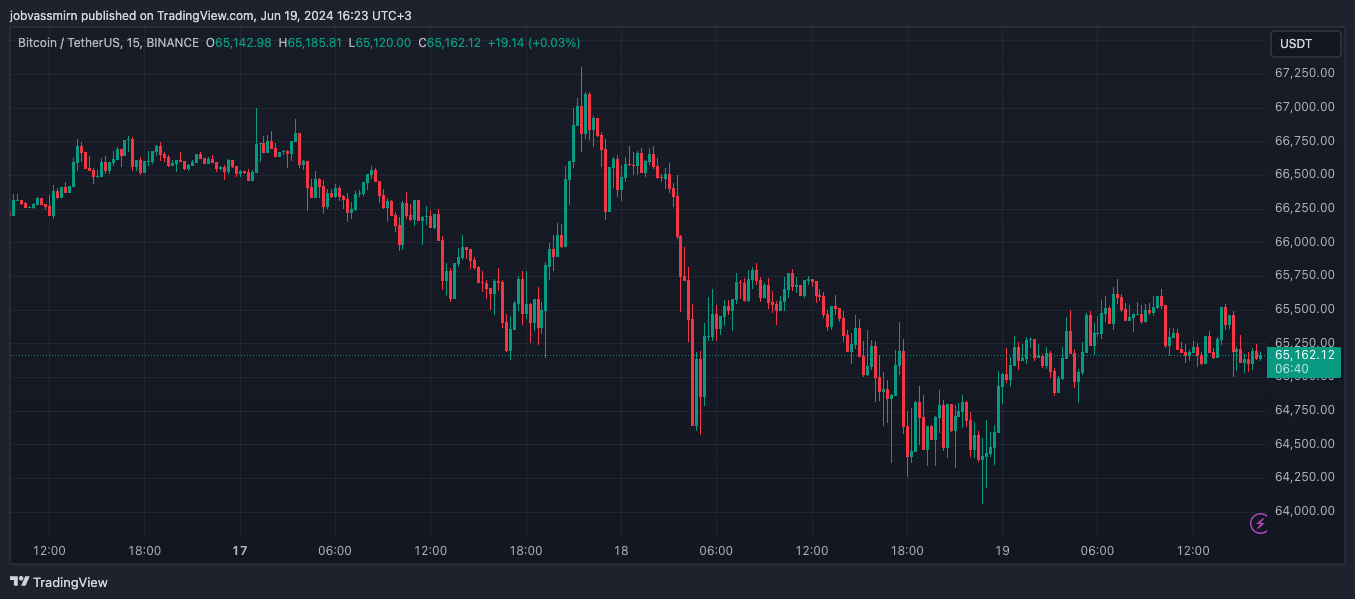
At the time of writing, Bitcoin is trading around $65,100, having fallen 6.1% over the week.

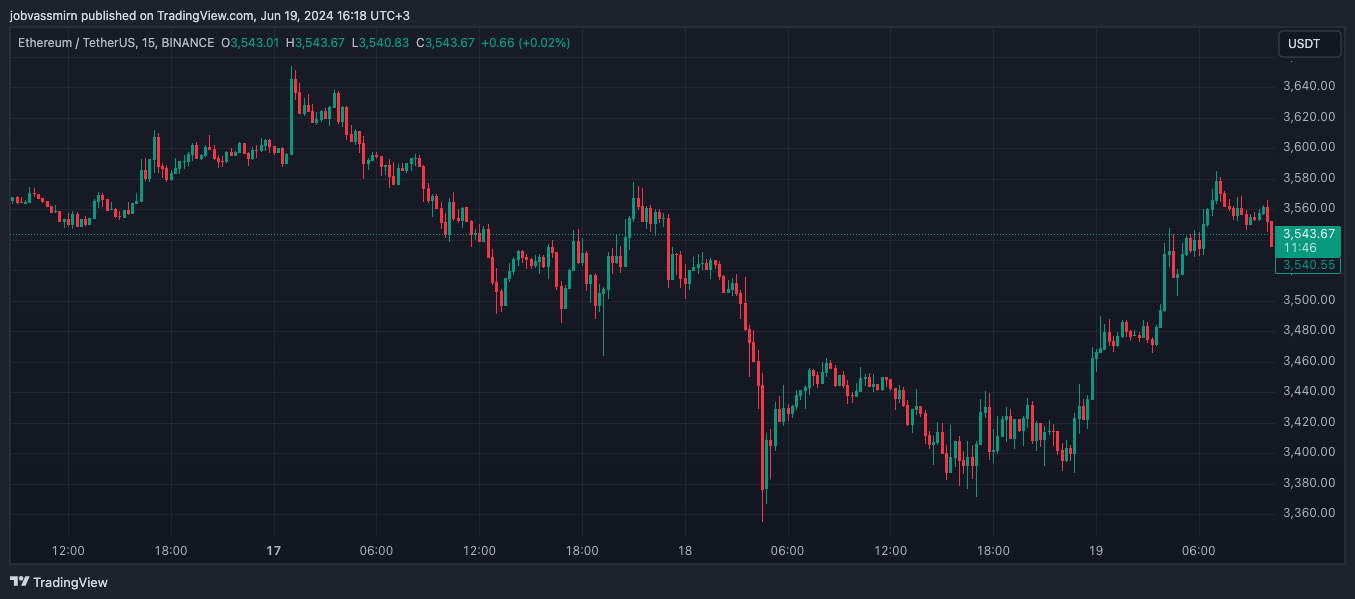
Ethereum is priced at $3,540, down 2.7% over the past seven days.
In K33 Research, it was noted that the significant inflow into BTC-ETFs largely reflects demand rather than arbitrage between spot and futures markets.
Previously, analyst Ali highlighted signs of a volatility spike and significant risk.