




The increase in Ethereum’s issuance to a two-year high of 0.74% per annum (30 DMA) raises doubts about the cryptocurrency’s deflationary prospects and its status as ‘hard money’. This conclusion was reached by Binance, reports Cointelegraph.
Experts highlighted the shift of network activity to L2, which led to a reduction in the number of transactions at the base level and a decrease in the rate of coin burning. The mechanism introduced in EIP-1559 was implemented as part of the London hard fork in 2021.


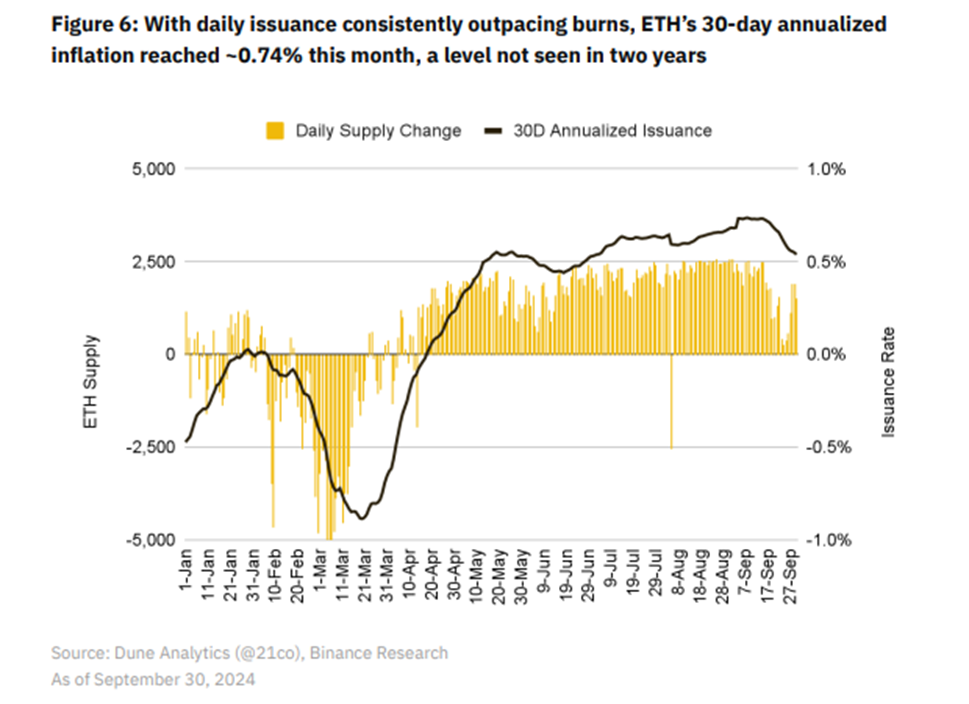
“As L2 concentrated network activity, transaction fees and, consequently, the burning rate decreased. In September, the latter fell to one of the lowest levels since The Merge,” the review states.
At the end of August, the issuance volume of the second-largest cryptocurrency by market capitalization exceeded 120 million ETH. This was driven by the growth of coins locked in staking and restaking protocols.
In late September, the average transaction fee on the Ethereum network surged fivefold compared to the beginning of the month.
Previously, amid criticism of Ether due to negative price dynamics, CIO of Bitwise Matt Hougan supported the second-largest cryptocurrency, highlighting its potential.