



Constraints within Ethereum are driving users, applications, and capital towards Layer 2 networks and competing blockchains like Solana as demand for faster and more scalable solutions grows. This perspective was shared by Zeta Markets co-founder Anmol Singh in a conversation with The Block.
“Ethereum’s Layer 2 is a result of the base infrastructure being insufficient to handle users, transactions, and data. Therefore, they migrate to L2 and other Layer 1 networks out of necessity,” he noted.
QuarkChain and EthStorage founder Qi Zhou highlighted that the growing number of L2 solutions leads to liquidity fragmentation.
“Each Layer 2 network like Arbitrum, Optimism, and zkSync has its own isolated liquidity pools, leading to fragmentation. Users must bridge assets between different networks, incurring higher transaction costs. This distribution results in diluted liquidity, complicating the achievement of deep liquidity pools in any single ecosystem. With weak fund distribution, there is a risk of lower market efficiency, increased slippage, and high fees for large trades, potentially deterring users from engaging with L2,” he said.
As a solution to the fragmentation issue, Zhou noted the emergence of protocols offering shared liquidity hubs and cross-layer fund distribution. These allow assets to move seamlessly between L2 solutions.
“As the ecosystem develops, achieving a balance between scalability, liquidity concentration, and user experience will be crucial for L2 in the Ethereum ecosystem to maximize adoption and utility,” he added.
Solana Drains Liquidity from Ethereum
Singh pointed out Solana’s “monolithic” architecture, capable of handling transactions and maintaining liquidity at a single level.
“Solana’s throughput and low latency allow it to meet core DeFi needs at scale. Layer 2s in the network like Bullet are designed for specific use cases, such as derivatives trading, where high throughput and low latency are important,” he said.
Singh referred to a recent a16z report indicating around 100 million monthly active addresses on the Solana blockchain compared to 57 million on Ethereum and other EVM networks. The higher user engagement in the former case is attributed to new applications like Pump Fun or Daos Fun and a scalable ecosystem that has laid a solid foundation for expansion.
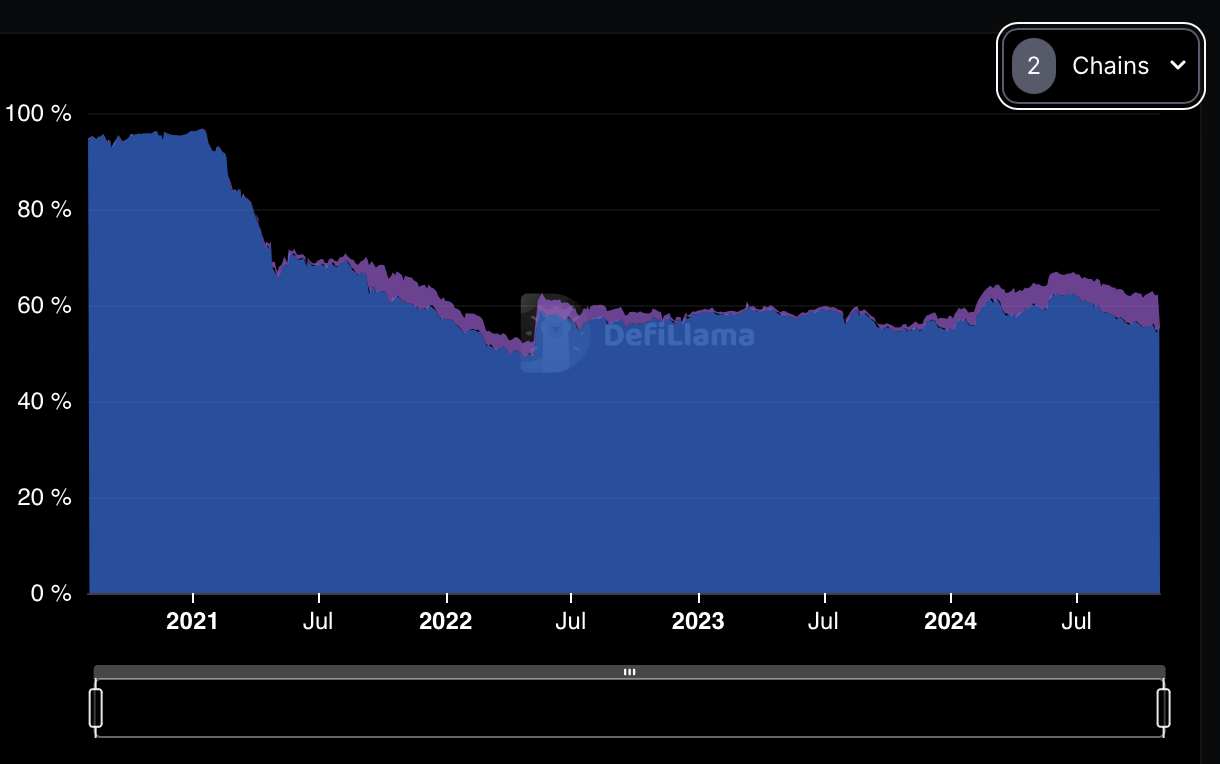
The Zeta Markets co-founder noted a decline in Ethereum’s TVL by nearly $20 billion since early June. During this period, Solana’s figure rose from $4.8 billion to $6.3 billion.


“Four out of the top ten meme coins by market capitalization — Dogwifhat, Bonk, Popcat, and Mew — were recently created on Solana, indicating the formation of new opportunities in this network rather than on Ethereum,” Singh added.
He emphasized that in the current cycle, meme coins are driving retail demand and showing a shift in user interest.
Arbelos Markets CEO Joshua Lim noted that Ethereum and its related assets are experiencing stagnation, while investor interest in Bitcoin and Solana is growing. According to him, the first cryptocurrency is in demand due to inflows into ETFs, while the second is fueled by meme coin trader enthusiasm.
The expert pointed out that the growing supply of Layer 2 tokens on Ethereum creates inflationary pressure, undermining the “ultrasound” monetary appeal of ether. Meanwhile, Solana has become a strong contender for use in the DeFi sector and speculative trading and is capable of challenging ether.
Previously, analysts expressed the view that concerns about the negative impact of L2 solutions on the price of ether might be premature.
Back in August, 1confirmation founder Nick Tomaino stated that Ethereum will surpass the first cryptocurrency in market capitalization within five years.
In October, QCP Capital noted high chances for the coin to break the $2800 resistance and move towards $3000.