



Casa’s co-founder and CTO Jameson Lopp drew the community’s attention to the second-layer Spiderchain concept on Bitcoin by Botanix Labs, noting its advantages.
Drivechains, Softchains, Spacechains, Statechains, Spiderchains, oh my!
In my latest essay I review the most recent proposal for a novel way to construct a 2-way pegged sidechain.https://t.co/3cnUiIPNiq
— Jameson Lopp (@lopp) September 18, 2023
One of the advantages of the proposed network, the expert noted, is that it can be implemented without altering Bitcoin’s blockchain.
The L2 solution is a sidechain with two-way pegging. Such protocols typically use the main blockchain’s coin, rely on its security mechanism, and provide access to a broader range of features such as scalability, programmability and privacy.
Developers at Botanix Labs noted growth in DeFi applications in the Ethereum ecosystem, which are largely unavailable for Bitcoin.
In L2 protocols built on the Bitcoin network, less than 0.1% of the total supply of digital gold is locked. At the same time, the volume of “wrapped Bitcoin” on Ethereum exceeds 2% of issuance.
Spiderchain compatibility with Ethereum expands Bitcoin’s use in DeFi applications
Spiderchain is fully compatible with EVM, uses the Proof-of-Stake (PoS), staking and smart contracts. The protocol consists of several layers, with the base blockchain serving as the calculation layer.
Lopp described it as sensible to reuse existing tools from the EVM ecosystem. The Solidity programming language for smart contracts provides a high level of trust and adoption, he added.
Lopp acknowledged that even the oldest and best-known Bitcoin sidechains like Liquid and Rootstock have not achieved broad adoption. However, demand for using digital gold for more complex financial functions does indeed confirm the volume of tokenised Bitcoin on Ethereum, he emphasised.
One of the problems the expert identified is the security of the bridging mechanism—the transfer of assets between networks. This usually entails the involvement of intermediaries in transactions.
“Trusted third parties are holes in security,” Lopp quoted the renowned cryptographer Nick Szabo.
The developers say they have addressed this by using multisignatures.
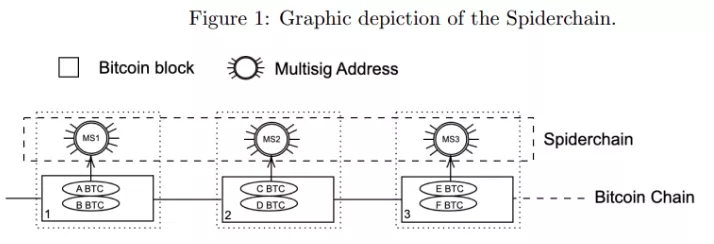
The sidechain is managed by so-called “orchestrators” (Orchestrator), who stake in Bitcoin. They simultaneously run two nodes in both networks.
“Orchestrators” manage requests for binding and unbinding assets, controlling multisig wallets opened for each new input. Users, through them, place coins in staking, obtaining a “synthetic Bitcoin” at a 1:1 ratio.
Wallets are controlled by a random set of currently active “orchestrators”. One of them by computations is chosen to manage the epoch, with the epoch end finalising transactions.
Blocks in Spiderchain do not sync with the Bitcoin blockchain, and their interval is likely 12 seconds, Lopp suggested.


The decentralisation of Spiderchain comes under scrutiny
In his view, the centralisation tendency of PoS networks is balanced by Bitcoin’s Proof-of-Work algorithm. However this means that stakers will not receive fees from the base network. Their income will consist of transaction fees in Spiderchain and penalties for orchestrators’ misbehaviour, which raises questions about incentive sufficiency, noted Lopp.
He also questioned whether there are sufficient mechanisms to prevent attacks by a malicious majority in the network.
In the initial stage Botanix Labs will control 100% of the nodes, with a gradual move toward decentralisation.
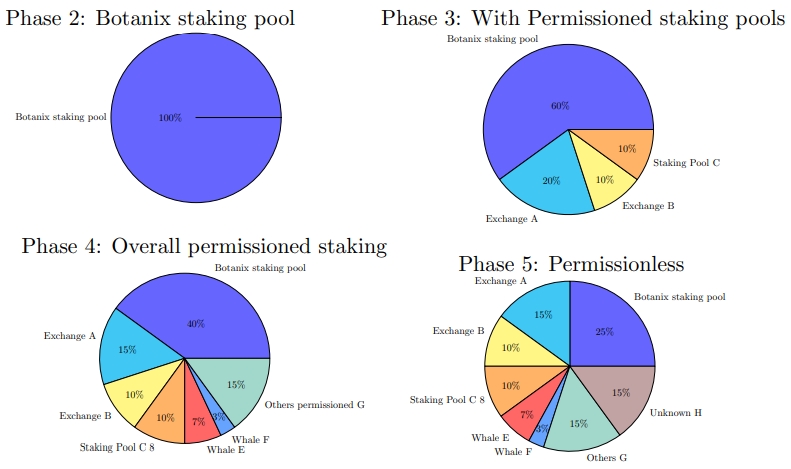
Lopp expressed scepticism about such an approach, adding that most projects following this path become increasingly centralised.
He also drew attention to certain technical vulnerabilities of Spiderchain regarding stake-based limits for the “orchestrators”. Because of their approval mechanism there is a risk of funds loss in the event of a Bitcoin network reorganising to a depth of more than five blocks, he noted.
As reported, in the Ethereum ecosystem, for the first time in history two L2 solutions — Base and zkSync Era — surpassed the base blockchain in terms of transactions per second.