




The successful activation of Dencun, introducing a new architecture for Layer-2 solutions and changes in the staking pool, is set to influence Ethereum’s monetary policy. These changes were analyzed by Glassnode.
The Dencun upgrade has activated successfully, introducing a new architecture for Layer-2 solutions to anchor into the mainchain. It also introduces modifications to the staking pool. Both could impact Ethereum’s monetary policy. pic.twitter.com/mJt4EdCliq
— glassnode (@glassnode) March 19, 2024
A key component of the Dencun upgrade is EIP-4844, which includes the Proto-Danksharding option. This is designed to scale the network by creating a new type of transaction for large binary data arrays (BLOB).
BLOBs are temporarily stored at the consensus level rather than the execution level. This solution aims to reduce fees for L2 protocols, especially those based on Rollups technology.
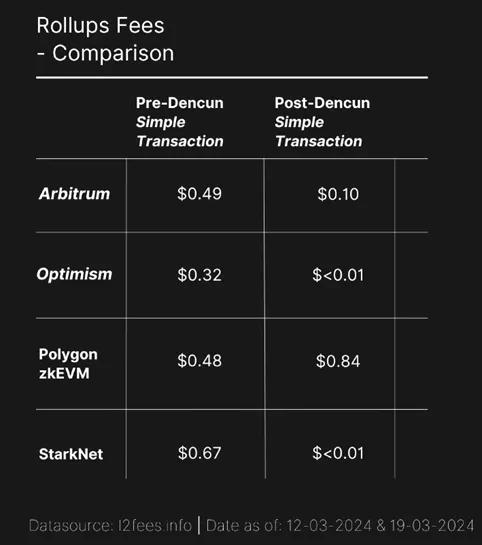
The presented table shows the dynamics of fees. Indicators for Optimism and StarkNet have dropped below $0.01.


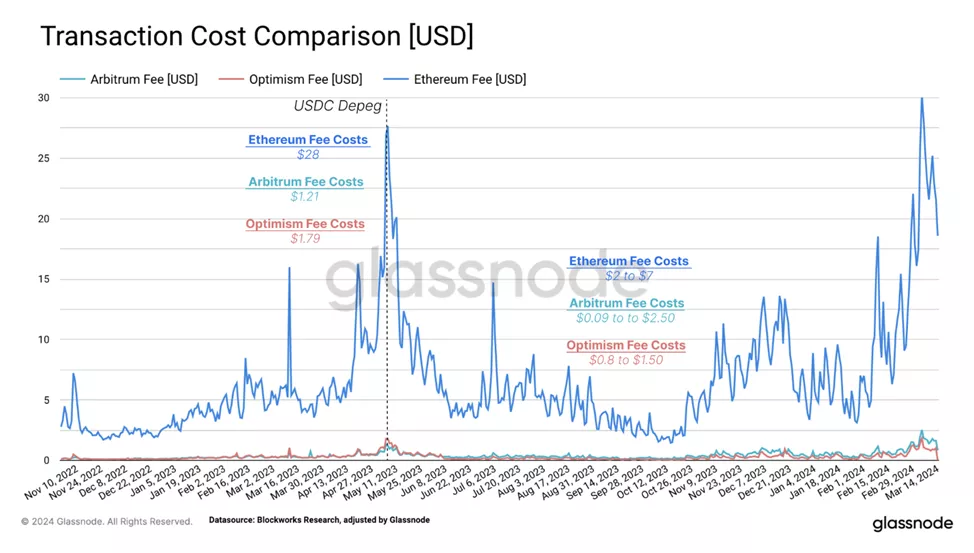
Experts normalized fees on the mainnet and L2 solutions in value terms. In Arbitrum and Optimism, the indicator ranged from $0.1 to $0.3, while on the main network it was $2 to $7.
During periods of significant on-chain activity, the metric in Ethereum could exceed $30, prompting a reaction in L2 networks where it spiked to $2.5.

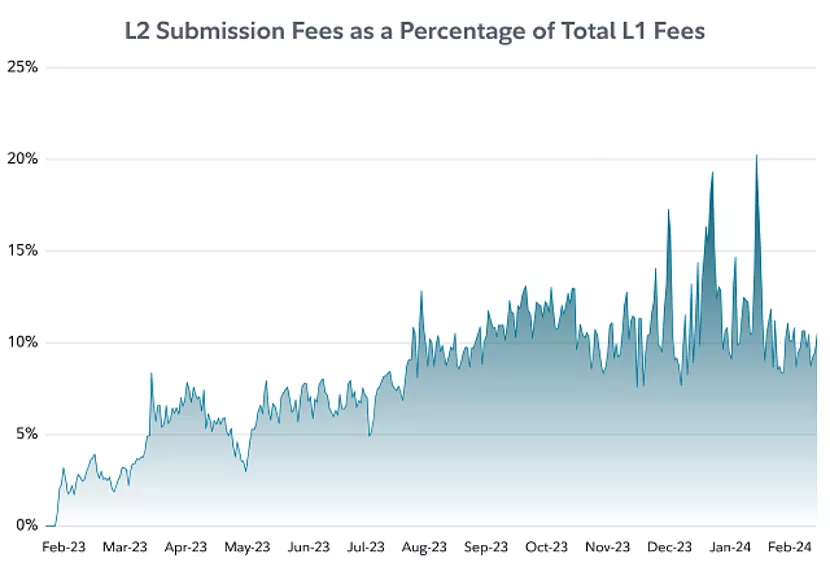
Analysts noted that such interdependence sometimes leads to higher costs and complicates the user experience. L2 solutions have added a new source of demand for block space in Ethereum. According to a Fidelity report, their share is about 10% of the total.

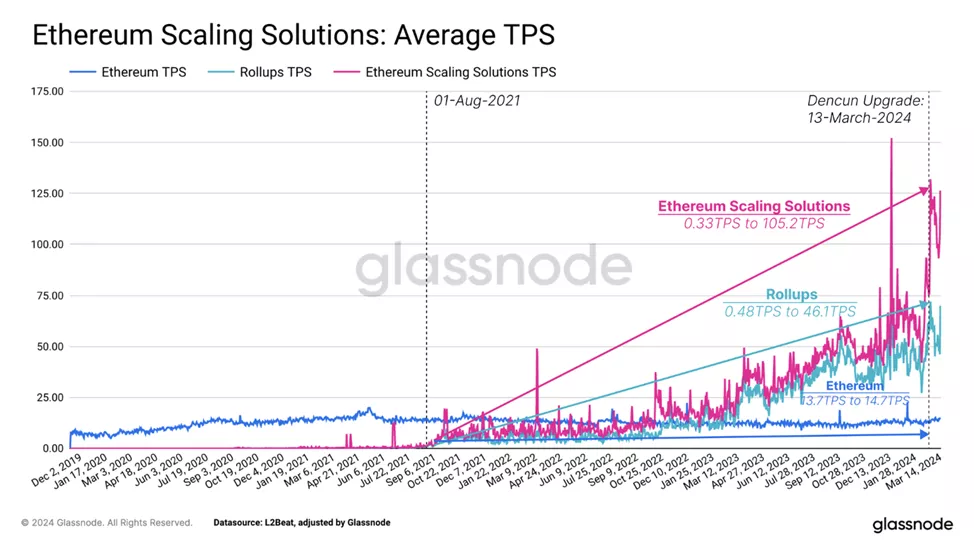
Experts noted that there is hope within the community for a shift of some users to L2 solutions from the main network due to reduced fees, which would reflect in increased Ethereum throughput without compromising the decentralization and security of the mainnet.
Experts recorded a jump in TPS in L2 networks to 105, including in Rollups to 46.
Glassnode saw this as a sign of the roadmap’s success. Compared to its largest competitor Solana, which averages about 2600 TPS, there remains a significant difference, largely dependent on architectural design. Ethereum’s is modular, while Solana’s is monolithic.

Dencun also impacted Ethereum stakers. Specifically:
- Permanent signed exits improve the user experience for liquid staking participants. Before the update, the signature key needed to authorize a user’s ETH withdrawal from the pool was held by the validator operator. This scheme implies that the service client relies on the validator operator’s goodwill when wanting to withdraw ETH. After Dencun, validator operators can pre-sign voluntary exits, allowing clients to cease using the service unilaterally.
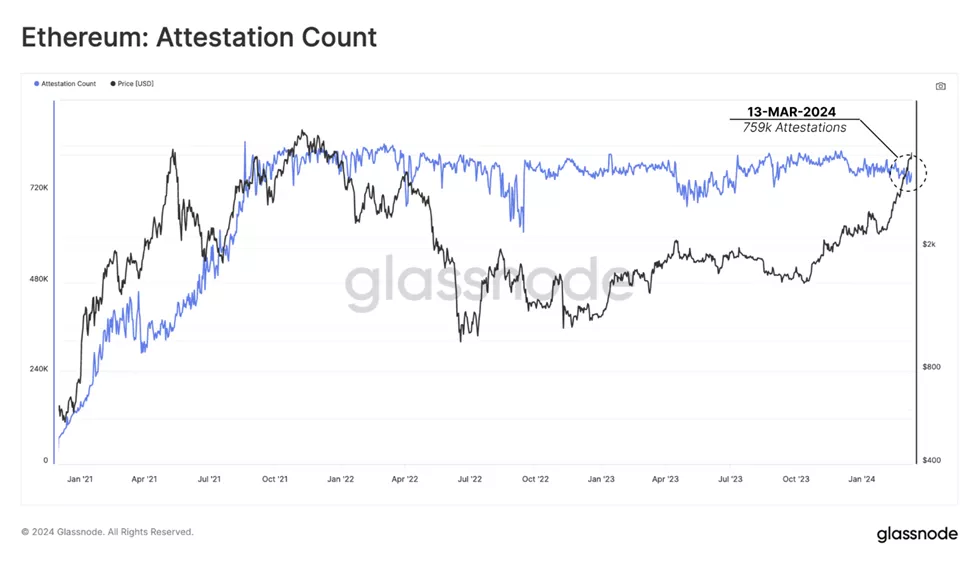
- Increased confirmation window doubles the time required for validators to vote on block correctness—from 6.4 minutes to 12.8 minutes. This allows for more confirmations to be gathered, potentially speeding up the block confirmation process. The daily number of attestations is now approximately 759,000.

The update also set a fixed limit for new validators (eight per epoch of 6.4 minutes) to slow their growth rate.
Before Dencun, the number of validator entries/exits from the staking pool was regulated by an outflow limit. The innovation is another step towards specifying the pace of increase in the total number of active validators. This will help reduce the side effect of deteriorating interaction speed between nodes.
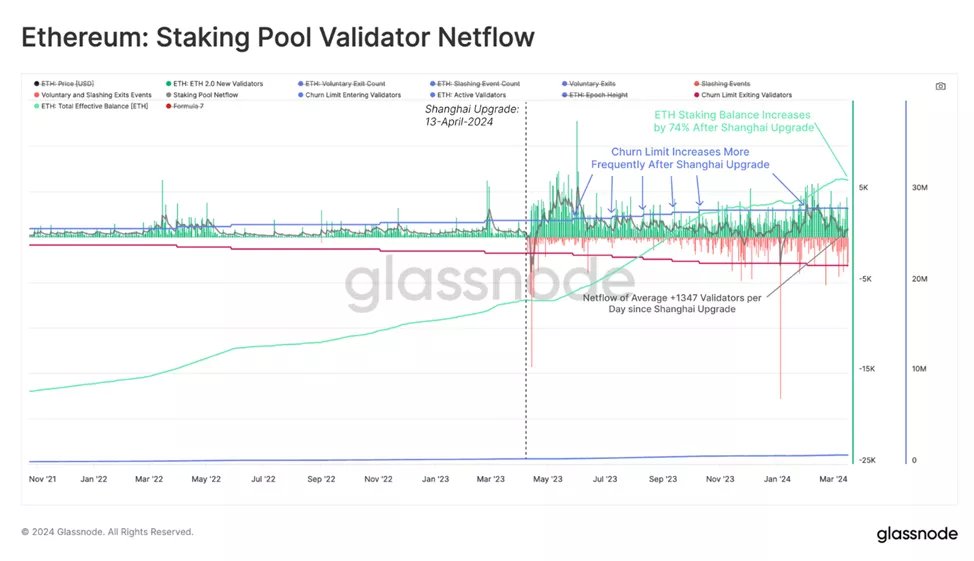
The slowdown in validator growth and consequently the effective balance of ETH in staking has a secondary impact on Ethereum’s monetary policy. Since current issuance is based on the number of active validators, the introduced restrictions will reduce the rate of coin supply expansion.
According to analysts’ calculations, after the Shanghai update, as the number of validators increased, daily issuance intensified from 1183 ETH to 2554 ETH per day. After Dencun, the indicator showed negative dynamics for the third time in history.
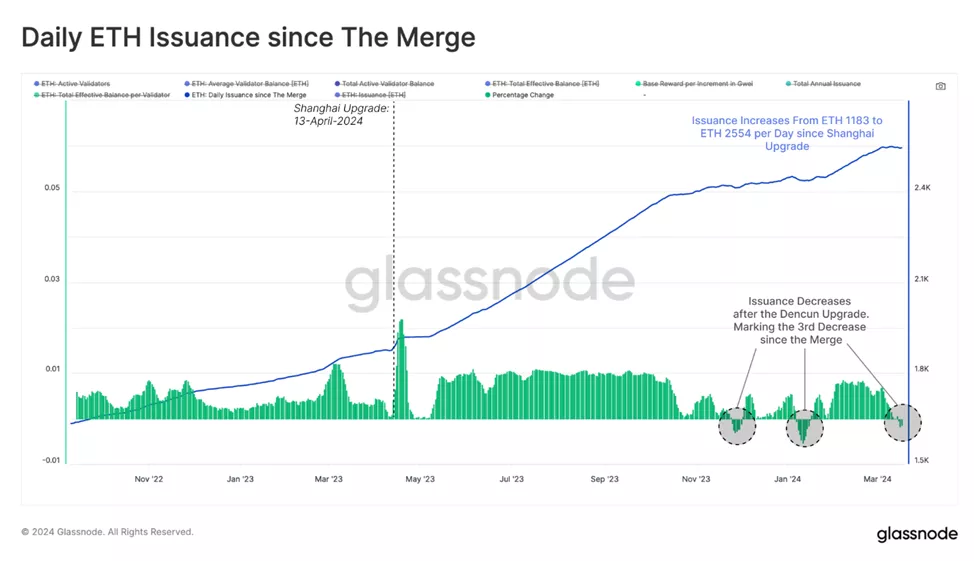
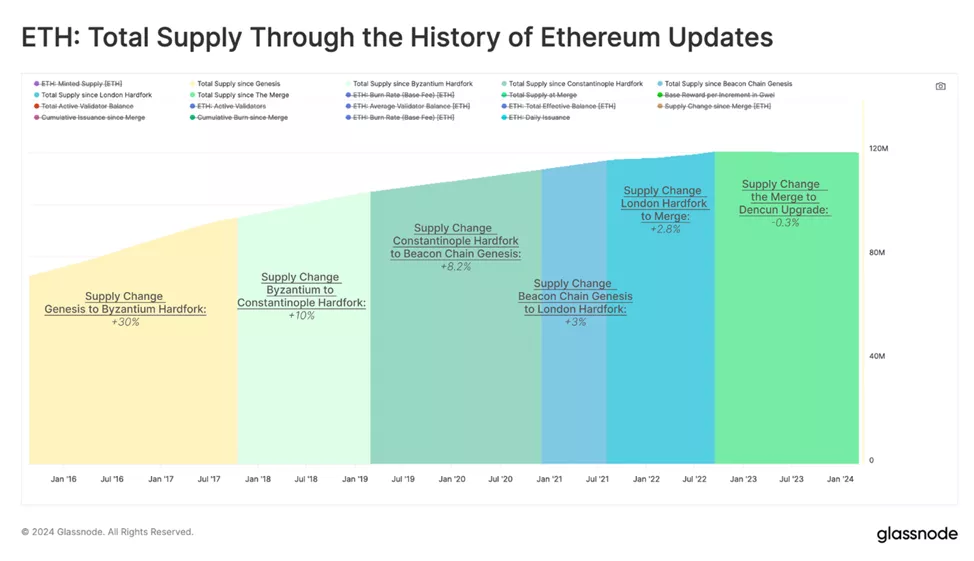
Potentially, the slowdown in issuance could result in a reduction in Ethereum supply if the number of burned coins during high on-chain activity exceeds the number issued. According to Glassnode, the total available ETH has decreased by 410,000 since The Merge.
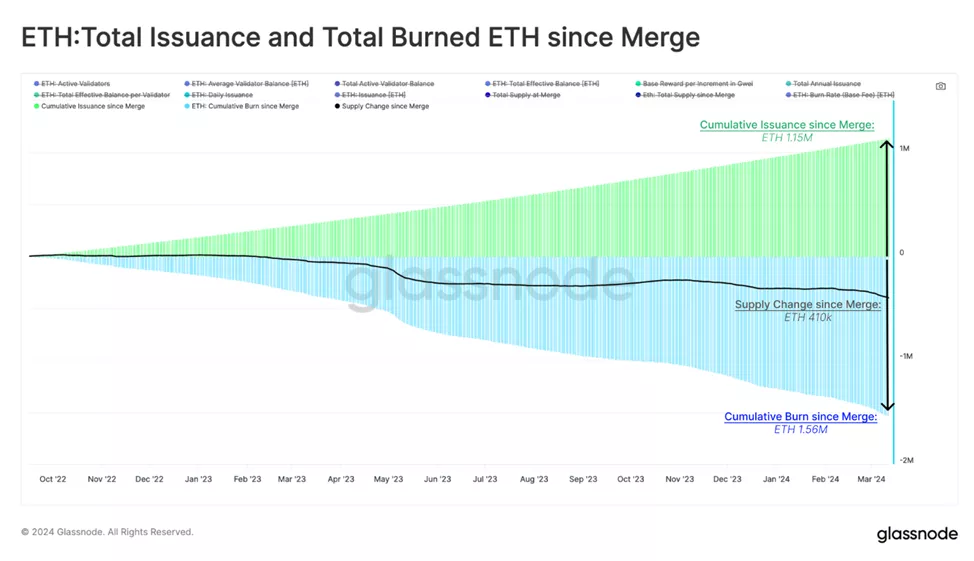
The impact of Dencun on Ethereum’s supply is yet to be assessed due to two interrelated changes:
- Transactions anchoring L2 solutions have been moved to the BLOB data structure, eliminating about 10% of the fee load. This could lead to a slight decrease in the number of ETH burned.
- Lower fees in L2 networks may encourage broader use of both the mainnet and scaling solutions, which could create upward pressure on fees.
According to analysts, the rate of issuance growth will decrease due to the reduced pace of new validator growth.
Throughout its history, Ethereum has undergone six major upgrades, not all of which were directly aimed at changing ETH supply. The last four have led to a slowdown in the metric. After The Merge, a negative trend was generally recorded.
As noted by Grayscale experts, the launch of Dencun will help Ethereum “mature” by increasing scalability.
Previously, Polygon developers also expressed hope for fee reductions as a result of Dencun, but acknowledged that the main beneficiaries would be Rollups networks.