




The decline in total exchange-deposit volume to the lowest levels since November 2018 may be linked to a new wave of investors betting on long-term Bitcoin storage. Industry representatives say.
As ForkLog previously wrote, since the market crash on March 13, the total deposits of the leading cryptocurrency on exchanges have fallen by 372,700 coins—to 2.59 million BTC. This marked the lowest level since November 2018, when the market was in the depths of the “crypto-winter”.
At the time, one of the factors behind the decline in exchange balances was the Bitcoin Cash hard fork and the desire of Bitcoin holders to obtain Bitcoin SV coins, prompting many to withdraw the cryptocurrency from exchanges to personal wallets. However, the situation is somewhat different now.
In a comment to CoinDesk, CEO of Digital Assets Data, Mike Alfred, said that the market structure is changing. In the pandemic era, more investors are arriving from traditional markets, and they prefer to use services of firms such as Grayscale Investments.
As of September 22, the assets of crypto funds under her management reached $5.5 billion. Alfred noted that at the beginning of September this figure was $4.1 billion.
09/22/20 UPDATE: Net Assets Under Management, Holdings per Share, and Market Price per Share for our Investment Products.
Total AUM: $5.5 billion$BTC $BCH $ETH $ETC $ZEN $LTC $XLM $XRP $ZEC pic.twitter.com/lK4l8MvH9R
— Grayscale (@Grayscale) September 22, 2020
“These investors know little about Bitcoin. They simply want to own cryptocurrencies, but do not want to do it themselves,” explained the head of Digital Assets Data.
For his part, CryptoQuant founder Ki Yon-Dju believes that the decline in exchange balances indicates that there are fewer Bitcoin holders who could reduce their positions and thereby trigger a serious market correction.


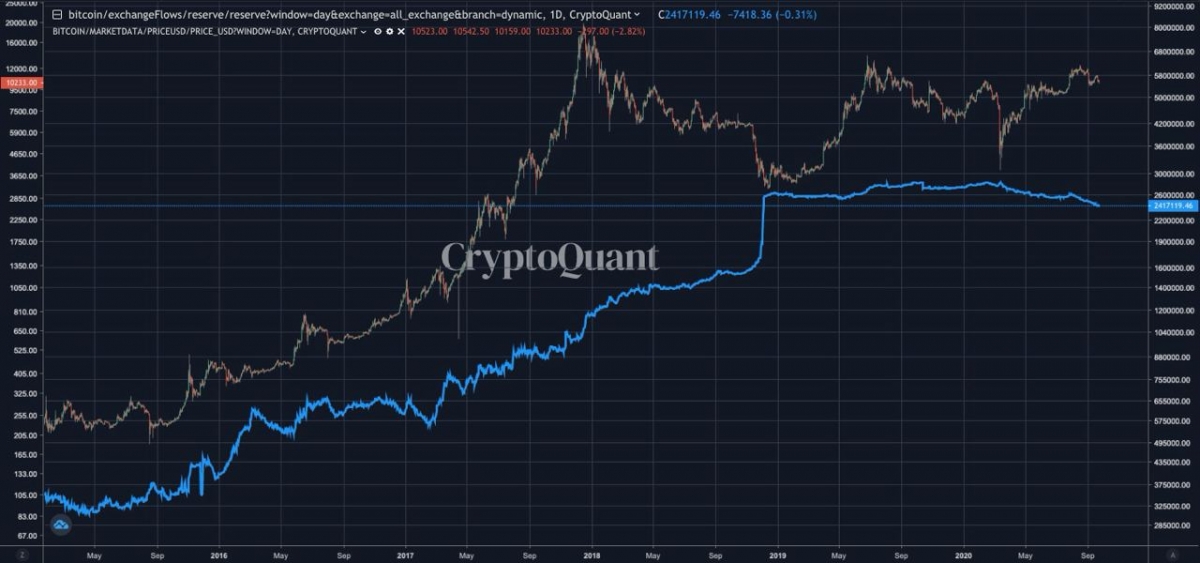
Ratio of Bitcoin balances on exchanges to price. Data: CryptoQuant.
Arcane Research cites activity in the decentralized finance (DeFi) sector, including the growing popularity of tokenized Bitcoins, as one of the factors behind the decline in Bitcoin balances on exchanges.
However, Chainalysis analysts note the trend of declines is not sustainable. On September 21, the company recorded the largest single-day inflow of funds to exchanges since the market crash on March 12.
Over the past months, the market has been characterized by lower volatility. Alfred believes that to some extent this is also linked to capital inflows.
“I think volatility has fallen, in part due to a large influx of traditional capital. All this new money demonstrates belief in the long-term fundamental story, and investors are buying not to sell immediately,” he added.
Earlier in September, CryptoQuant’s Ki Yon-Dju said that mining sales will not stop the market’s growth.
Subscribe to ForkLog news on Facebook!