



The Federal Reserve is not ready to launch a digital dollar and is not interested in a form that would allow for citizen surveillance. This was stated by the head of the regulator, Jerome Powell, during hearings in the U.S. Senate.
“I want to say that we are far from recommending or, even more so, adopting a CBDC in any form,” he said.
According to the Atlantic Council tracker, work on creating a national digital currency is at some stage in 131 countries worldwide. Authorities in 13 developing countries have already launched a CBDC.


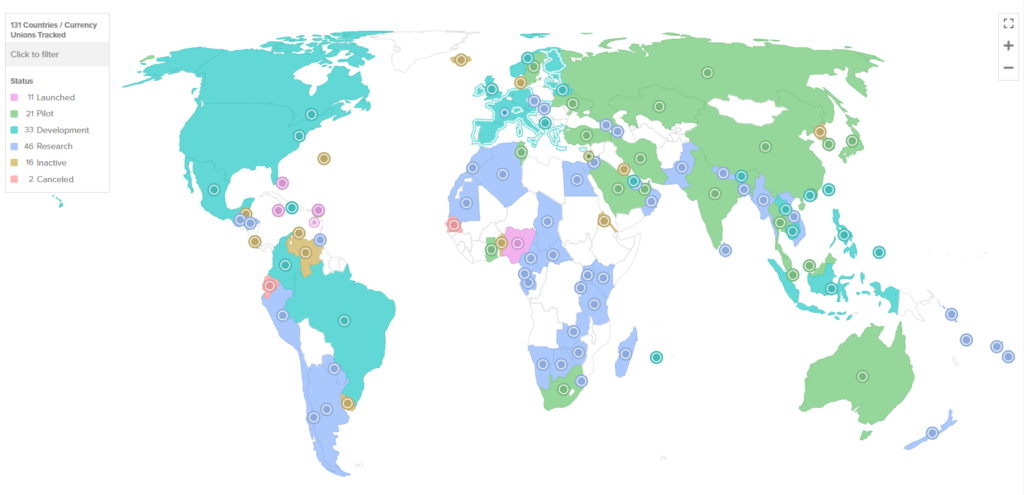
The U.S. is categorized by the American think tank as a country where development is underway.
In 2022, the Federal Reserve released a 40-page report on the findings of its CBDC study, which did not conclude that issuance was necessary. Powell subsequently confirmed the absence of such plans. In October 2023, Michelle Bowman, a member of the Board of Governors, stated that there are no compelling arguments for a digital dollar.
However, the Atlantic Council believes that the U.S. delay in CBDC development has allowed other major economies like India, the EU, and China to take the lead. Similar statements have been made in Congress.
During the hearings, Powell referred to the example of the digital yuan in the context of concerns that retail CBDCs could enable governments to monitor citizens and “see all transactions.” The Federal Reserve, he assured, does not support this.
He noted that although it is too early to consider launching a digital dollar, it would, in any case, be implemented through the banking system.
“The last thing we at the Federal Reserve would want is to have individual accounts for every or any American, for that matter,” Powell emphasized.
He also confirmed the agency’s stance that a retail CBDC could only be implemented with Congressional approval.
Privacy Concerns Are Not Unfounded
On February 26, a group of five U.S. senators introduced a bill titled “No CBDC Surveillance Act,” which prohibits the Federal Reserve from directly distributing a digital dollar to citizens.
The proposal was put forward by Republican politicians Ted Cruz, Bill Hagerty, Rick Scott, Ted Budd, and Mike Braun.
The initiative has garnered support from several public and financial organizations in the U.S.
Cruz previously attempted to advance a bill against CBDC in March 2023. He introduced a document prohibiting the Federal Reserve from launching a consumer-oriented digital currency. A year earlier, he did not progress beyond the review stage with a similar proposal.
In February 2023, U.S. House Majority Leader Tom Emmer introduced a bill to protect citizens’ “financial privacy” when using a digital dollar. The politician described CBDC technology as an affront to American values, privacy, individual sovereignty, and the free market. The congressman has consistently opposed retail digital currency since 2021.
In September, Emmer reintroduced the bill. The document faced criticism from Democrats, who called it “anti-innovation.”
During the ongoing presidential campaign, Republican candidate Donald Trump promised to prevent the creation of a digital dollar if elected, calling CBDC a “dangerous threat to freedom.”
Similar views were expressed by his primary opponents, Ron DeSantis and Vivek Ramaswamy.
“Rich Dad Poor Dad” author and entrepreneur Robert Kiyosaki also highlighted the privacy threat posed by CBDCs. He sees Bitcoin as an alternative.
In the EU, regarding the improvement of digital euro privacy, relevant regulators — the EDPB and the EDPS — have provided their recommendations.