




In early February, Fidelity will introduce its own “stablecoin” under the ticker FIDD on the Ethereum blockchain, according to Bloomberg, citing the firm’s press release.
The issuer will be Fidelity Digital Assets, a subsidiary of Fidelity Investments, which holds a federal banking license.
The stablecoin is backed by the US dollar at a 1:1 ratio. It can be converted at face value on Fidelity’s own crypto platforms (Fidelity Digital Assets, Fidelity Crypto, and Fidelity Crypto for Wealth Managers), as well as on leading crypto exchanges.
Company representatives emphasized that the creation of the asset is a response to growing client demand and part of a strategy to expand the practical utility of blockchain-based financial instruments.
“This is truly the next step in the evolution of our digital asset platform,” commented Fidelity Digital Assets President Mike O’Reilly.
FIDD is designed as a tool for 24/7 settlements among institutional traders and for on-chain payments in the retail sector.
The token can be freely transferred to any address on the Ethereum mainnet, ensuring its integration with the DeFi ecosystem and other blockchain platforms.
Fidelity confirmed that FIDD reserves will consist of cash, cash equivalents, and short-term US Treasury bonds. This fully complies with the requirements of the Genius Act, signed in July.
According to O’Reilly, the law was a key catalyst for the company’s decision to launch the stablecoin:
“The document provides clear regulatory frameworks: what the reserves should be and how to manage them. This is beneficial for the entire industry and made the current moment suitable for bringing our product to market.”
The Stablecoin Boom in the US
As early as last year, the Financial Times noted plans by several global banks and fintech companies to launch “stablecoins.” Journalists described the trend as a “stablecoin race.”
Activity in the sector has been largely driven by the adoption of the Genius Act in the US, where USDC from the regulated issuer Circle leads. Recently, the firm’s main competitor, Tether, also launched a separate token, USAT, for the American market.


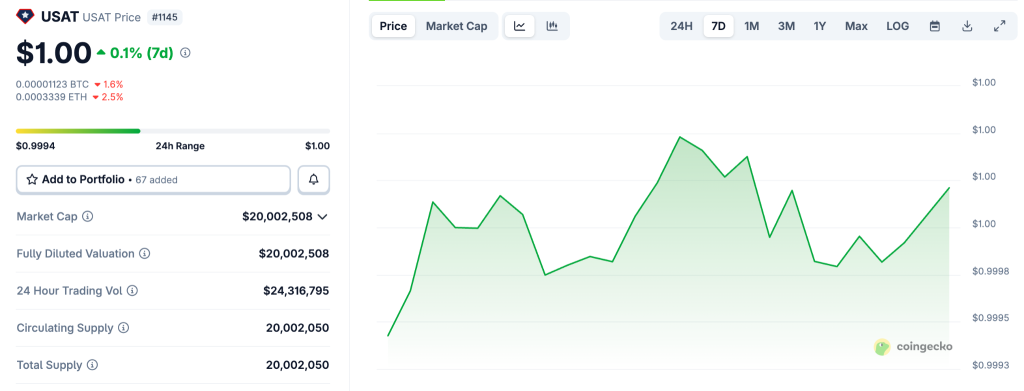
Previously, Aishwarya Gupta, head of payments and RWA at Polygon, predicted the emergence of 100,000 fiat-pegged assets by 2029. In his view, the market has entered the initial phase of a “stablecoin supercycle.”
However, the expert pointed out risks for banks—“stablecoins” offer investors yields unavailable in the traditional system. Standard Chartered and Bank of America have already acknowledged the potential flight of billions of dollars from traditional deposits to stablecoins.
The issue of yields on such assets has already become a central topic of discussion among US lawmakers. The latest version of another important industry bill, the Clarity Act, prohibits issuers and other crypto service providers from paying interest on “stablecoins.”
Banks are actively lobbying for the restriction, but leaders in the cryptocurrency sector oppose it. Coinbase CEO Brian Armstrong stated that the updated bill is “significantly worse than the current state of affairs.”
SkyBridge Capital founder Anthony Scaramucci noted that a ban on yield-bearing stablecoins puts the US dollar at a disadvantage compared to China’s digital yuan.
Earlier, McKinsey and Artemis Analytics found that stablecoin transaction volumes will reach $35 trillion by 2025. However, only about $390 billion are related to actual payments, accounting for ~0.02% of the global figure.