



Flatcoins: Can flatcoins stop global inflation?
The inflation problem in 2023 took on new dimensions and even reached the United States, where the Federal Reserve hastened to raise the key rate to the highest levels of the 21st century. In such a situation, people want to preserve their wealth as efficiently as possible, which is why a new class of digital assets—flatcoins—has emerged.
Why flatcoins?
By the end of last year inflation in the United States reached its highest level in more than 40 years—9.1%. The global figure, according to the World Bank, rose by 4.8%.
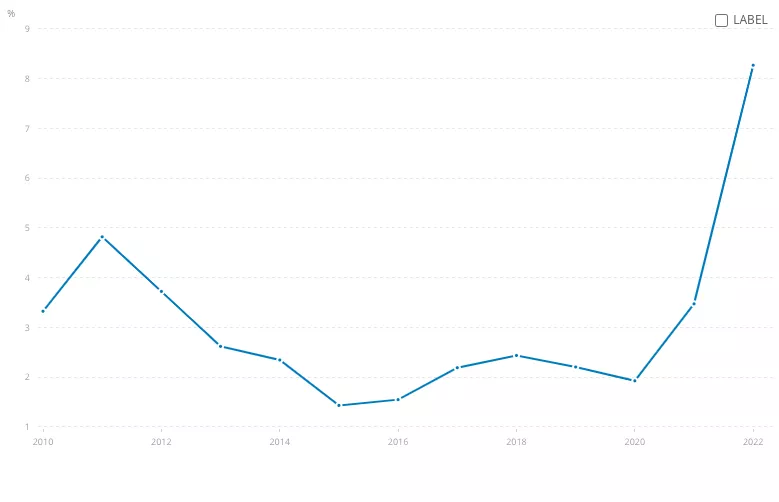
Global and local regulators tried to slow the devaluation of money by raising the policy rate. However the threat of high inflation remains relevant for ordinary citizens and private companies.
Flatcoins are intended to address this problem. Such coins are algorithmic stablecoins, which allow preserving the purchasing power of the currency or another asset.
Representatives of Coinbase have repeatedly spoken about the need to launch flatcoins, including the exchange’s chief executive Brian Armstrong. He thinks that “flatcoins” provide better preservation of value, offering higher returns on investments. They can be backed by a basket of assets or use an algorithmic approach.
According to Frax founder Sam Kazemian, he conceived the concept of flatcoins together with former Coinbase CTO Balaji Srinivasan CTO during a private conversation about the idea of an asset that would preserve the standard of living of its holders.
As a result, Kazemian created one of the first inflation-linked stablecoins — Frax Price Index (FPI). The asset’s quotes are periodically adjusted based on the US CPI. Synchronization is achieved through the use of oracle, which each month submits changes to the network based on new data.
However the CPI is often criticised. For example, the president of Euro Pacific Capital Peter Schiff argues that the metric is deliberately misleading American citizens to hide serious economic problems. But flatcoin issuers use various methods of preserving value.
How does it work?
Flatcoins can be seen as a new concept in token economics, where the coin serves as a store of value and adjusts its valuation over time to reflect inflation movements.
The main goal of “flatcoins” is to preserve the purchasing power of individual holders or a particular group, for example, users of a specific platform.
To illustrate the concept, consider a fictional flatcoin iUSDT. The peg will be determined not only by the asset itself, in this case USDT, but also by its value on a specific day.
The coin’s price is adjusted in real time to reflect changes in inflation, so the purchasing power of iUSDT holders is preserved.
| Date | iUSDT | iUSDT to USDT | Change in CPI over the year | Price of a Big Mac in USDT |
| 01.01.2022 | 1 | 1,1 | N/A | 5 |
| 01.01.2023 | 1 | 1,1 | 10% | 5,50 |
| 01.01.2024 | 1 | 1,15 | 5% | 5,78 |
Developers have tried to implement “flatcoins” in different ways. One approach involved using a basket of assets to back the token. This method is relatively simple and understandable, but important factors must be considered:
- Asset selection. The basket should accurately reflect the cost of living. If the wrong products are chosen, the flatcoin’s value may become unstable;
- Liquidity. The assets in the basket must be easily bought and sold, otherwise the stability of the asset will be fragile;
- Risks. One should select low-risk assets with low volatility;
- Transparency. The issuer of a “flatcoin” must provide open information about the assets in the basket and how they interact with them. This is important for building investor trust and ensuring the product’s legitimate use;
- Regulation. Using a broad basket of assets would require broader reporting to authorities, which complicates and increases the cost of implementing flatcoins.
The most common way to implement “flatcoins” is smart contracts. Typically, the token protocol is programmed to adjust the supply of the asset in response to changes in a public or private cost-of-living index.
When the index rises, the smart contract automatically mints more flatcoins, and when it falls—burns them. This is a fairly effective way of preserving value, because it does not rely on other assets to reduce volatility.
But because the concept of “flatcoins” is still insufficiently studied and deployed, such projects face challenges.
“Flatcoins imply a synchronous change in asset value with inflation, but inflation can be calculated differently. Also for each currency inflation is different, and the main products are offered in USD, where inflation, for example, is tens of times lower than in Turkey, yet there are no offerings in Turkish lira,” notes Vagiz Nurullov, managing partner at VG GROUP.
Security of the technology also raises questions. An open-source protocol vulnerability threatens the flatcoin’s very existence. In the event of a hacker attack, attackers could exploit a potential flaw to mint or burn coins, causing destabilisation of the value.
In addition, flatcoins require a reliable, access-controlled data source for accurate and timely updates on the indices. Developers typically rely on oracles, which complicate project implementation and add new points of failure.
Smart contracts can struggle to process a large number of transactions. This can hinder the use of “flatcoins” for mass transactions, so the protocol’s scalability must be considered.
“I do not see great prospects for this idea due to the complexity of implementation and the instability of systems. If a person chooses a product that will shield them from inflation, they may choose government bonds and bank deposits, which, overall, perform this function tolerably well,” says Nurullov.
Flatcoin issuers also need to have sufficient liquidity to ensure seamless withdrawals for investors or adjust the price in case of an unforeseen depeg.
Examples of flatcoins:
- Nuon (NUON) — an inflation-resistant coin implemented on the Ethereum smart contract;
- Spot (SPOT) — a project of the Ampleforth Foundation, pegged to the US cost-of-living index;
- International Stable Currency (ISC) — a flatcoin pegged to the value of a basket of real assets that does not include the US dollar;
- Collypto — a “flatcoin” that uses a tokenised index of real estate and commodities as collateral;
- LendrUSD (USDL) — a devaluation-resistant coin pegged to its own oracle, which uses more than 18 million data points from more than 30 trusted sources to calculate the level of inflation.
Most of these projects are still at early stages of development, but the vision of flatcoins has already undergone many changes. Companies are experimenting with methods to preserve the peg or even invent their own algorithms to combat inflation.
The future of “flatcoins” remains fuzzy, as the crypto market already hosts many ways to preserve asset value, such as staking and farming pools. Yet big players are interested in the technology, so ruling out further development of flatcoins would be premature.
Рассылки ForkLog: держите руку на пульсе биткоин-индустрии!