



The fragmentation of the tokenized real-world assets (RWA) market across various blockchains results in annual losses of up to $1.3 billion, according to Cointelegraph, citing a report from the RWA.io platform.
This fragmentation hinders liquidity flow and the free movement of capital, preventing the segment from functioning as a unified financial system.
Identical or economically equivalent assets are typically traded at different prices across various blockchains. The complexity and cost of transferring funds impede the market’s self-correction mechanism—arbitrage.
“This fragmentation is the biggest obstacle to realizing the multi-trillion-dollar potential of the market. In traditional finance, the pan-European SEPA Instant mandate demonstrates how funds can move between accounts in seconds. Tokenized assets should be just as easy to use,” said Marco Widrich, co-founder and COO of RWA.io.
According to the report, identical RWAs in major networks trade with a 1-3% difference. Technical obstacles such as fees, delays, and operational risks make cross-chain arbitrage unviable. The costs of moving funds exceed the potential benefits.
Experts estimate that even simply transferring capital from one network to another results in losses of 2-5% of the transaction amount.


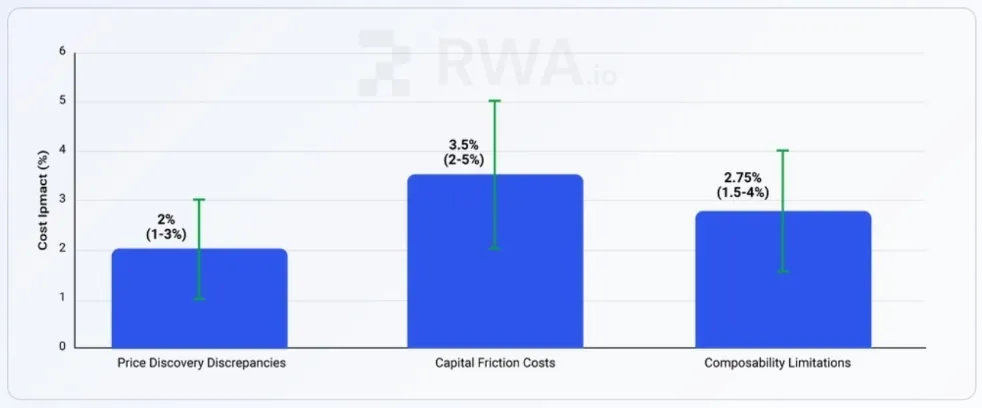
If the fragmentation model persists, the associated costs could amount to $600,000-1.3 billion annually.
Analysts predict that the capitalization of the RWA segment could grow to $16-30 trillion by 2030. The annual inefficiency-related losses could potentially reach $30-75 billion.
Swift Proposes a Solution
During the Sibos 2025 conference, Swift’s business development director and the head of traditional banking at Standard Chartered Bank discussed significant changes in global finance.
We’re already making progress with our plans to add a blockchain-based ledger to our infrastructure, working with a global group of 30+ banks globally to shape the ledger’s design.
“In order to unlock that benefit of scale, we need to work together,” said Thierry Chilosi, our… pic.twitter.com/FS0c7qOLm2
— Swift (@swiftcommunity) December 19, 2025
As tokenization moves from pilot projects to real-world practice, top executives have set a goal to provide a reliable digital global infrastructure. One of the main issues in this area, according to the firm, is fragmentation due to the multitude of blockchains that struggle to interact.
The Swift interbank messaging network serves over 11,500 financial institutions in more than 200 countries worldwide. Therefore, the company considered it a natural step to create its own distributed ledger.
Swift is implementing the initiative in collaboration with over 30 global partners, including technology companies and central banks.
“By connecting tokenized assets across different networks and jurisdictions, the industry can better support trade, payments, and economic growth worldwide. It’s not just about technology. We’re talking about financial operations evolving at the speed modern economies require,” Swift stated.
Fragmentation to Persist
The American provider of post-trade, clearing, and settlement services in the financial market, Depository Trust & Clearing Corporation (DTCC), announced a partnership with Digital Asset. The collaboration aims to tokenize U.S. Treasury securities on the L1 blockchain Canton Network.
The initiative is a further development of DTCC’s experiments to ensure collateral mobility and the implementation of the company’s strategy to build a digital asset ecosystem based on distributed ledger technology.
DTCC will also take a leading role in managing the Canton Network, joining the Canton Foundation as co-chair alongside Euroclear.