




Some U.S. politicians lambast the crypto industry; others champion bitcoin with equal fervour. Experts, for their part, cite the coming U.S. presidential election as one of the main forces shaping the crypto market in 2024.
Before the race for the White House saturates the airwaves, ForkLog reviewed what U.S. politicians have said about digital assets and how they justify their positions.
Crypto’s detractors
In 2016, when bitcoin’s ATH was below $1000, then U.S. president Barack Obama likened the first cryptocurrency to “a Swiss bank account in your pocket.” While listing the technology’s drawbacks, he also stressed its revolutionary character.
Obama: If govt. can’t crack encryption, then people are walking around «with a Swiss bank account in their pocket.»https://t.co/PkZlq9sOl7
— CNBC Now (@CNBCnow) March 11, 2016
“If, from a technical point of view, it is possible to build an impenetrable device or system with encryption so strong that there is no key and no door at all, then how do we apprehend a child-pornography distributor? How do we uncover a terrorist pilot?”
He added that if the government cannot “crack bitcoin,” it cannot ensure “even something as simple as tax enforcement.”
In 2021, former secretary of state and 2016 presidential candidate Hillary Clinton voiced concern about the crypto market’s growth because of its potential to “undermine the role of the dollar as the world’s reserve currency.”

In 2023, sitting U.S. president Joe Biden accused House Republicans who support Donald Trump of refusing to close “tax loopholes to help wealthy crypto investors.”
“A crypto investor, unlike an investor in stocks or bonds, can sell digital assets at a loss to reduce their tax burden, and then repurchase the same cryptocurrency the very next day,” the 2024 budget plan stated.
That same year, the administration released a report pointing to the risks digital assets pose to citizens and financial stability.
“Cryptocurrencies […] are not an effective alternative to fiat […] instead, their innovations are primarily aimed at creating artificial scarcity to support prices. Many of them have no fundamental value. This raises the question of the role of regulation in protecting consumers, investors and the rest of the financial system from digital-asset-related panics, crashes and fraud,” the document said.
Crypto’s proponents
In May 2023, U.S. presidential candidates Robert F. Kennedy Jr. and Vivek Ramaswamy began accepting bitcoin as campaign donations.
Kennedy backed digital gold and criticised the SEC and the FDIC for a “war on cryptocurrencies” that, he argued, led to the country’s banking crisis. The nephew of America’s 35th president also opposed CBDCs.
If elected, he promised to back the national currency with bitcoin and exempt income from bitcoin transactions from taxation. In the summer, Kennedy Jr. also disclosed buying 14 BTC for his children. Block head and Twitter founder Jack Dorsey endorsed the politician.
Florida governor and Republican presidential candidate Ron DeSantis pledged to protect bitcoin and criticised CBDCs. Vivek Ramaswamy agreed, calling the instrument “a serious threat to free speech.” He also criticised the SEC and crypto regulation.
Former U.S. president Donald Trump also opposed a CBDC. He vowed never to allow the ФРС to launch a digital dollar, noting the technology’s accompanying “debanking and political-weaponisation risks.”
“As your president, I will never allow the creation of a CBDC. Such an asset would give the federal government absolute control over your money. That would be a dangerous threat to freedom — I will not let that happen in the United States.”
According to Trump, bitcoin’s current development will require the authorities to introduce dedicated regulation, since the first cryptocurrency has already “taken on a life of its own.”
“Many people are adopting it. I see more and more people wanting to pay with bitcoin, which is interesting. Some regulation will probably be needed. But I think I could coexist with it,” the former president said.
Even so, the politician is not inclined to embrace bitcoin as a means of payment in the United States. Trump stressed that he has “always liked the dollar.”
Whole groups of U.S. politicians oppose a digital dollar. In February 2024, five U.S. senators introduced the “CBDC Anti-Surveillance State Act,” which would bar the Fed from distributing the asset directly to citizens.
Its authors—Republican politicians Ted Cruz, Bill Hagerty, Rick Scott, Ted Budd and Mike Braun—fear a central-bank digital currency would be programmed to surveil ordinary people by monitoring their transactions.
“The Joe Biden administration is salivating at the thought of encroaching on our freedom and invading citizens’ privacy to monitor their personal spending habits, so Congress must make clear that the Fed has no authority to implement a CBDC,” Cruz said.
In 2023, U.S. politicians repeatedly criticised SEC chair Gary Gensler, who accused the crypto industry of failing to comply with regulatory requirements.
In April, during a House appearance, he could not answer whether Ethereum should be classified as a security. Gensler was accused of deliberately driving the crypto industry out of the country “into the arms of the Communist Party of China.”
Dissatisfaction with the SEC chair’s handling of digital assets came from both Republicans and Democrats. He was also criticised for failing to take pre-emptive action to avert FTX’s collapse, to draw lessons from it and to set clear rules for crypto firms.
Throughout 2023, Republicans repeatedly introduced bills to remove Gensler and restructure the SEC. Such proposals surfaced in April, June and August.
Why it matters
According to a Grayscale report, candidates’ embrace of cryptocurrencies reflects the forecast that Gen Z and millennials will make up a significant share of voters (about 44%) in the 2024 election. Younger people trust traditional institutions less and are more committed to new technologies.
“A candidate’s views on cryptocurrencies matter not only because the president runs the country, but also because he is responsible for appointing the heads of more than 50 independent federal agencies that can influence various aspects of the market,” Grayscale noted.
Bitcoin will be framed not simply as “an accessory for government officials and politicians, but as a matter of America’s national security,” the report’s authors suggested.
Coinbase, Ripple, Circle, Kraken and other bitcoin-market players have allocated a total of $78m to support the Fairshake political action committee, which backs pro-crypto U.S. presidential candidates.
“Leveraging the transformative potential of the American crypto community, Fairshake seeks to elevate leaders who are ready to champion innovation and navigate the complexities of responsible regulation in the digital age,” Fairshake said.
Ripple CEO Brad Garlinghouse said his company intends to “lead the effort together with other industry leaders” to support candidates who advocate for digital-asset regulation.
“The U.S. cannot continue to be in the back seat on the global stage. Overregulation (especially by the SEC) is actively pushing the jurisdiction in the wrong direction, and other countries are taking full advantage of the lack of U.S. leadership,” he added.
a16z founder and managing director Chris Dixon noted Fairshake’s ambition to elect leaders who “support thoughtful regulation.”
“There is a battle in Washington for the future of blockchain technologies: some politicians intend to ban them, while others believe innovation should face no obstacles. Neither option will allow the technology to fully realise its potential and reorient the future of the internet from big tech to the people who use it,” he wrote.
Coinbase CEO Brian Armstrong said the industry now “has a sizable war chest to elect pro-crypto candidates in 2024.” He also called the upcoming election a turning point for the crypto industry and its legal status.
According to Politico, Fairshake has backed 13 candidates and already spent $1.2m on television ad campaigns. All the spots note that the politicians are working to “bring the jobs of the future” and build “the next generation of the internet.”
In a report, Coinbase said 27% of California’s adult population—about 8.2m people—own digital assets. Roughly 86% agreed that the financial system needs transformation; 78% said it is important for politicians to support innovation.
Nearly four in five digital-asset holders in California are more likely to back a candidate who supports the crypto industry as a job creator and a source of U.S. geopolitical strength.
Nationally, 51% of adult millennials and Gen Z expressed the same view. The report says that in the 2024 election they will be an active minority, and by 2028 they will form a majority of voters.
About 83% of respondents to the Crypto Council for Innovation poll would prefer a candidate who seeks clear crypto rules so investors retain choice and the industry can continue to grow and create jobs.


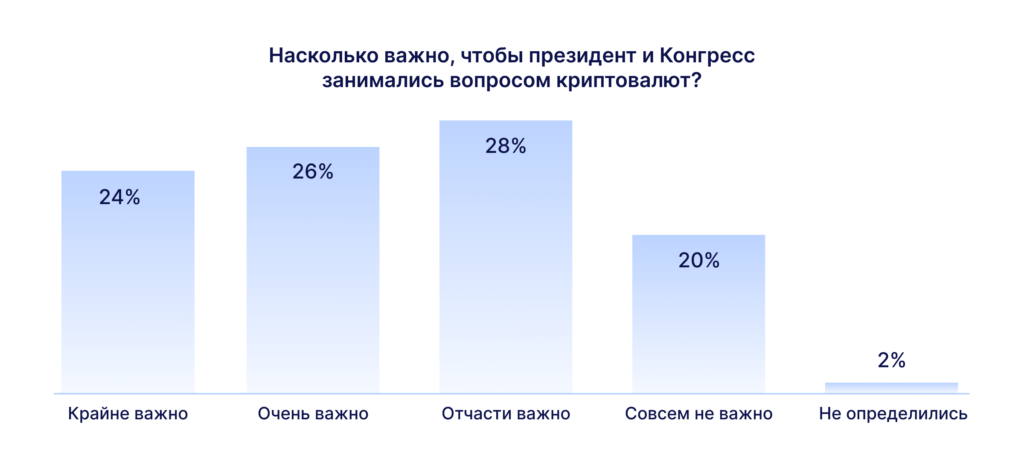
Although Republicans more often speak up for cryptocurrencies, anti-CBDC and pro–sensible-regulation initiatives also come from Democrats. Support for or criticism of digital assets has not hardened into party positions.
Experts and analysts agree that crypto’s role in U.S. politics is growing. Crypto companies are likely to keep lobbying in Washington and, perhaps, one day the country will see an active supporter of digital assets in the Oval Office.