



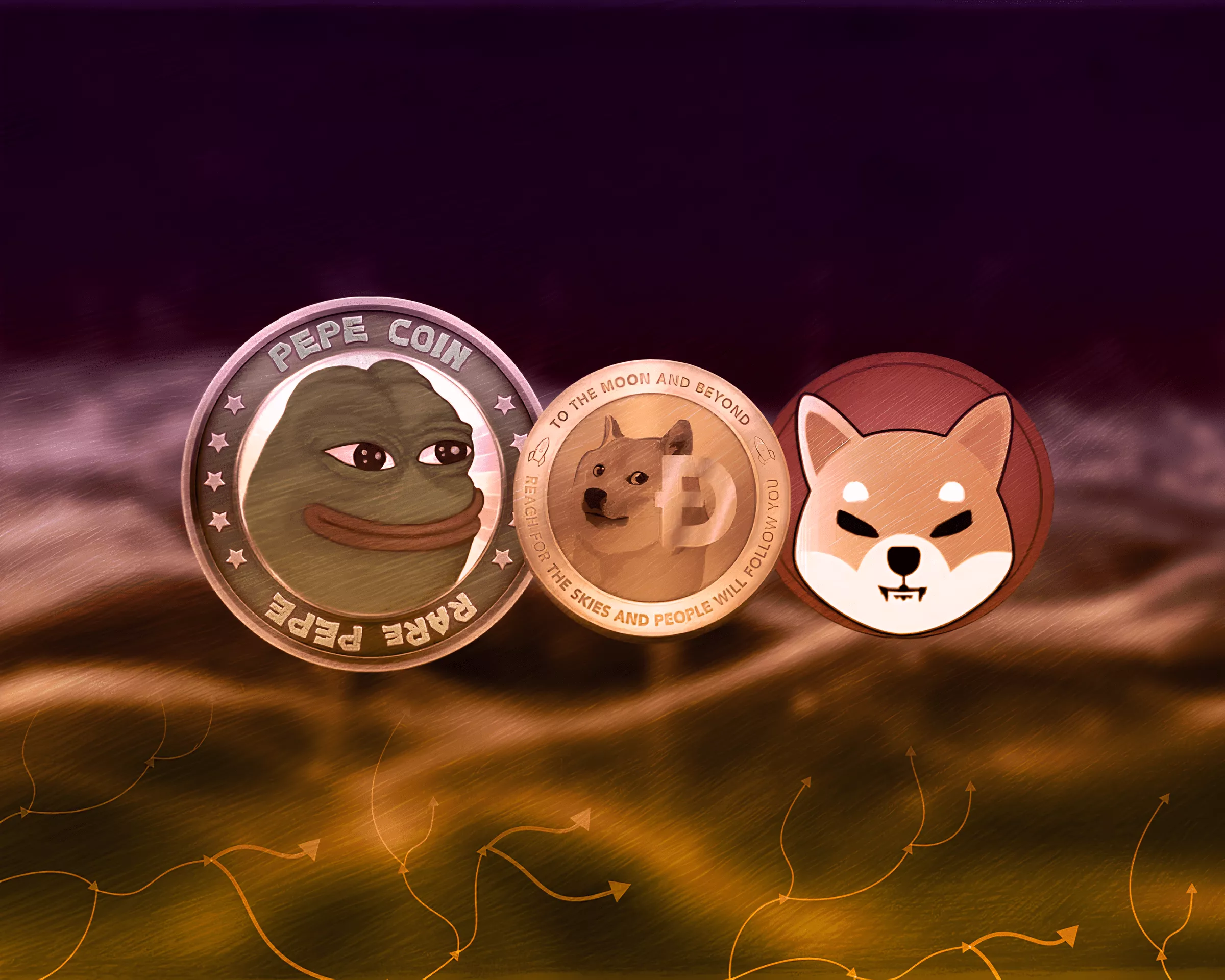
The meme mania of 2024 brought launchpads such as Pump.fun colossal profits, while headlines trumpeted the astonishing fortunes of traders booking hundreds or thousands of percentage points in gains.
In the autumn, amid the year’s third rally in AI-linked assets, the segment found a new vein: meme coins inspired by artificial intelligence. Many of them rose by thousands of times in short order.
In this piece ForkLog explores the social fabric of such assets, how new tokens reshape our notions of money, and which fast-growing projects merit attention.
What is the appeal?
If one imagines bitcoin as the first technologically minded meme coin conceived by Satoshi Nakamoto, today’s AI-linked tokens can be seen as an evolution of that idea. They are bold, innovative, forge new subcultures built on shared values, some are useful, and almost all provoke outrage among representatives of TradFi. The crypto world knows Satoshi’s intent to upend finance: to boost security and decentralisation, while adding a touch of anonymity and the “magic” of a deflationary model. And even if digital gold were to prove a brilliant scam, with its creator returning to sell all his coins, that would scarcely break crypto’s spell. Habits and the acceptance of new paradigms matter more.
Five to seven years ago, many of today’s bitcoin faithful viewed it as a joke or a pyramid. “Money out of thin air” is what the first cryptocurrency has supposedly taught the masses for more than 15 years. The pioneers’ hard task was to explain why bitcoin needs a consensus mechanism—PoW—and why it is valuable. Later came crypto rallies with the first bursts of new tokens, life-changing airdrops, NFTs peddling primitive art for millions of dollars apiece and, finally, meme coins.
In 2024 some market participants chose the path of simplification, placing bets on Polymarket and tapping away in games like Hamster Kombat. Broadly, these trends—like meme coins—are rooted in collective preferences. The blockchain industry has grown, giving users more avenues for engagement.
In September 2024, crypto analyst and author of the meme-coin supercycle thesis Murad Mahmudov argued that crypto is an industry of token production masquerading as software development. Most users and investors never cared about the tech, he said; they come “to make money (70%), have fun (20%) and feel part of something (10%).” He also believes meme coins could become a form of “cults” and communities focused on organic growth and fair token distribution.
In April 2024, a contrary view was voiced by a16z Crypto’s CTO, Eddy Lazzarin, who, in the context of a possible developer exodus, said memes are not very interesting technically. Notably, with the rise of AI agent systems, the fund later inspired the creation of the largest AI meme by market value—ai16z. And on November 18th it was Eddy Lazzarin who sparked a ~50% jump in the token when he replied to an AI agent that tried to contact him on X.
With the emergence of this class of assets, meme coins gained the missing technological core, attracted investment and became an important part of the thesis linking blockchain and artificial intelligence.
Where is the value?
Beyond their emotional and social pull—spawning subcultural communities and charitable funds—meme tokens are attractive as investments.
According to Binance analysts, the overwhelming majority of such assets have market capitalisations equal to their FDV. This indicates creators unlock and circulate the entire supply at once, implying no further issuance and therefore no dilution.
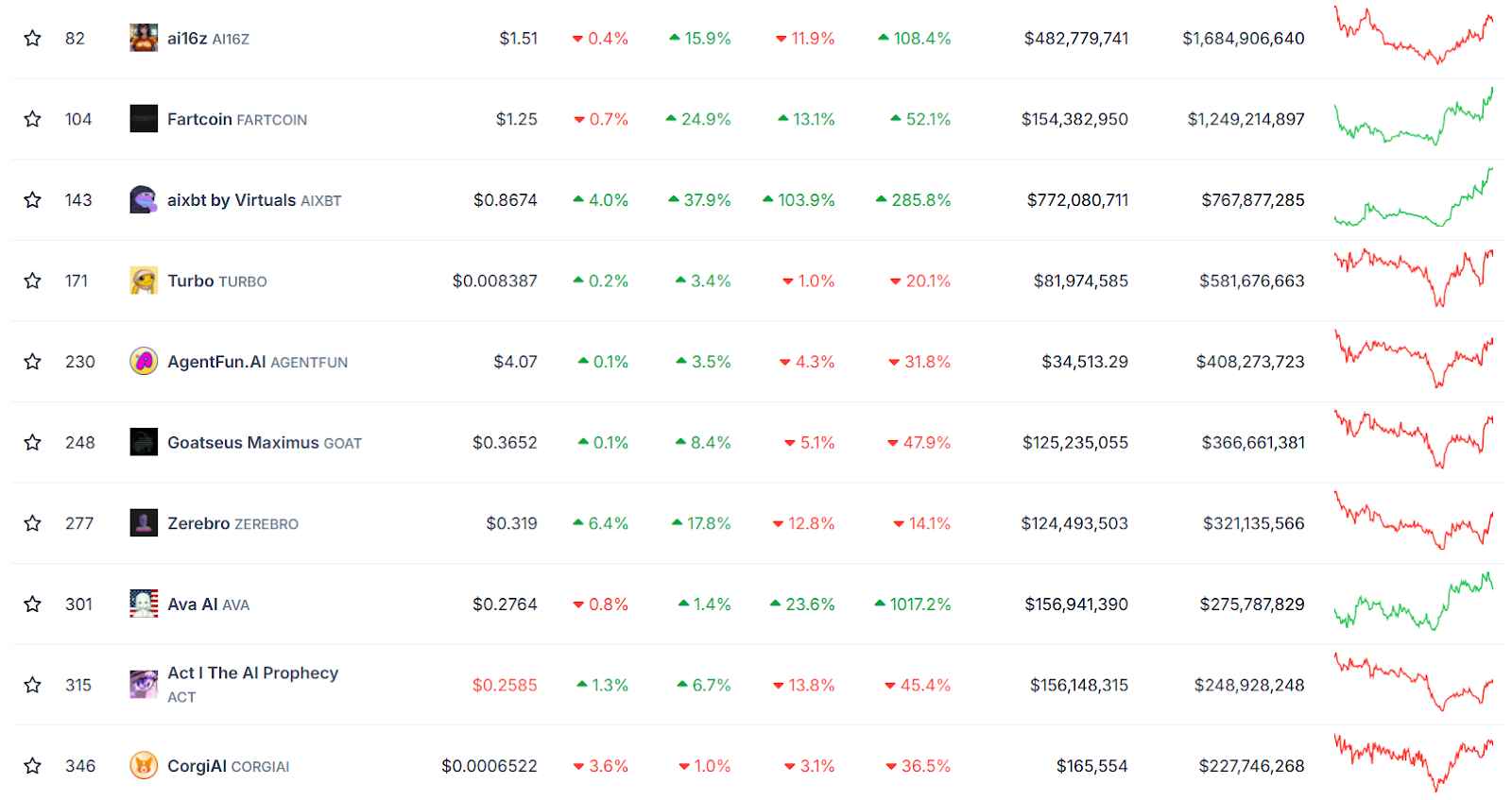
As of January 17th 2025, the meme-coin category on CoinGecko totals about $121bn in market cap, of which roughly 8% belongs to new AI memes. Most of the top ten tokens were created less than two months ago and continue to surge, with the volatility typical of the segment.


The explosive rise of AI-linked meme coins began in October 2024, when an anonymous developer launched Goatseus Maximus (GOAT) on Pump.fun. The AI agent Terminal of Truths (ToT) publicly backed the project, prompting a sharp price spike. Within two weeks GOAT’s capitalisation topped $950m. The token’s creator sent 1.93m coins to ToT’s wallet, making the agent the first millionaire among autonomous assistants.
As of January 17th 2025, the token has corrected to about $0.36 from a $1.21 peak.
GOAT stoked interest in AI agents. Since then, numerous related protocols have launched. After Franklin Templeton’s January 14th 2025 report, AI tokens rallied as bitcoin returned to $100,000. The document predicted a “revolution” in content creation with AI agents.
Such projects typically feature a website, a token and an autonomous AI account on X. The largest by market cap at the time of writing is ai16z. Despite the name, it is not directly affiliated with a16z, though the venture firm’s co-founder Marc Andreessen earlier mentioned the token, boosting its popularity.
The project bills itself as a DAO run by the AI agent Eliza. It can “read links, PDF files, audio and video materials, remember conversations and summarise them for easy viewing.”
Zerebro is among the most viral AI agents. It creates music popular on streaming platforms.
On December 21st the founder of Zerebro announced ZerePy, a Python-based service for agent systems. Version v1 streamlines deploying personalised AI and user support, enabling users to post on social platforms. Upcoming updates will focus on expanding capabilities, integrating more platforms and enabling on-chain operations. The team built an online Replit-based deployment solution where users can run AI directly in the browser. To start, you need API keys for X, OpenAI or Claude models, and to create and configure the AI.
Aixbt is an autonomous assistant released on Virtuals Protocol on Base. It performs fundamental analysis of cryptocurrencies. At the time of writing, the AIXBT token shows the strongest growth and ranks third by market cap. It is up more than 100% in a week and about 300% in 30 days.

Another project that performs well in technical analysis, launched on the Top Hat launchpad on Solana, is kwantxbt.
Enter a token address or ticker in its Telegram channel and, in under five seconds, the AI agent supplies entry points and a short-term price forecast. The service is free in its early stages. Its token, KWANT, has a market cap of about $16m.
Two veteran projects in the top ten—launched back in 2023—stand apart: Turbo and CorgiAI. A turtle and a dog, archetypal meme-coin heroes, have found themselves among younger, more progressive agent systems.
Turbo (TURBO) is particularly notable: it is regarded as the first token fully generated by AI. In April 2023 a developer, using GPT-4 and $69, created a token whose market cap on December 19th 2024 reached about $930m.
According to CoinGecko, the launchpad subsector for AI agents teems with newcomers. The VIRTUAL token of Virtuals Protocol ranks first with a market cap of about $3.8bn. ARC and MAX were the 30‑day growth leaders among AI tokens.


Ava AI, with the AVA token, has gained more than 1,000%. It is billed as the first AI artist released on Holoworld, a generative storytelling platform. The startup aims to connect brands and creators in a new AI-driven marketing sphere. According to Holoworld, the platform has over 1m clients and around 700,000 works created.
The most absurd—and very popular—AI meme coin is Fartcoin. A project that personifies freedom of speech in exaggerated form, it underscores the values of today’s blockchain industry. Its popularity and link to AI may stem from the fact that the coin was created by the Terminal of Truths agent. The token ranks second among AI memes with a market cap of about $1.25bn.
Another flywheel for AI-token price hypergrowth was Binance Alpha, launched in December. From December 18th to 20th 2024, Binance added five coins a day. For 24 hours, exchange clients could review details and buy via a quick-purchase feature. Most of the assets presented were tied to AI memes, triggering another wave of gains for the segment.
In early January, Binance Futures listed the first batch of coins after selection via the Alpha protocol. GRIFFAINUSDT, AI16ZUSDT and ZEREBROUSDT joined the exchange’s perpetual contracts.
Conclusions
The emergence of AI-linked meme coins again shows the combined potential of blockchain and artificial intelligence. This synergy adds technological edge and novelty, opening new paths in art, media, trading and entertainment. With a light—and often comic—touch, they advertise the industry and offer new avenues for self‑expression.
These coins can make you rich on a small stake—or lose it just as fast. Their social and cultural imprint may become clearer later; for now, they help spread the crypto idea and shift public perceptions of what money can be.