



Fusaka Hard Fork Goes Live on Ethereum Mainnet
ETH price rose 3.6%
Ethereum developers have successfully deployed the Fusaka upgrade on mainnet.
Fusaka is live on Ethereum mainnet!
— PeerDAS now unlocks 8x data throughput for rollups
— UX improvements via the R1 curve & pre-confirmatons
— Prep for scaling the L1 with gas limit increase & moreCommunity members will continue to monitor for issues over the next 24 hrs.
— Ethereum (@ethereum) December 3, 2025
The hard fork is designed to deliver foundational improvements to boost the scalability, efficiency and security of the network behind the second-largest cryptocurrency.
Fusaka is the second-largest upgrade after Pectra, comprising ten improvement proposals. The most significant is EIP-7594, which brings the PeerDAS protocol to Ethereum. The technology allows validators to verify small fragments instead of entire BLOB objects, improving data availability across the ecosystem.
The upgrade also envisages more than doubling the gas limit at layer 1. It is expected to lift blockchain throughput to 12,000 TPS.
Among other changes:
- EIP-7825: sets a 30m per-transaction gas cap to strengthen network security and prevent overloads;
- EIP-7939 and EIP-7951: improve performance and expand the capabilities of ZK solutions.
The EIPs within the upgrade will be rolled out in stages from December to January.
The team will then focus on the next hard fork, Glamsterdam, which—like Fusaka—falls within The Surge phase of Ethereum’s technical roadmap.
ETH reaction
The second-largest cryptocurrency rose 3.6% over the past day following the upgrade. At press time the asset trades around $3,100.
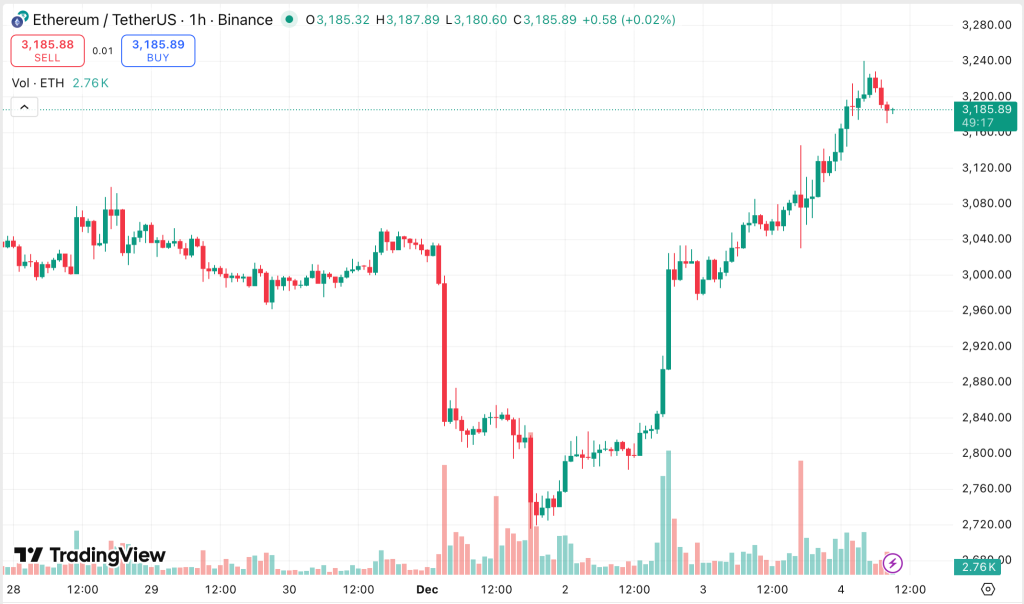
Market participants called Fusaka a powerful long-term catalyst for Ethereum.
A trader known as Merlijn The Trader pointed to the impact that the previous upgrade—Pectra—had on the coin’s price.
ETHEREUM: THE MOST UNDERRATED CATALYST OF Q4.
Ethereum upgrade Fusaka drops Dec 3.
Faster blocks. Cheaper gas. Smarter scalingPectra triggered a +58% move.
Fusaka is built to launch harder.Price lags fundamentals.
But not for long. pic.twitter.com/O0u3jcDHAY— Merlijn The Trader (@MerlijnTrader) November 30, 2025
“After Pectra we saw a 58% jump. Fusaka is the next level. Price does not yet reflect the fundamental changes, but the gap is only a matter of time,” he wrote.
A similar view was expressed by the bitcoin investor known as Lucky:
“Fusaka is a qualitatively different level. The upgrade feels like the very catalyst that can ignite a truly powerful rally. Ethereum is finally showing how far scaling can go without compromising its core principles and architecture.”
Almost sharding
Ethereum co-founder Vitalik Buterin congratulated developers on the successful Fusaka rollout and again stressed the importance of PeerDAS. In his words, the protocol “is significant because it literally is sharding.”
PeerDAS in Fusaka is significant because it literally is sharding.
Ethereum is coming to consensus on blocks without requiring any single node to see more than a tiny fraction of the data. And this is robust to 51% attacks — it’s client-side probabilistic verification, not… pic.twitter.com/OK81xBteER
— vitalik.eth (@VitalikButerin) December 3, 2025
“Ethereum is coming to consensus on blocks without requiring any single node to see more than a tiny fraction of the data. And this is robust to 51% attacks — it’s client-side probabilistic verification, not validator voting. Sharding was a dream for Ethereum since 2015, and data-availability sampling since 2017, and now it has become reality,” he wrote.
However, the implementation of sharding in Fusaka is deliberately incomplete, Buterin noted. Eliminating the following three constraints will be the main task for developers in the coming years:
- Scaling for L1. The update sped up layer-2 solutions. To make the base chain faster and cheaper, ZK—EVM needs to be introduced.
- Centralisation in block building. Today a single participant must assemble the next block in Ethereum. This creates a bottleneck and harms decentralisation.
- A single transaction pool. All unconfirmed transactions end up in one large queue for the entire network. For full scaling, this queue needs to be split into shards so load is distributed evenly rather than pressing on a single node.
“The next two years will give us time to refine the PeerDAS mechanism, carefully scale it while maintaining stability, use it to scale L2s, and then, when ZK-EVMs ‘mature’, aim it at scaling the gas limit on Ethereum L1,” Buterin stressed.
In November, the co-founder proposed shifting from scaling to optimising Ethereum. The gas limit and the cost of complex operations such as storage could be increased fivefold.
Рассылки ForkLog: держите руку на пульсе биткоин-индустрии!