




We aim to inform readers not only about events in the bitcoin industry, but also about developments in related technological fields—cybersecurity, and now the world of artificial intelligence (AI).
ForkLog AI has gathered the most important AI news from the past week.
- By 2022 the AI software market is forecast to surpass $62 billion.
- Saudi Arabia will build an eight-sided city of the future on the water.
- Moscow authorities have designated 140 streets where driverless cars will be permitted to operate.
- Robots are now in Google’s offices performing routine tasks.
- Pokémon Go developers released an AR game with bitcoin-based rewards.
- The robot maker is offering $200,000 for a friendly and approachable face for its humanoid device.
- Nvidia updated its AI tool for generating photorealistic landscapes.
Experts: the AI market will reach $62 billion in 2022
In 2022, revenues in the AI software market are forecast to reach $62.5 billion, up 21.3% on current levels. The report was published by Gartner.
According to researchers, the main categories of software usage will be ‘knowledge management’, virtual assistants, drones, ‘digital workplaces’, and ‘crowdsourced’ data.
The strongest growth is expected in ‘knowledge management’ at 31.5%, while the smallest projection is in the virtual assistants segment — 14.7%.
According to the report, business spending on AI systems will rise as trust grows and as companies seek ways to achieve returns from applying artificial intelligence.
Samsung to build a chip plant in Texas
Samsung announced plans to build a $17 billion semiconductor fab in Texas.
The facility, spanning 5 million square metres, will begin construction in the first half of 2022 and enter operation in 2024. In the long term, the plant will employ around 2,000 highly skilled workers, with 6,500 people involved in its construction.
The plant will manufacture chips based on ‘advanced technologies’ for mobile networks, 5G, high-performance computing, and AI.
Moscow to allow driverless cars on 140 streets
Moscow authorities have designated 140 streets for testing driverless vehicles.
The city administration and the Mosgorduma presented a document authorising private, public and commercial robo-cars to operate on the designated highways, avenues and other city arteries.
On 18 sites, including the Skolkovo centre, the robo-cars will be able to transport passengers and luggage.
Economists forecast AI’s impact on the labour market
At the World Economic Forum in Davos, experts presented a report on the potential consequences of widespread AI adoption.
The authors assume that broadly capable AI will emerge ‘in the coming decades’ and will replace humans in nearly all sectors of work. In one domain, several intelligent systems may operate in concert, coordinating tasks.
Experts forecast that in about 35 years algorithms will displace surgeons, in 25 years they will write a bestseller, and in 10 years they will replace retailers. Full automation will occur by 2141.
Widespread AI adoption could boost the world economy tenfold, while increasing the risk of higher social inequality. The authors proposed strengthening the powers of institutions responsible for wealth distribution and requiring them to pre-emptively address job displacement.
In Saudi Arabia, an octagonal city of the future on the water
By 2030, Saudi Arabia will build the floating smart eco-city Oxagon. It will be equipped with ‘all cutting-edge technologies’.

The octagonal city on the Red Sea will be 33 times larger in area than New York. It will house a full complex of technical facilities, including hydrogen-production plants and modular-building factories.
Oxagon is set to employ a range of technologies, including Internet of Things, human–machine interaction, robotics, artificial and predictive intelligence.
Alphabet deploys robots to handle daily office tasks
Alphabet has deployed 100 robots in Google offices to carry out everyday tasks.


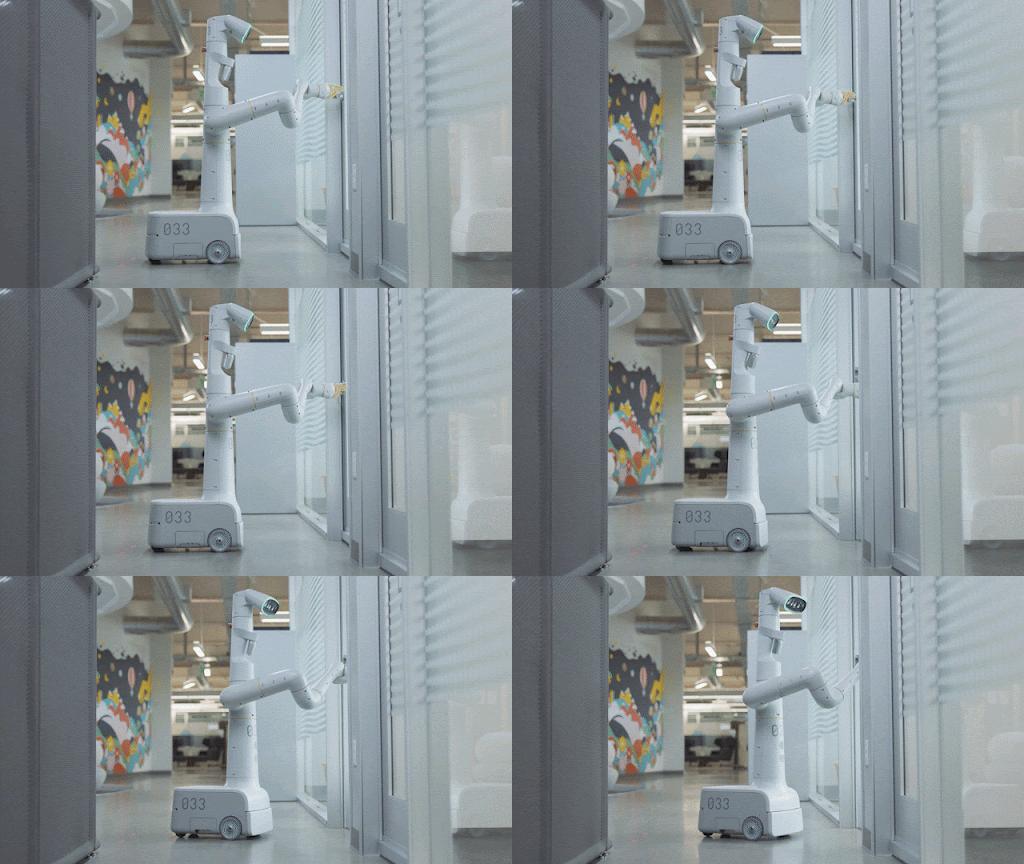
AI-powered devices are equipped with cameras and various sensors. They can wipe desks, wash windows, sort rubbish, open doors and move chairs.
According to the project lead Hans-Peter Brondmo, for robots to be genuinely useful where people live and work, they must learn:
We intend to create a universal robot capable of applying knowledge learned from solving one task to others without reconfiguring the device or writing code from scratch.
Pokémon Go developers create a game with bitcoin rewards
Fold, the fintech, and Pokémon Go developer Niantic created Fold AR, a game with rewards denominated in bitcoins.


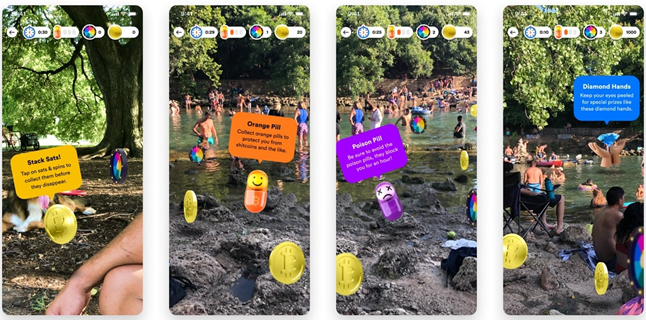
Users are invited to locate binary-code blocks and tap them several times until a reward in satoshis or Fold bonuses appears. The app also features various cryptocurrency jokes.
The game is based on Niantic’s augmented reality technology and generates objects up to 15 metres from the user every 10 minutes, reflecting the real-world Bitcoin mining rate.
Promobot pays $200,000 for a friendly-face model
Promobot, the robot maker, has offered $200,000 for a ‘friendly and approachable face’ for its humanoid device. The corresponding ‘role’ is posted on the company’s site.
The developers say they are exploring the approach to avoid ‘legal delays’ by licensing user biometric data.
Nvidia updates its photorealistic landscape generator GauGAN2
Nvidia researchers unveiled GauGAN2, an AI tool for generating photorealistic landscapes from textual descriptions.

The deep-learning algorithm is built on the GauGAN neural network and was trained on 10 million nature photos. It lets you create an image from a short phrase and then refine it with ‘rough sketches’.
Nvidia has opened access to the web version of the tool and plans to publish the source code on GitHub.
The week’s most notable AI deals
From 21 to 26 November 2021, AI startups raised more than $1.37 billion. Here are the most interesting transactions.
- Niantic raised $300 million to improve AR games, develop apps, and grow the ‘metaverse’.
- Longevica received $2.5 million to launch tools for drug testing.
- Simpro attracted $350 million to develop a platform for managing field workers.
- Verbit, the AI transcription service provider, raised $250 million.
- Rescale raised $105 million to expand its platform for modelling scientific research.
- Deliverr raised $250 million to grow its e-commerce network.
- LifeVoxel raised $5 million to enhance its remote patient-diagnosis platform.
- Jina.ai, developers of an AI search service for unstructured data, raised $30 million.
- Primer Sazze Partners raised $127 million to fund South Korean tech startups.
- Earkick raised $1 million to build an AI-powered mental-health tracker.
Also on ForkLog:
- In New York ban biased AI systems for recruitment.
- Media: UK authorities expect ARM to go public on the stock exchange instead of merging with Nvidia.
- Clearview AI ranks among the ten most accurate facial-recognition systems.
- The US has placed on the blacklist Chinese developers of quantum computing systems.
- Neu.ro launched an AI cloud with zero carbon footprint.
- UNESCO members adopted the first global agreement on AI ethics.
What to read this weekend?
In new ForkLog cards, we explain what computer vision is, how it works, where it is used, what threats it poses, and what it means for the metaverse.
Subscribe to ForkLog’s Telegram news feed: ForkLog AI — all the news from the AI world!