



Key points
- Governance tokens are akin to shares within blockchain ecosystems. They confer voting rights on key questions of how decentralised protocols evolve.
- They are not only instruments of direct democracy; governance tokens can be used across many other use cases.
- Utility tokens serve to interact with services or to access specific features and privileges within ecosystems. Such assets cannot be used for voting within a DAO.
What is a governance token?
A governance token is a digital asset whose holders can vote on key matters of a blockchain project’s development as part of a decentralised autonomous organisation.
A DAO may decide on:
- setting various protocol fees and how they are distributed among ecosystem participants;
- changes to the user interface;
- creating and funding a project development treasury;
- developer grants, and so on.
Many cryptoassets in the DeFi ecosystem are governance tokens. Their use cases extend beyond voting. Such coins can usually be deployed in staking, lending protocols and yield farming.
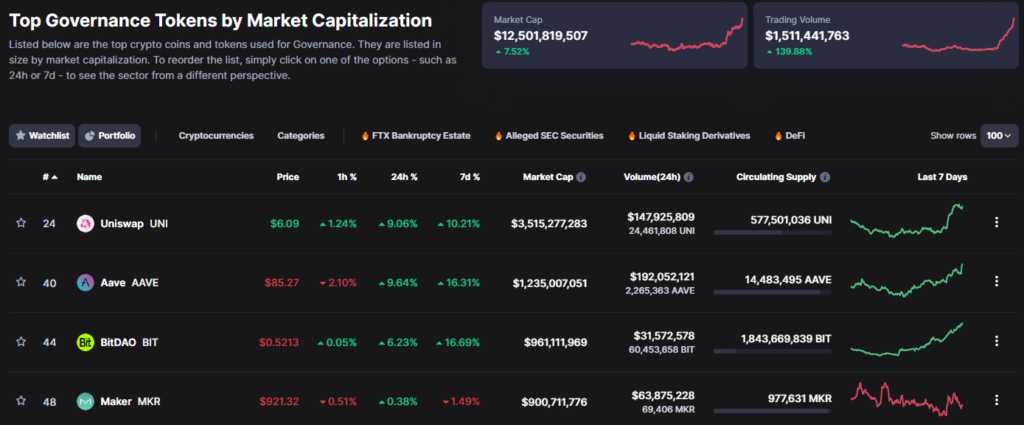
There are rankings of governance tokens ordered by market capitalisation.


What is a utility token?
Utility tokens are cryptoassets designed for specific use cases within particular ecosystems. They are also called native or utilitarian tokens.
Such assets also mimic Ethereum’s gas model. For example, MATIC, the utility token of the Polygon ecosystem, is used to pay transaction fees.
Basic Attention Token (BAT) allows users of the Brave browser to be rewarded for their attention to ads and also serves as a means of payment for advertisers.
In some cases a utility token is required to access a platform; more often it is optional, enabling specific features or privileges.
For example, BNB holders receive discounts on trading fees when using the Binance centralised exchange, as well as the opportunity to support new projects on the Launchpad platform.
The same asset is a core element of BNB Chain. In addition, it is used to pay transaction fees for operations in the DeFi ecosystem.
LINK, the native token of Chainlink, is used mainly to pay node operators whose oracles power the decentralised network.
How do governance tokens differ from utility tokens?
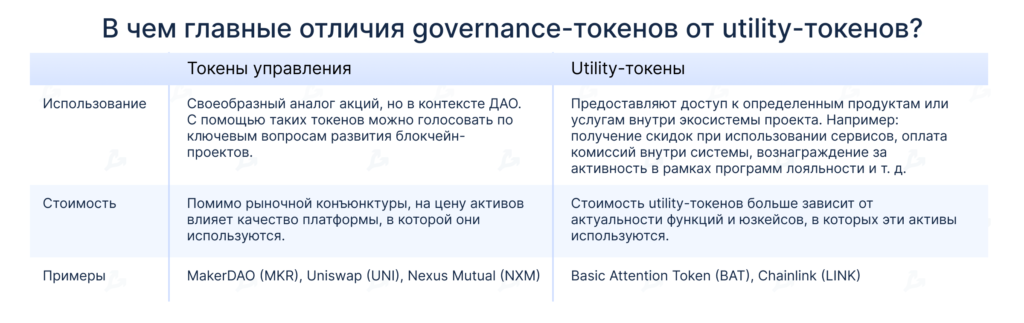
Governance tokens resemble ordinary shares in traditional finance, which allow votes on key issues at public companies.
Holders of such blockchain assets propose, accept or reject initiatives within a DAO.
In short, governance tokens are a core element of decentralised systems—an instrument of direct democracy.
By contrast, utility tokens do not confer voting rights—only the ability to use specific features in defined use cases. Most such assets are, in effect, stripped-down versions of governance tokens.


What are the pros and cons of governance and utility tokens?
The main advantages of governance tokens:
- Decentralisation. Only with such assets can DeFi applications truly be called decentralised. Without governance tokens, platforms would be faceless sets of smart contracts controlled solely by developers and founders.
- Scope for collaboration. Voting underpins constructive debate about a project’s future. Discussion, in turn, creates incentives for collaboration among ecosystem participants.
- Engagement. Governance tokens give holders levers to influence a project’s future, motivating them to take part in votes.
There are also pitfalls:
- Elements of direct democracy do not guarantee that a project will develop in the right direction. Some DAO participants are guided primarily by self-interest. Among them may be large holders capable of strongly influencing voting outcomes.
- If a community decision proves suboptimal and ultimately harms the project, the majority is to blame—meaning no specific DAO participant bears responsibility.
- Every decentralised autonomous organisation has large holders of governance tokens. They may single-handedly put forward proposals and secure outcomes favourable to themselves, which can conflict with the interests of others. Hence the distribution mechanism for governance tokens must be well designed.
- Because of legal uncertainty, many projects—and their tokens—may attract regulatory scrutiny.
Holding utility tokens can also entail significant risks. During the “ICO mania” of 2017–2018, many hollow tokens were created with no fundamental value or prospects. Such assets were often issued by fraudsters to obtain funds from novice crypto investors.
There were exceptions—in those years the token sales of what are now the largest centralised exchange, Binance, and the leading non-custodial platform, Uniswap, took place.
The value and prospects of utility tokens depend on the quality of the underlying project and the relevance of the use case in which they are employed. If a platform lacks demand, the asset tends to fall in price.
Utility tokens contribute little to mass adoption of cryptocurrencies, since their real use is largely limited to specific platforms and use cases. Consequently, only a few such assets have preserved value over long periods.