



We aim to inform readers not only about developments in the bitcoin industry but also about what is happening in related technology fields — cybersecurity, and now in the world of artificial intelligence (AI).
ForkLog AI gathered the most important AI news of the past week.
- Putin has allowed the possibility of equipping military drones with artificial intelligence.
- Google намерена to resume cooperation with the Pentagon in cloud computing.
- Tesla recalled 11,704 electric vehicles due to a software fault in the emergency braking system.
- Microsoft will grant developers access to GPT-3.
- Meta unveils tactile skin for robots.
- “Sber” has developed a neural network for image generation from Russian text descriptions.
- Most notable AI deals of the past week.
Putin allows AI integration in UAVs
President Vladimir Putin allowed the possibility of equipping military drones with artificial intelligence.
He noted that military drones are already capable of effectively repelling attacks by terrorist UAVs in Syria. Nevertheless, he said, unmanned aviation must be developed and equipped with the most modern technologies, including AI.
Putin also recalled that the state owns more than 2,000 drones.
Media: Google plans to resume cooperation with the Pentagon
The company Google intends to resume cooperation with the U.S. Department of Defense in cloud computing.
According to the media, the tech giant is aggressively seeking to participate in a project described by the Pentagon as an effort to “achieve supremacy in both traditional and non-traditional battlefields.”
A Google spokesperson confirmed that the company has submitted a bid for the tender.
Google had previously worked with the Pentagon. However, in 2018, under staff pressure, it dropped military projects.
Tesla recalls nearly 11,704 vehicles due to autopilot errors
Tesla recalled 11,704 electric vehicles due to a software fault in the emergency braking system.
According to the document, the 23 October Full Self-Driving 10.3 update caused a loss of communication between two chips, leading to a “false braking” issue.
On 25 October the company fixed the fault and issued a patch, and the next day halted the rollout of the update and disabled emergency braking on vehicles using this beta version.
Tesla noted that it had not received reports of crashes or injuries caused by the autopilot fault.
Microsoft to grant developers access to GPT-3
Microsoft at the Ignite 2021 conference announced several AI-related innovations.
The company unveiled the Azure OpenAI Service platform, which opens access for cloud clients to GPT-3 language models. Developers will have tools to filter and moderate content in prompts and responses.
The initial users will be selected by the company. Applicants must clearly articulate the use cases for GPT-3.
The company also introduced Mesh for Teams for collaborative work in the metaverse. It will run on VR headsets, phones, tablets and PCs in two modes: in a shared virtual space or a room with a host and listeners. The company will use AI to create virtual avatars from a user’s voice.
The tool will be available in the first half of 2022.
SenseTime and Megvii plan IPOs
Chinese AI startups SenseTime and Megvii planned initial public offerings on Chinese stock exchanges amid regulatory pressure on local tech giants.
According to reports, both companies closely cooperate with the Chinese government. They supply facial recognition technologies to private sector and government agencies.
SenseTime said in its IPO prospectus that in the first half of 2021 nearly 48% of revenue came from the “Smart City” project, which includes selling video surveillance and traffic-management technologies to local authorities.
Survey: 97% of Ukrainians know about AI
Neurotrack, in a survey found that 97% of Ukrainians know about AI, and 3% have never heard of it.


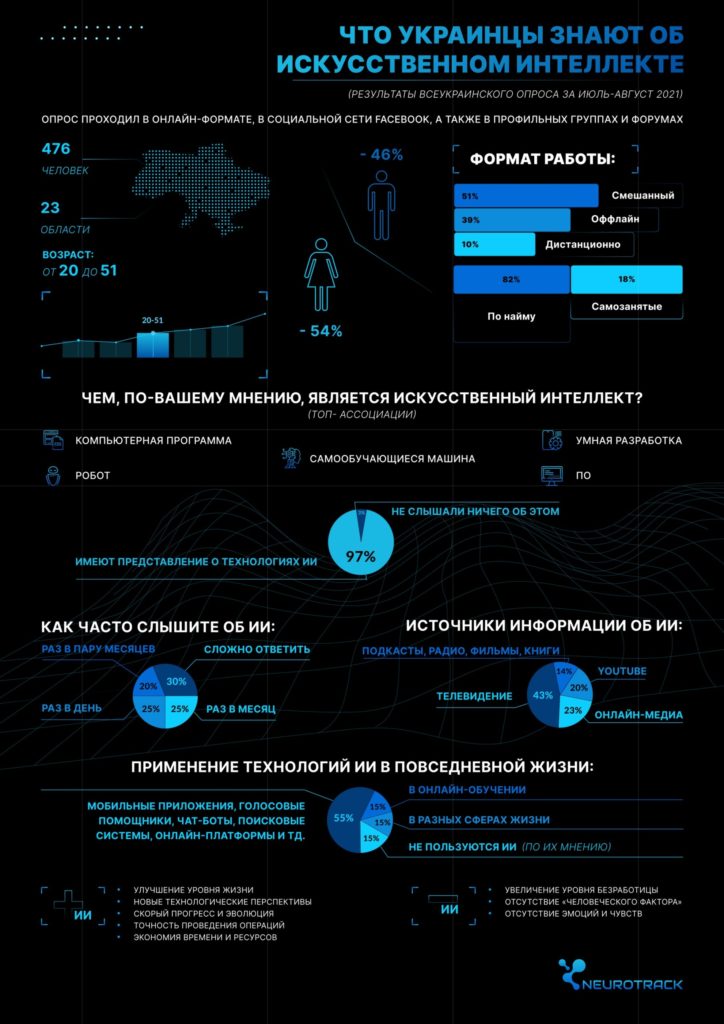
Respondents associate the term “artificial intelligence” with a computer program, a robot, a self-learning machine, software or smart technology.
43% learned about it through television, 23% on online media services, 20% on YouTube, and another 14% from podcasts, radio, films and books.
Among AI’s advantages, Ukrainians cited improved quality of life, time and resource savings, new technological prospects and greater precision in operations. Disadvantages cited included rising unemployment, lack of emotions, feelings and the “human factor.”
The survey included 476 people aged 20 to 51 from 23 regions of Ukraine.
Researchers successfully applied AI to remove cancer tumours
Israeli researchers developed a method of removing aggressive cancer tumours with AI.
The researchers used high-intensity radiation therapy through a virtual network. They targeted malignant neoplasms that cannot be removed surgically due to their proximity to vital organs. They used complex calculations and AI to determine the radiation intensity and direction.
The trial involved three patients at Rambam Health Care Campus. The researchers managed to completely remove a leg sarcoma without subsequent chemotherapy or resection.
Meta unveils tactile skin for robots
Researchers from Meta AI (formerly Facebook AI Research) and Carnegie Mellon University developed the tactile skin ReSkin for robots.


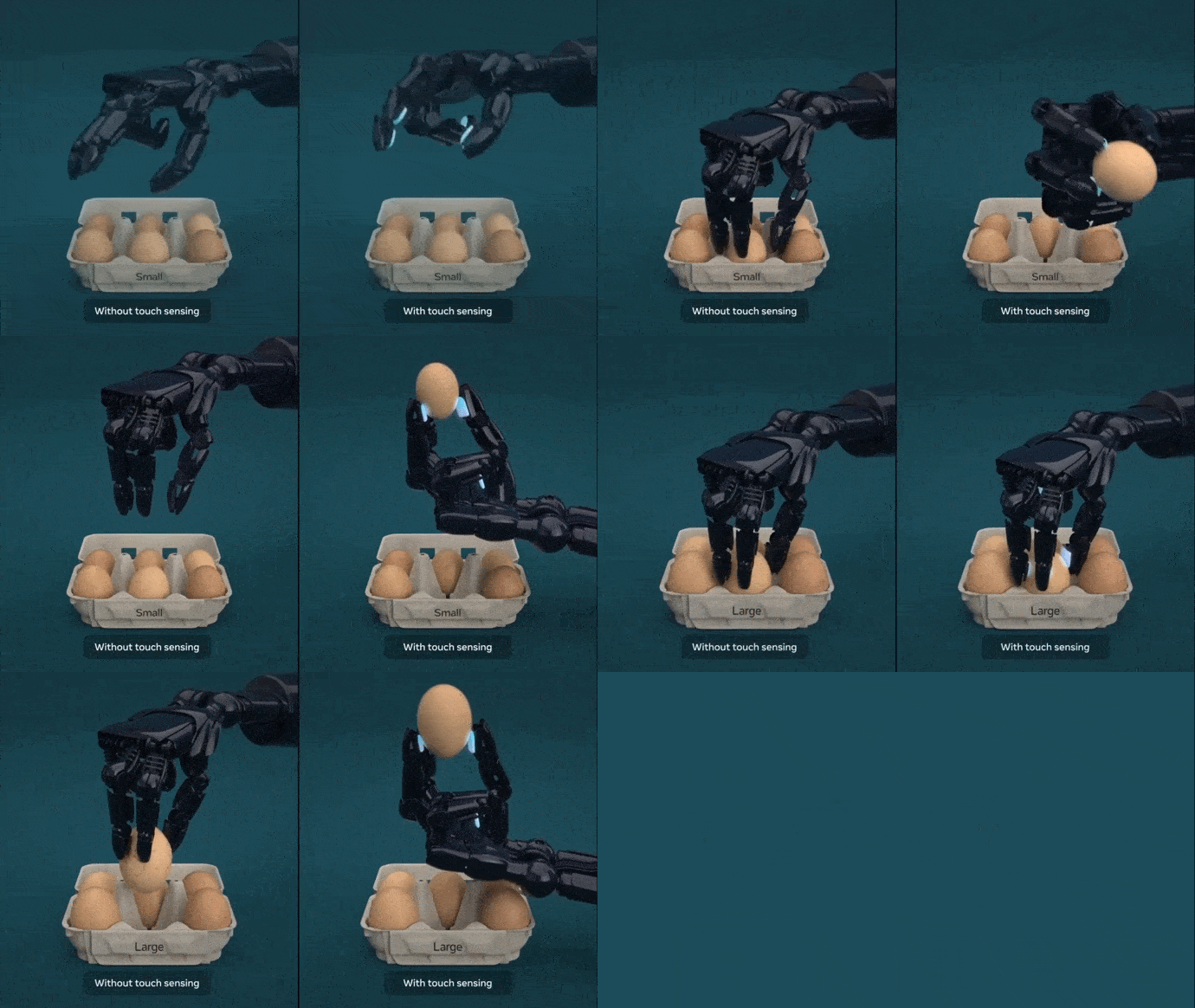
The technology is based on a self-supervised learning algorithm and uses magnetic sensors. It enables devices to perceive information through tactile sensing over large surfaces.
The project code is available on GitHub. According to the developers, this supports rapid and scalable AI progress in understanding information through “tactile sensations.”
US to deploy robots for skyscraper window cleaning
American company Skyline Robotics will roll out a project to use robots for washing windows of skyscrapers.

The Ozmo manipulator device is equipped with LiDAR, a force sensor, an automatic water-supply system and a large brush. It also uses AI to adapt to different working conditions.
In October 2021 Skyline Robotics entered a partnership with Platinum, a real estate company that owns cleaning and maintenance contracts for 65% of Class A buildings in New York.
Sber launches Russian-language version of the DALL-E algorithm
The company Sber launched the ruDALL-E neural network for generating images from text descriptions in Russian. The project includes versions with 1.3 billion and 12 billion parameters.
Engineers used OpenAI’s DALL-E algorithm and trained it on 120 million pairs of description-image. The network was trained on the ML Space platform on the Christofari supercomputer.
ruDALL-E consists of three models. The first takes text and creates a specified number of images, the second selects the best, and the third enlarges the sample size without quality loss.
Anyone can use the algorithm. We at ForkLog AI tried generating a few images and here is what we got.



Most notable AI deals of the past week
From 31 October to 6 November 2021, startups in the AI field raised over $1.27bn. Here are the most interesting deals.
- Sama привлекла $70 млн on expanding an end-to-end AI platform.
- Notable собрала $100 млн for scaling AI algorithms to automate healthcare tasks.
- FingerprintJS получила $32 млн.
- BrainCheck собрала $10 млн for software to detect and manage cognitive impairments.
- Everlaw привлекла $202 млн to support a cloud-based legal technology platform.
- Activeloop получила $5 млн to build a streaming database for AI-powered media apps.
- Autonomous vehicle maker Nuro собрал $600 млн.
- Anomalo привлекла $33 млн for a service that automatically detects data quality issues.
- Autonomous driving firm 42dot получил $88.5 млн to advance autonomous driving tech.
- OctoML собрали $85 млн for a platform to deploy ML models.
Also on ForkLog:
- Opinion: experts are «напуганы» by their own AI breakthroughs.
- OpenAI trained a language model to solve mathematical problems from school curricula.
- Facebook will drop its facial recognition system and delete related data.
- In Australia authorities banned Clearview AI from collecting citizens’ data.
- Alphabet has founded a new company to search for drugs with AI.
Subscribe to ForkLog’s AI news on Telegram: ForkLog AI — all the AI news!