



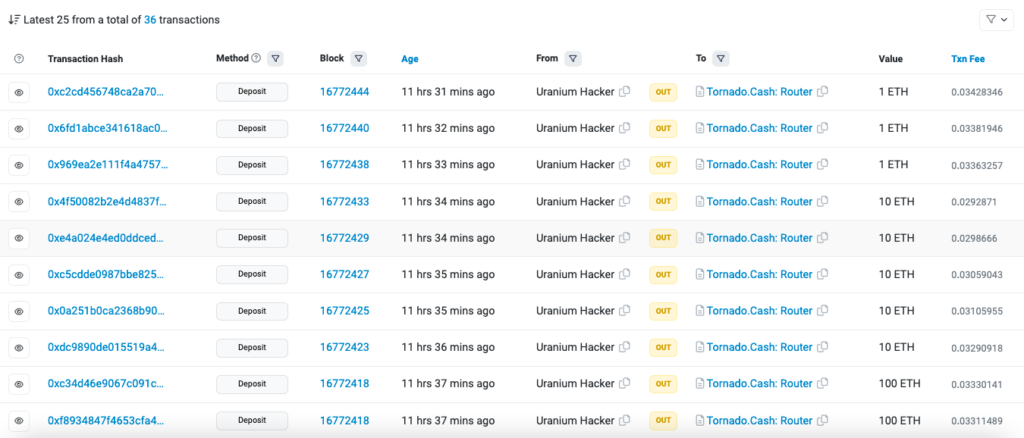
An address tied to the Uranium Finance breach suddenly moved 2250 ETH (~$3.35m) after 647 days of inactivity.
#PeckShieldAlert After 647 days, @UraniumFinance hacker started move 2250 ETH (~$3.35m) stolen funds into @TornadoCash. On April 28, 2021, the hacker drained approximately $50 million worth of tokens from Uranium’s “pair contracts”. https://t.co/mBhMxmAdS5 pic.twitter.com/OOF3R0w3ll
— PeckShieldAlert (@PeckShieldAlert) March 7, 2023
According to Etherscan, on March 7, over seven hours the presumed hacker sent all funds from the wallet to the cryptocurrency mixer Tornado Cash. He made several transactions ranging from 1 to 100 ETH.


However, this was only one of the addresses linked to the platform’s breach. Another well-known wallet in September 2022 moved 5 ETH to the Aztec Network, a scaling solution for Ethereum using ZK-Rollups.
The Uranium Finance protocol breach occurred on April 28, 2021, resulting in a loss of $50 million. The hacker exploited a vulnerability that arose when moving assets to the project’s new fork.
The project apparently never recovered. The last company post on Twitter was dated April 30, 2021. In it, developers urged users to withdraw funds from various liquidity pools.
Please read our latest medium article : “Last rewards of the money pot, please remove funds from pools” :https://t.co/W5uw0DUSXS
— Uranium Finance (@UraniumFinance) April 29, 2021
In February 2023, the total damage from DeFi hacker attacks amounted to $21 million. The largest was the hack of the Platypus Finance protocol for $8.5 million. The attacker used a ‘flash loan’ and a logic error in the collateral-checking mechanism.
Earlier this month, the hacker withdrew $700,000 from the LaunchZone liquidity pools, causing the project’s token to devalue by 82%.