




Canadian mining company HIVE Digital Technologies has launched the first GPU cluster for artificial intelligence in Paraguay. It is already operational on real tasks, according to a press release.
The equipment is housed in a data center in Asunción and has been integrated into the BUZZ AI Cloud platform. A research group from Columbia University is using the cluster to train large language models.
The project is non-commercial and serves as a proof-of-concept (PoC) for distributed AI computing. The model is trained from New York (USA), while computations are performed on GPUs in Paraguay.
HIVE will collect data on latency, bandwidth, and load management. These metrics will determine the prospects for scaling the HPC segment in the region.
The cluster in Asunción marks the first step in integrating AI and high-performance computing into HIVE’s existing energy base in Paraguay. The company currently controls about 300 MW of hydroelectric power and plans to add another 100 MW. If the experiment succeeds, further investments in data centers are possible, with a planning horizon extending to 2027.
Industry Shift
HIVE is not the only mining company seeking new revenue streams beyond cryptocurrency mining. ASIC equipment is unsuitable for AI, but many players control large energy capacities and data centers that can be adapted for GPU clusters.
The firm is already restructuring its business: on March 16, HIVE announced the winding down of mining in Sweden and the expansion of GPU capacities in Canada through its BUZZ division.
HIVE’s course differs from the strategy of some competitors who are exiting Latin America. For instance, Bitfarms earlier this year sold its site in Paraguay and focused on developing data centers in North America.
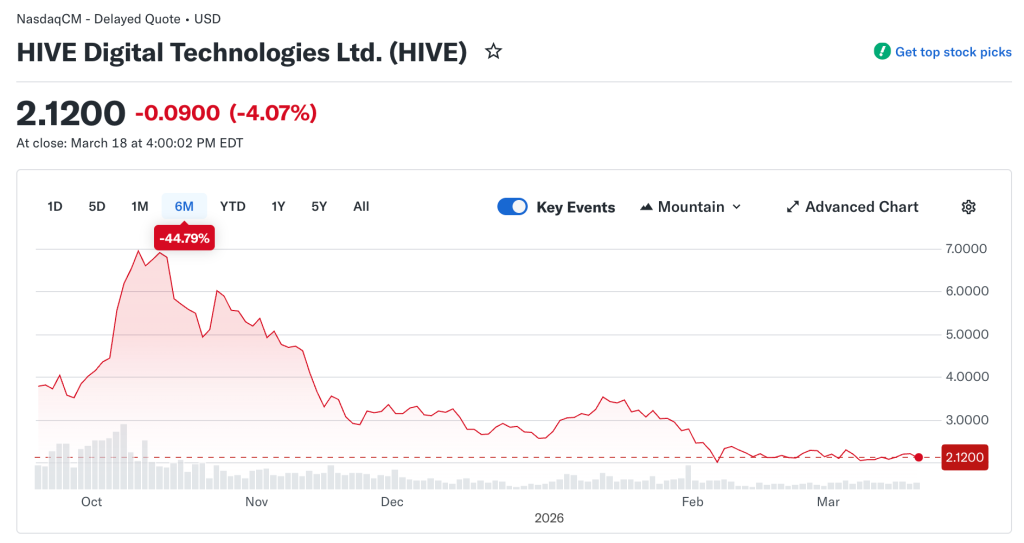
Within a day, HIVE’s stock price fell by 4% to $2.1. Over the past six months, the shares have plummeted nearly 45%.


Earlier, miner Cango reported a $453 million loss in its first year of bitcoin mining. The firm is moving towards AI infrastructure.