




Bestchange lists 444 exchanges. But this list is not exhaustive: it excludes centralized and P2P exchanges that prefer anonymous offline trades.
We conducted an interview with a representative of обменника VIP|BTC to learn about the features of a “whale-friendly” service: a minimum trade of $5,000, deals in a secured office, and anonymity. We describe the services the exchange provides to large clients and whether big trades on exchanges influence the price of Bitcoin.
ForkLog: How did the idea for an exchange catering to large clients originate?
VIP|BTC: We started operating in 2017. There was a crypto boom, everyone was buying Bitcoin, and the market for crypto exchanges was just taking shape. Exchanges of that era did not prioritise service: clients waited for cryptocurrency for hours, support responded sporadically, and one-day exchanges disappeared with clients’ Bitcoins.
ForkLog: Why do you favour offline trades?
VIP|BTC: Online it is difficult to execute large operations. Banks impose transfer limits, and if you bypass them there is a risk of falling under financial monitoring. We know of cases where a bank blocked a client\’s accounts over a single transfer of 600,000 rubles. So we decided to focus on cash deals: they are faster and safer. And — only offline can ensure the anonymity of the deal.
ForkLog: How has VIP|BTC changed since inception? What are your plans for development?
VIP|BTC: We started with an office in Moscow, and now we have offices in 5 countries. Three months ago we opened an office in Dubai, where there is demand for large cryptocurrency operations. We also plan to open offices in Istanbul and Prague, and expand the network of offices in Russia.


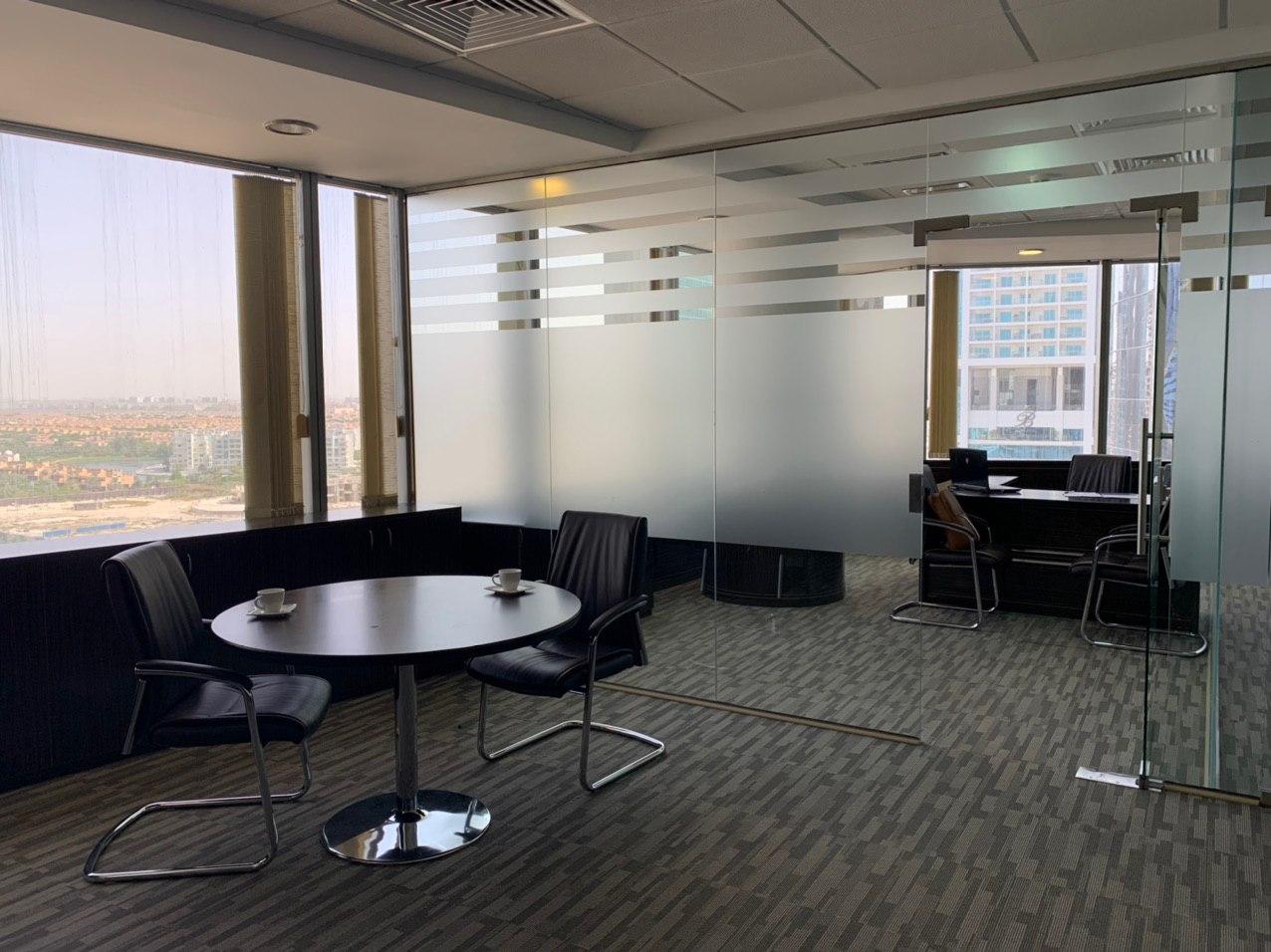
Office of VIP|BTC exchange in Dubai
ForkLog: Are trades conducted only in VIP|BTC offices?
VIP|BTC: Most clients prefer to come to the office, as it is the most convenient option. We now have six offices in secure business centres with convenient locations: Moscow, Saint Petersburg, Kyiv, Barcelona and Dubai.
The exchange takes place in front of the client: a staff member counts the money, verifies the transaction and confirms completion. This takes 10–30 minutes, depending on network load. This is the fastest and most transparent option, so clients use it most often.
There is also a courier-delivery service, whereby the client hands money to a courier and we send them cryptocurrency. Or, the client sends us cryptocurrency and the courier brings the money. Courier-delivery is often used by European clients: it is more convenient than travelling to Moscow or Barcelona.
ForkLog: Your staff work with large sums. By what criteria do you recruit?
VIP|BTC: We hire only “our own” — people we know and trust. The usual requirements are that the person is honest and hardworking.
ForkLog: What are the difficulties in running an exchange? How do you cope with them?
VIP|BTC: The hardest part is scheduling. You need to manage the time of managers so they can complete all tasks. Managers coordinate the timing of trades considering force majeure, for example delays in the mempool.
There was also a difficulty with exchanging very large sums. Clients were reluctant to travel around the city with a bag of cash, so we introduced a cash-in-transit service. A security vehicle arrives for the client and escorts them to the office. And if a client sells a lot of cryptocurrency, the escorts accompany them with the money to their home or bank.
ForkLog: How do you maintain the anonymity of trades?
VIP|BTC: We have our own rules for conducting trades, and we prefer not to disclose them. I will say that security at the entrance to the business centre may ask to sign the visitor log, but this does not affect the anonymity of the deal.
ForkLog: Do you verify clients\’ funds using KYC/AML procedures?
VIP|BTC: We verify the origin of the client\’s cryptocurrency, but I cannot disclose all details of the KYC procedures and [simple_tooltip content=’Anti-Money Laundering Policy’]AML[/simple_tooltip]. Among our clients are traders and investors who buy Bitcoin and deposit it on crypto exchanges. On ordinary exchanges there is a risk of buying ‘dirty’ Bitcoins that were previously involved in hacks, scams and darknet deals. Crypto exchanges block accounts that attempt to deposit ‘dirty’ coins.
We do not want a client to buy Bitcoins from us and have the exchange block them. Therefore, when purchasing we check the cryptocurrency using a private service. It cross-references the client\’s transaction with a database of ‘dirty’ wallets and shows the overall risk level for all coins the client wants to sell us.
For verification no access to a wallet is required. When the client sends us cryptocurrency, we pass the transaction hash to the verification service. If it finds coins in the transaction to be suspicious — we return the cryptocurrency to the owner and cancel the deal.
ForkLog: How do you calculate commissions?
VIP|BTC: We take into account the ruble-to-dollar rate, the dollar-to-yuan rate, and the levels of demand and supply in the crypto market. Other exchanges try to lure clients by driving commissions down to the floor. Based on their fees we determine the current demand and supply.
Because of so many variables VIP|BTC does not have a fixed percentage. For clients this is a plus, as we adapt to market conditions and offer competitive commissions rather than taking numbers from above. There have been periods of demand-supply imbalance when we offered negative commissions and the client received more than they gave.
For especially large trades we offer additional services free of charge, such as the same cash-in-transit. For trades of the minimum amount one can also have home delivery with security, but this will incur an extra charge.
ForkLog: Do exchanges influence the price of cryptocurrencies?
VIP|BTC: Exchanges have little influence on Bitcoin\’s global price. According to our data, to move the price you would need to execute a trade of at least 10,000 BTC, and for such volumes you would have to use OTC services on exchanges. So manipulating the overall market price of Bitcoin with exchanges is not feasible.
However, exchanges do affect the local price of cryptocurrency in a country or region. Theoretically, an investor could buy all Bitcoins on exchanges in one country and push the Bitcoin rate against the local currency. But the BTC/USD rate on major exchanges would not be affected.
ForkLog: More crypto exchanges and wallets are adding fast crypto-to-fiat exchanges. In the future could these services replace exchanges?
VIP|BTC: I think they will fall out of the market. They have weak infrastructure, high fees and little room for growth. Most people will continue to use centralised exchanges because it is more convenient. Do not worry — exchanges will not disappear.
Sign up for ForkLog news on Telegram: ForkLog FEED — all the news feed, ForkLog — the most important news and polls.