



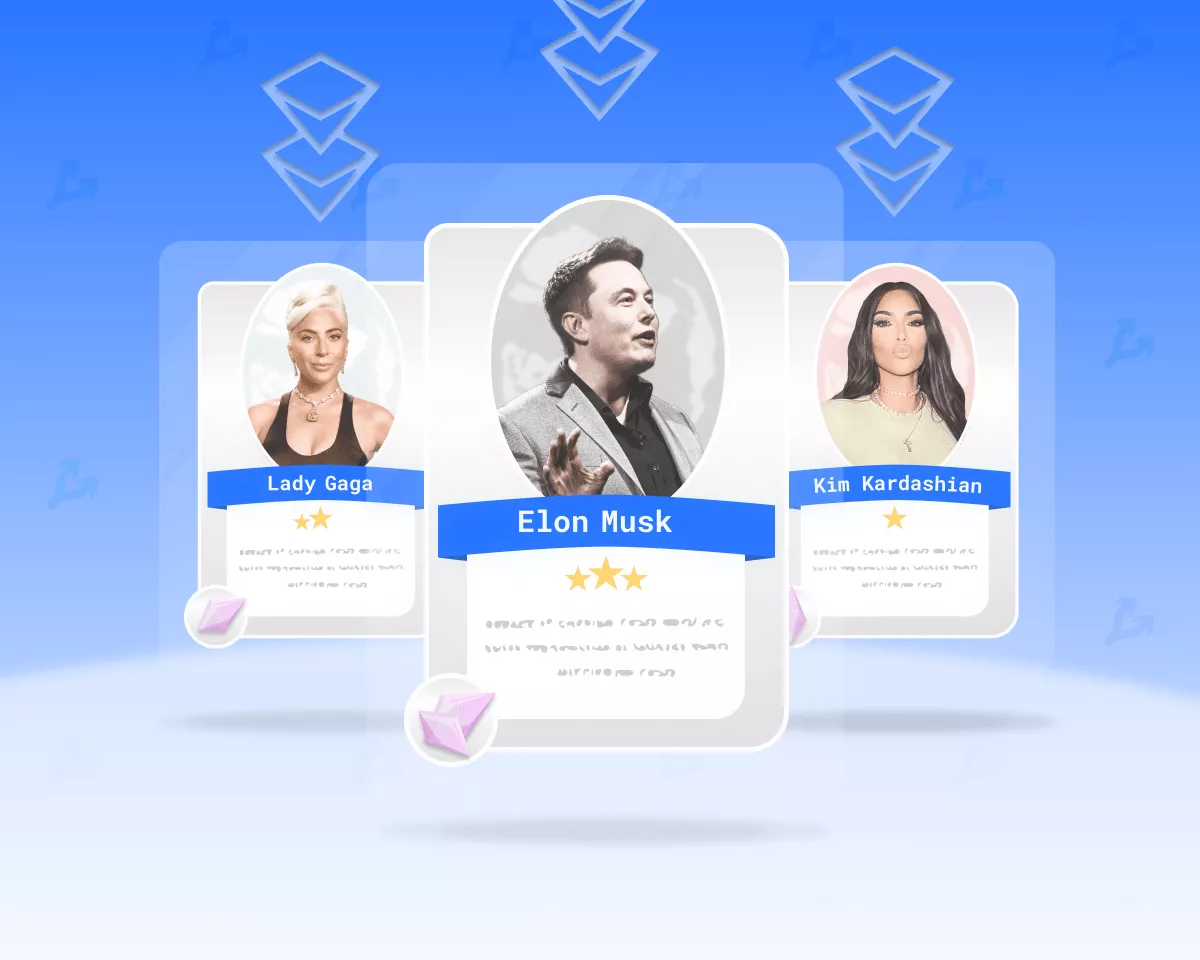
In March, a wave of discussion swept through the media and the cryptocurrency community about the new social network BitClout, which ambitiously brands itself as a decentralized alternative to Twitter and even offers a way to earn money.
The need for a social network without centralized governance and moderation has long been apparent. It has been sharpened by recent events with virtually arbitrary account blocks on Facebook and Twitter (think of Trump and his supporters), and scandals over data held by corporations and massive leaks.
There have been attempts to create such an alternative, but decentralized social networks have not achieved mass adoption. And it seems BitClout is ready to fill this niche.
But it is not only decentralisation that attracts new users. BitClout aims to bring to life plots reminiscent of Black Mirror or to craft an enhanced version of the Chinese social‑credit style rating. The main asset at the heart of the network is a person’s reputation.
A number of major venture funds have already invested in the project, which for many acts as a kind of guarantee against fraud. Nevertheless, BitClout is surrounded by suspicion and even direct accusations of a scam.
ForkLog has examined how the network is structured, the main criticisms, and its prospects for development.
- BitClout is built on its own blockchain and aims to be a decentralized alternative to Facebook and Twitter.
- The network allows trading coins linked to specific individuals, whose prices rise or fall depending on the person’s reputation and demand. Internal BitClout tokens can be bought only with Bitcoin, withdrawals from the platform are not yet possible.
- BitClout already has profiles of about 15,000 celebrities. Many of them are unaware of it.
- Many are critical of the project and see signs of a pyramid scheme.
How BitClout Works
BitClout presents itself as a social network of a new kind, built on its own blockchain.
“BitClout decentralises social networks in much the same way Bitcoin decentralises the financial system,” says the project’s white paper.
In many respects it resembles Twitter: the same profiles, messages of up to 280 characters, the ability to follow interesting people, and a familiar interface.


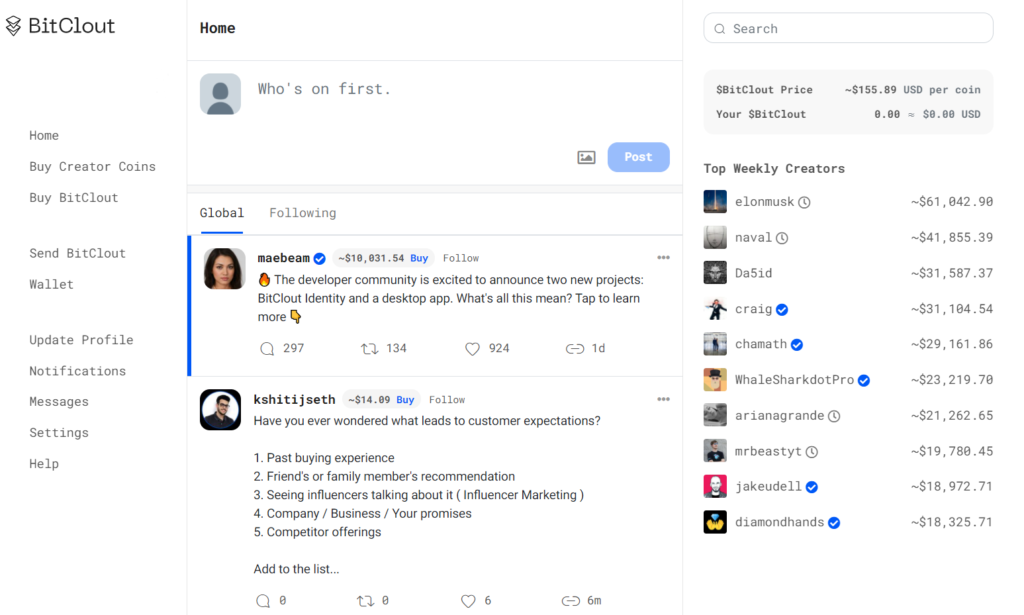
BitClout’s creator, who uses the nickname Diamondhands, and the project’s investors emphasise that, despite its outward resemblance to Jack Dorsey’s service, it is at its core an alternative to centralized networks like Twitter or Facebook.
The founder of Arrington XRP Capital, the publication TechCrunch, and one of BitClout’s investors, Michael Arrington said that the world needs a “censorship‑resistant” platform where users would not be punished for expressing different opinions.
According to Arrington, although he voted for Joe Biden in the US presidential election, he was shocked by Twitter’s blocking of conservatives. By all appearances, he is referring to the blocking of former U.S. President Donald Trump’s accounts and his supporters.
The BitClout story still hasn’t been told. Journalists have only focused on the hiccups around the launch. We NEED this product. BitClout is freedom. Few will become many.
— Michael Arrington (@arrington) March 24, 2021
BitClout has no corporate entity that would prioritise the interests of shareholders over the community, the creators emphasise.
“BitClout isn’t a company, it has no board of directors and no CEO — it’s only code running via nodes on the internet, like Bitcoin. Every profile, post, and subscription is stored on a public blockchain to which anyone has access. This makes it a fully open platform that can address existing problems,” writes Diamondhands.
In April BitClout announced the ability to run nodes. Among other things, they will allow users to create their own feeds devoted to specific topics (BitClout likens this to the concept of subreddits), use various analytics tools, or implement their own improvements.
According to the creators’ design, this approach should shield the platform from centralized moderation (which many see as one of the main problems of social networks) and allow its participants to profit.
Perhaps BitClout’s main gimmick is not so much decentralisation but the possibility to earn — to earn from someone else’s reputation.
At the heart of the network lie two kinds of coins. The first are Creator Coins, tied to a specific profile. They represent a tokenised gauge of a person’s actions or statements.
BitClout describes Creator Coin as a tool for society to “trade social influence” as an asset.
“For example, if Elon Musk manages to send the first person to Mars, the price of his coin would theoretically rise. Conversely, if he makes a racist remark during a press conference, the price of his coin would theoretically fall,” the white paper says.
Incidentally, Elon Musk’s profile already exists on the platform, and his Creator Coin is the most expensive on BitClout. At the same time, the Tesla chief himself has not registered on the social network.
You can buy a Creator Coin for a specific person using BitClout’s internal cryptocurrency (BTCLT). Practically every action on the platform is conducted through it.
As Diamondhands told CoinDesk, during the pre‑mining they mined 2 million BTCLT to be distributed among investors. He said that, technically, there are no constraints on BTCLT supply, but around 19 million coins are expected to be issued.
To register on BitClout you must enter an email address, and to verify your account you must link a phone number or top up your BitClout wallet.


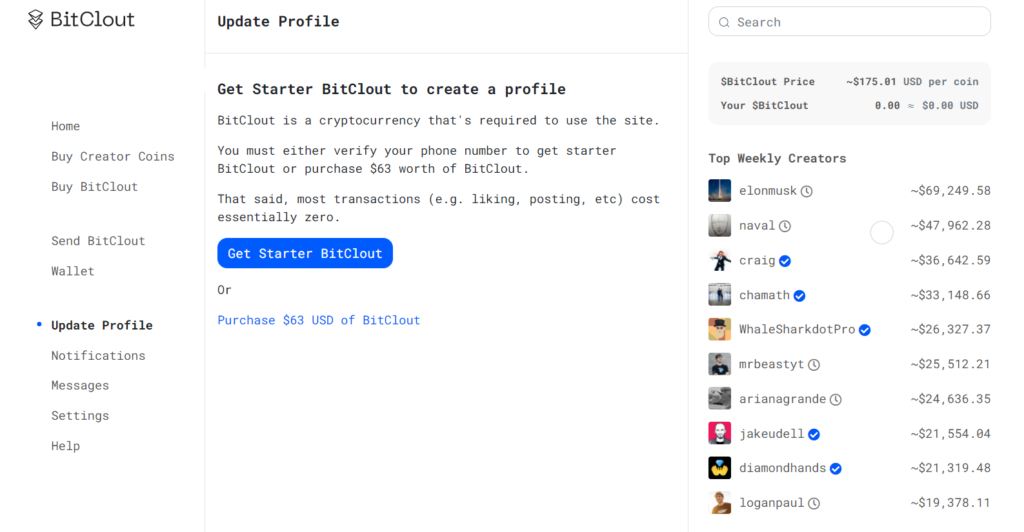
The top‑up amount changed during the piece’s preparation, from $63 to $55 in BitClout tokens. The white paper states that the coin’s price doubles with every sold million tokens.
BTCLT can be bought only with Bitcoin. And at this stage many questions arise, since there is no way to convert them back into Bitcoin.
Major investors, “useless tokens” and Hydra links
It would seem that all participants stand to gain — the “creators,” whose Creator Coins are bought by users, monetising their achievements, and the holders of these tokens who can profit from investments in the “right” person.
The creator receives a commission on every purchase of their token, the size of which is set by the creator themselves.
The incentive to run nodes also lies in the ability to earn. Node operators will be able to monetise the reach of the feeds they curate — for example, by charging for posts pinned in the feed.
They can also collect a commission on every Creator Coin transaction that lands in the node operator’s wallet.
“Thus, any node operator effectively performs the functions of a crypto-exchange,” notes BitClout in a statement.
Fees for operators may also include in‑node maintenance transactions.
However, to date the profit story on the platform begins and ends on BitClout. The BTCLT token is not traded on any exchange — therefore it can be used only within the social network itself.
Diamondhands pledged that such an option would appear soon, pointing to support from major BitClout investors.
Perhaps the new social network would not have attracted so much attention if it were not for the high‑profile backers. Among the investors of the project are Sequoia, Andreessen Horowitz, Social Capital, TQ Ventures, Coinbase Ventures, Winklevoss Capital, Arrington Capital, Polychain, Pantera, Digital Currency Group, Variant and others.
“Almost every major venture capitalist is involved in this project,” notes The Block analyst Frank Chaparro.
Spoke with the Bitclout team today. I thought this information was embargoed for tomorrow but it’s out there now: Basically every major VC is in this project. Coinbase, Sequoia, a16z, Social Capital, DCG, Pantera, Huobi, Winklevoss Capital, Alex Ohanian, North Island Ventures…
— Frank Chaparro (@fintechfrank) March 23, 2021
That trust from major investors persuades many. Yet it also raises concerns for some. In particular, questions have been raised about premining for investors.
Not only that, but they and their friends have also been premining all of the creator coins they think are most valuable, so you can enjoy paying a much higher price for those as well.
— alcouchy the coziest (@C0inAlchemist) March 17, 2021
“Venture capitalists and their friends have been buying up [coins] for more than a week on a blocked site, and now you’ll pay a multiples-higher price for them. Moreover, they pre-mined coins they deem most valuable, so you can pay far more for them,” a Twitter user said.
Founder James Prestwich of Summa says BitClout is a fraudulent project, noting — “just because institutions push a scam does not mean it isn’t a scam.” quoted by Decrypt.
In conclusion, this is a scam. It is engineered to pay back early investors with later investors’ money@nadertheory is hoping that the big dollar signs and the blitz of brand name VCs will blind you to this simple facthttps://t.co/KrvYq5YDaQ
— James Prestwich (@_prestwich) March 24, 2021
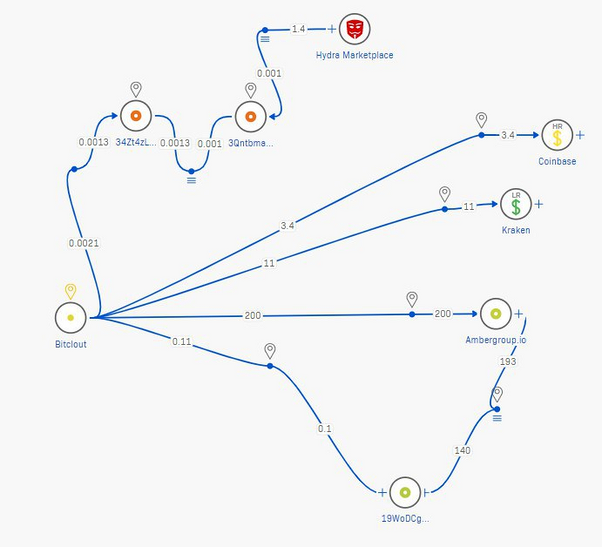
At launch, CipherBlade founder Rich Sanders found that BitClout funds flowed to three crypto platforms: 88% to Amber Group, 11% to Kraken, and under 1% to Coinbase. From there the funds moved to other exchanges and wallets.
The analyst also found that one address BitClout paid directly was receiving money from the Hydra darknet marketplace.
According to indications, the address belongs to a Nigerian individual whom BitClout may have paid for Twitter bots to promote the project, Sanders said.


Coinfirm, a firm that tracks suspicious crypto transactions, has gone so far as to call the new project “Bitconnect 2.0” — a scheme that many countries regard as a wide-scale financial pyramid.
Prestwich also flagged another concern from a privacy and funds‑safety perspective: BitClout uploads users’ keys to their server with every API request.
BitClout uploads your keys to their server on every API request. Any employee with access to that server can steal all the money on the platform at any time@nadertheory and team are too incompetent to build a browser wallet, so they decided not to ?♀️
10 pbkdf iterations ? pic.twitter.com/SastJkMfF2
— James Prestwich (@_prestwich) April 8, 2021
Diamondhands responded that the project takes security very seriously and that seed phrases are never stored anywhere other than in your browser.


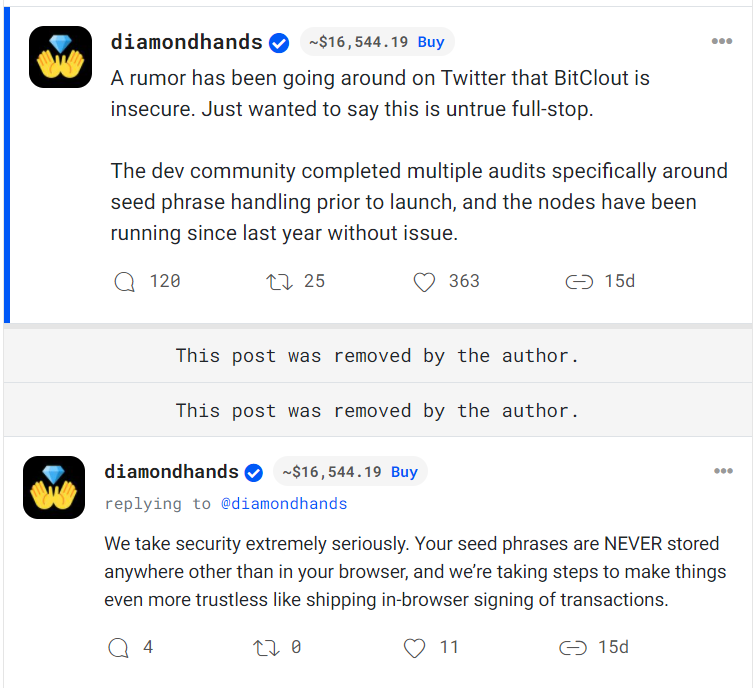
Later BitClout released a desktop application, which it recommended for maximum security, and launched BitClout Identity for the secure storage of “confidential account information in the local browser storage.”
Yet questions for the network do not end there.
“Creator Coins” without creators
Since launch, BitClout has seen accounts belonging to a number of celebrities — the platform initially hosted profiles of about 15,000 famous people from various spheres. The problem is that many of them probably don’t even know about it.
Among the celebrities with accounts on BitClout are the aforementioned Elon Musk, Katy Perry, Kim Kardashian, Donald Trump, Lady Gaga, and others. There are also profiles of Binance CEO Changpeng Zhao, Coinbase CEO Brian Armstrong, and Twitter founder Jack Dorsey.
None of them have verified their accounts.
As of the time of writing, here is a list of about ten accounts whose Creator Coins are the most highly valued:


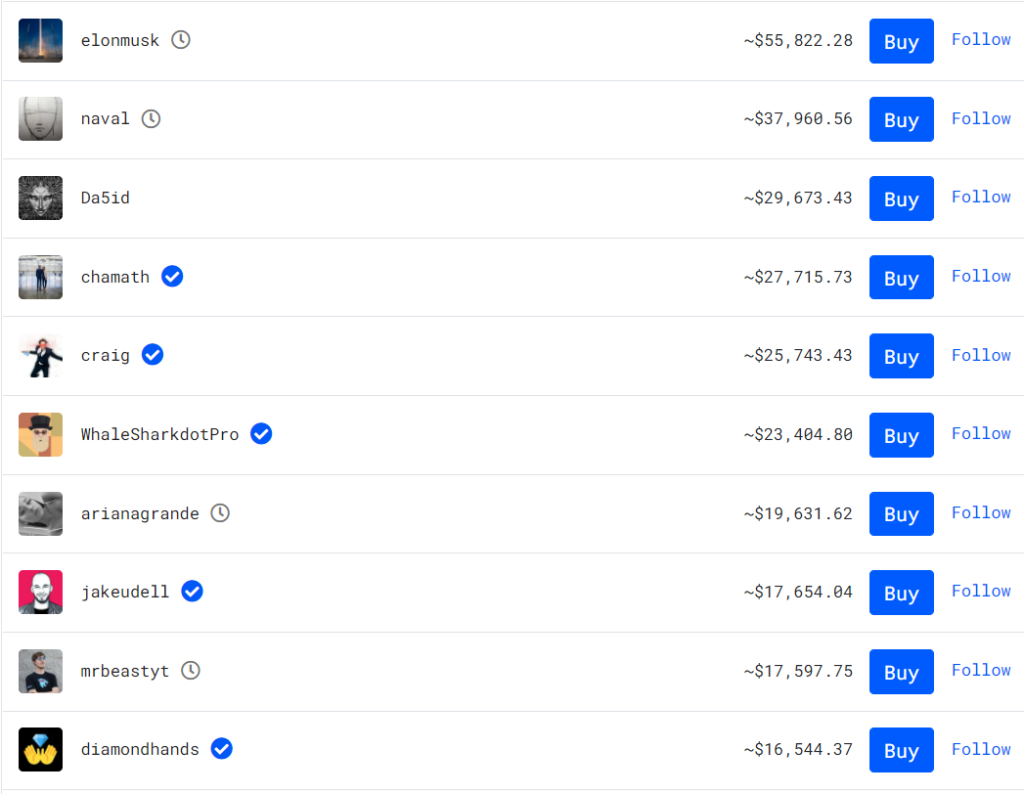
Profiles with blue checkmarks are verified. What does that mean?
Initially, BitClout’s creators simply copied popular users’ accounts from Twitter, without their consent.
Diamondhands explains this move by saying they “reserved” profiles in advance to prevent fake accounts from being created.
However, for the hypothetical Elon Musk to gain access to an account created for him on BitClout (and already trading a Creator Coin), he would need to publish his key on Twitter. In other words, to give BitClout free publicity.
Some have already done so. For example, actress Pamela Anderson.
Freedom,
Find me here and only here @bitcloutlist #bitclout
de·cen·tral·i·za·tion
the transfer of control of an activity or organization to several local offices or authorities rather than one.
— Pamela Anderson (@pamfoundation) March 27, 2021
BitClout also welcomed comedian and writer Stephen Fry. Yet, in his own words, he “hasn’t yet worked out what BitClout amounts to, but felt he should secure his name and ID before someone else did.”
Hey, I join (almost) everything new as a matter of course. Haven’t worked out what BitClout amounts to, but I felt I should bag my name and ID before someone else does. Seems wise. The tweet above is the way to do that I’m told……
— Stephen Fry (@stephenfry) March 26, 2021
At the same time, the vast majority of celebrities have not verified their accounts and did not consent to their creation.
A partner at law firm Anderson Kill, Stephen Palley, demanded his profile be removed from the platform, noting that he did not consent to monetising his “name, image and reputation.” He also advised BitClout to shut down the site and obtain written consent from people first.
Even better, you should pull down the site completely and get written consent from people first.
— Palley (@stephendpalley) March 22, 2021
Lawyers at Anderson Kill sent a cease-and-desist letter on behalf of Radar Relay founder Brandon Curtis with a similar demand for removal. Others who discovered their profiles on BitClout issued similar statements.
There is another problem: many celebrities whose Creator Coins are trading on the platform simply do not know about it. Since BitClout has largely targeted international audiences, the accounts of Russian-speaking stars do not seem to be thoroughly checked by BitClout.
For example, fake profiles of Ksenia Sobchak and the rapper Basta have already appeared in the network. The strategy for combating fake accounts remains weak.
The irony is heightened by the fact that BitClout’s developers insist on their own anonymity. Diamondhands communicates with journalists via the privacy‑oriented Messenger Signal and does not reveal his real name. Yet the community suspects who is behind Diamondhands and who to direct complaints to—the figure widely discussed in connection with the ill‑fated Basis launch, Nader Al‑Najhi.
The mystery of Diamondhands and Satoshi’s ambitions
In 2017, former Google employee Al‑Najhi founded Intangible Labs. A year later, his company attracted $125 million to create the stablecoin Basecoin (later renamed Basis).
The project was backed by Andreessen Horowitz, Bain Capital Ventures, Winklevoss Capital, Digital Currency Group, MetaStable Capital, Pantera Capital and PolyChain Capital. Some of them became BitClout investors:
“We’re investors. The same team that stood behind Basis several years ago,” said Decrypt’s Tyler Winklevoss.
Like BitClout, Basis faced criticism from experts, yet investments continued to grow.
But something went wrong — at the end of 2018 Al‑Naji announced the project’s closure. The reason was the US Securities and Exchange Commission (SEC) — the agency deemed the Basis tokens securities.
Al‑Najhi later acknowledged that one reason for the decision could be that, unlike Bitcoin or Ethereum, Basis tokens did not have real functional use.
In an interview with Decrypt, Al‑Najhi did not deny that he is the one behind the Diamondhands nickname. He said it is a reference to Bitcoin’s creator, Satoshi Nakamoto, whose identity remains unknown.
He stated that BitClout should follow the same path as Bitcoin:
“If something is decentralised, it should be governed by the community rather than a dictator. Diamondhands exists to absorb all attention and prevent associating any single person with the project,” he said, adding that one day Diamondhands will disappear, just as Satoshi did.
***
If the conjectures are correct, and BitClout is run by the same creator and the same investors, will the project meet the same fate as Basis? The answer is not obvious. While the idea and concept of the network differ completely from a stablecoin, experts say the SEC could still raise questions about the project.
According to the Howey test, which the US applies to determine whether an asset is a security, BitClout’s tokens could fall into this category.
A token is a security if:
- Funds are invested.
- The investor expects profits to come from a third party, not from his or her own efforts.
- The funds are invested in a common enterprise.
As can be seen, almost every one of these points can be found in BitClout.
“The fact that BitClout did not have a traditional ICO doesn’t matter,” said attorney Grant Gulovsen.
It’s also worth noting that unlike company stock, which typically gives holders certain rights, BitClout tokens aren’t tied to any real assets or claims, according to Intelligencer.
If you own Elon Musk’s token, you do not own a stake in his personal wealth or future earnings.
Despite all this, BitClout’s user base is growing. At the time of writing, Creator Coin wallets hold funds totaling more than $187 million, according to BitClout Pulse.



Castle Island Ventures’ Nick Carter says that even if BitClout has “some Ponzi-like features,” it would be hard to call it a classic scam: “Everything is gamified today. Every app is gamified. Bonus miles for flights are also a pyramid,” he says.
— Alina Saganitskaya.
Read ForkLog’s Bitcoin news in our Telegram — news on cryptocurrencies, prices and analysis.