


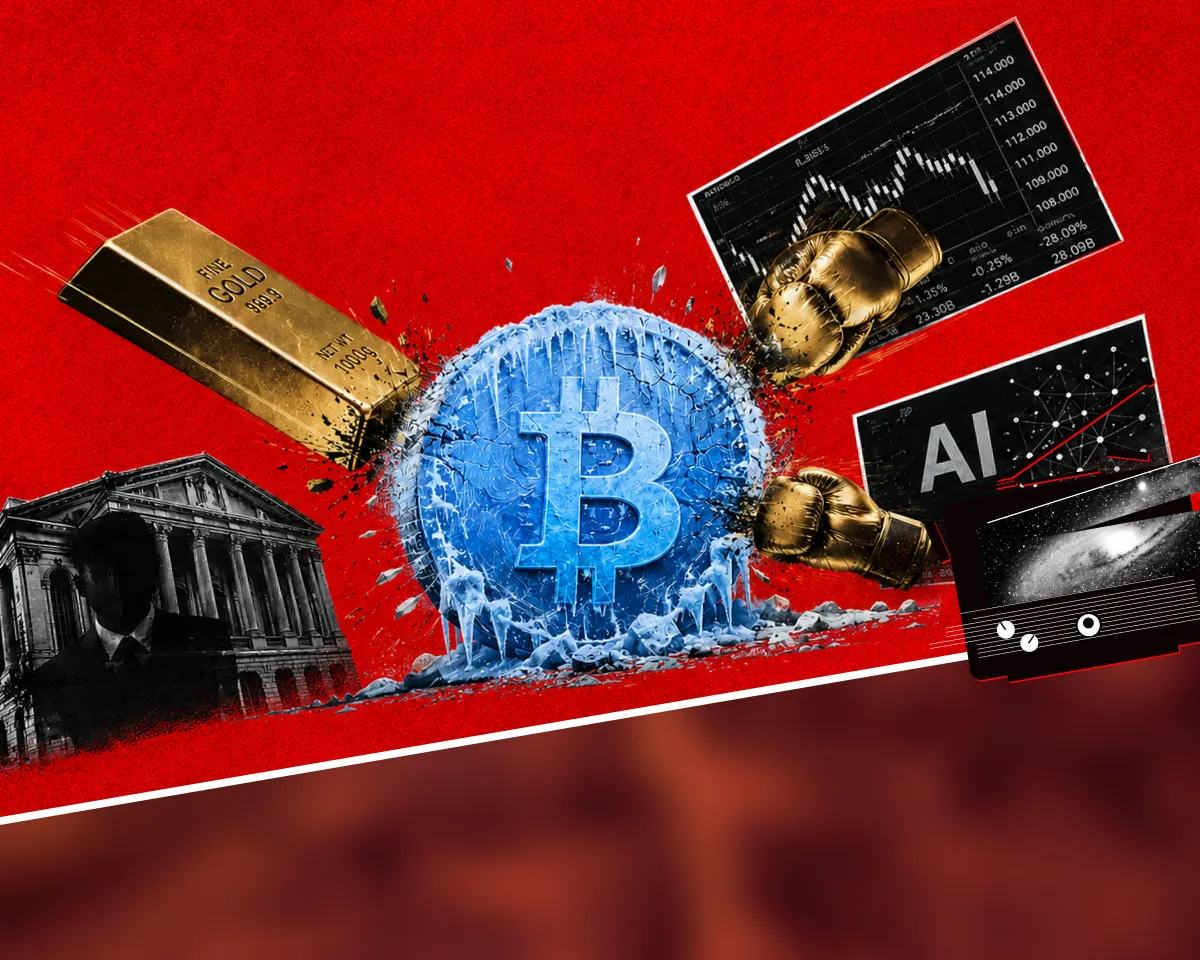
This week, “Deconstruction” focuses on the systemic crisis in the crypto market, the rebranding of TON, stricter listing on Aave, the end of anonymity for stablecoins, a conservative risk model for DeFi by Buterin, and the dopamine trap of perpetuals.
The Coldest Crypto Winter
According to Bloomberg forecasts, the digital industry is experiencing not just a price drop but a systemic crisis of narratives that have been built over the past 10-15 years. The thesis of Bitcoin as a hedge against inflation has been questioned, and the arrival of institutional players has stripped the industry of its revolutionary technology aura.
For the first time, the crypto industry finds itself as a technology competing for the attention and capital of engineers with artificial intelligence, which, combined with the concentration of coins among corporations, creates new systemic risks for the market.
The Illusion of Decentralization in TON
The announcement of Toncoin’s return to its historic name Gram was a political statement about strengthening the project after claims from U.S. regulators.
However, the vote on the rebranding revealed a problem of influence distribution — although 90% of unique wallets opposed the name change, one address with a massive balance had a decisive impact on the outcome. Formally, the blockchain is decentralized, but in practice, the weight of a vote entirely depends on the concentration of tokens among major participants.
Tightening Listings on Aave
The incident with the hack of the Kelp protocol for $293 million demonstrated how closely modern DeFi protocols are interconnected: a problem in a third-party solution immediately spread throughout the ecosystem, triggering a threat of bad debt and an outflow of nearly half the liquidity from the largest crypto platform.
In response, Aave revised its listing standards, effectively moving from evaluating a single asset to a strict assessment of the entire associated infrastructure, including bridges and scenarios of contagion to other markets. The main takeaway from this story is that risk today is determined not only by the quality of smart contracts but also by the connections between protocols, where an external hack can create a systemic threat to the entire industry.
The End of Regulatory Arbitrage
Financial regulators in New York State and the EU are strengthening data exchange, closing companies’ ability to maneuver between jurisdictions with different rules.
Stablecoins are gradually becoming part of the regular financial system, making them more predictable and reducing the risks of liquidity loss. However, using digital dollars as a tool for complete anonymity or circumventing restrictions is becoming unreliable due to increased control over transfers and the possibility of address blocking by issuers.
Buterin’s Risk Management
Reacting to past failures of algorithmic stablecoins, Vitalik Buterin proposed building synthetic instruments on the most conservative risk management principles. He urges abandoning the idea of “magical resilience” through the token’s internal economy and using over-collateralization with external liquid assets, primarily Ethereum.
In his view, for the next generation of protocols, the system’s ability to survive in crisis conditions becomes more important than capital efficiency.
The Dopamine Trap of Perpetuals
At the retail investor level, the main issue is trading derivatives with leverage. A psychological analysis shows that high volatility and uncertainty of outcome activate the brain’s dopamine system, which responds to anticipation rather than financial results.
Trading platforms significantly amplify this effect through gamification of interfaces, rankings, and constant notifications. As a result, trading turns into a casino-like experience, shifting from rational analysis to impulsive decisions made under continuous stress.
This is a shortened version of the podcast. Watch the full episode:

Subscribe to the podcast: