



How I Grew Tired of Digging Potatoes and Learned to Love AI Games
Hoping to take the edge off techno-overload, ForkLog contributor Sergey Golubenko decamped to the May countryside. Memories of a gamer youth—and a wish to relive it—came to the rescue of dacha chores.
Quickly tired of digging up potatoes and inspecting May beetle larvae, he returned to his computer and discovered a new AI-infused genre. By “test-driving” large language models (LLM), he aimed to recapture that old thrill and sink into unforced play.
The new wave of AI games spans genres: puzzles, text sagas, arcades. Cutting short the break, the author shares impressions of five of them.
Video games with AI
After a few days out of town with birds, squirrels and a laptop, memories of childhood—and its simple thrills, video games—began to bubble up.
Having long since stopped following new releases, I decided to Google. By chance I left “AI” in the search bar and discovered games that use artificial intelligence—and gladly dived into a closer look.
An AI game is one created or largely driven by systems using various LLMs such as GPT, Claude or Gemini.
AI games break down into four main types:
- text adventures (story-driven games). A retro trend that nods to classics like Colossal Cave Adventure or The Hobbit. Older plots were limited to dozens or hundreds of branches, whereas AI games promise near-boundless freedom. In AI Dungeon, for example, you can hop between worlds, eras and dimensions with a couple of chat lines;
- AI-generated. Partly or entirely created with LLMs. Only a few such video games are available so far. One is The Girl Does Not Exist, a relatively simple puzzle in which all elements were created by the machine;
- with advanced techniques. Many projects already use AI to sharpen gameplay. In The Last of Us: Part II, for example, the system creates a state of “alertness” for enemies: if a character sees an ally killed but not the attacker, they grow more cautious and prepare for revenge;
- with generative AI. These use a NPC, game objects, procedural generation or other elements. In Cygnus Enterprises, a companion named PEA is controlled autonomously.
Having grasped the basics of AI gaming, I picked the one that kept topping the search results—AI Dungeon.
An endless storyline: AI Dungeon
Made by Latitude, the game offers a free version on the official AI Dungeon site. A classic text-dialogue mechanic lets you paint the world vividly in your head. A ChatGPT-like window lets you direct your character with text.
The story-selection page shows the scale of the project’s ecosystem. Users can create their own AI-based stories. Judging by 1.2m plays, 1,800 likes and ~5,000 bookmarks, I chose Kedar.

The creator of this game world described it as follows:
“Kedar is a world of dragons, demons and monsters. These dark creatures are constantly waging wars for control of the Earth, leaving the few human kingdoms in the shadow of a dark and powerful force. But now the kingdoms of men are beginning to resist, slowly gathering an army to take back their world.”
I was ready to defend humanity and, to speed things up, hit “quick start” instead of creating a character.
The AI generated my hero—or rather heroine—and named me Sss:
“You are Sss-sik, a female mage of the Lizardfolk, with scaly skin shimmering with a mottled pattern of green and golden hues. As a member of the Kedarn faction, you have devoted yourself to honing your magical abilities to help the kingdom in its fight against the encroaching darkness.”

As so often in game narratives, the action opens in a bustling city market:
“A hooded figure approaches you, the emblem of the Mages’ Guild visible on their garb. ‘Sss’sik,’ it says in a quiet voice, ‘We have received word that a shipment of rare magical components will arrive today. The head of the Guild asks that you go to the dock and ensure its safe delivery.'”
The figure handed my heroine a sealed scroll, then vanished into the crowd, leaving me to ponder my next move.
What followed—underscoring the hallmark of AI games—were several unexpected plot twists.
I tried to pry from the vendors gossiping about the shipment what was in the crate. Then I headed to the port, where I had to fight the remains of the ancient demon Tagralot—once defeated and sealed into several containers warded by magical runes.
The chat mechanic lets you take different actions. You can interact with the AI by proposing an alternative storyline; skip ahead and let it generate more events; add imagery or voice; or (the simplest) give the hero a command. You can write in Russian.
The story is generated in English, but here’s a tip: paste the text into ChatGPT for translation and you’ll get extra clarifications from the model with suggested actions.
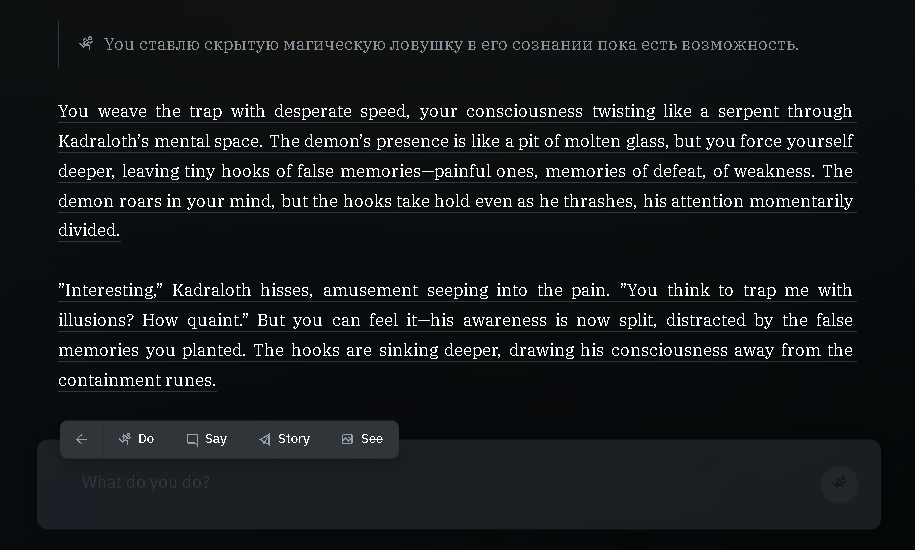
After an hour, having seized a moment to plant a magical trap in the ancient demon’s mind, I jolted at a sudden flash. The missing visual flair of AI games was supplied by a thunderstorm outside the window.
Over the session I noticed no hallucinations; the AI’s responses were unexpectedly engaging and non-repetitive.
A word game from Google AI — Semantris
Late in the evening came a “battle” with the AI on the field of words—associations, to be precise. I picked Semantris by Google AI as a light, plotless diversion you can play in about five minutes.
The developers offer two modes: an arcade for quick analogies, and “blocks” for a slower pace. Given the hour—and my reaction speed—I chose the latter.
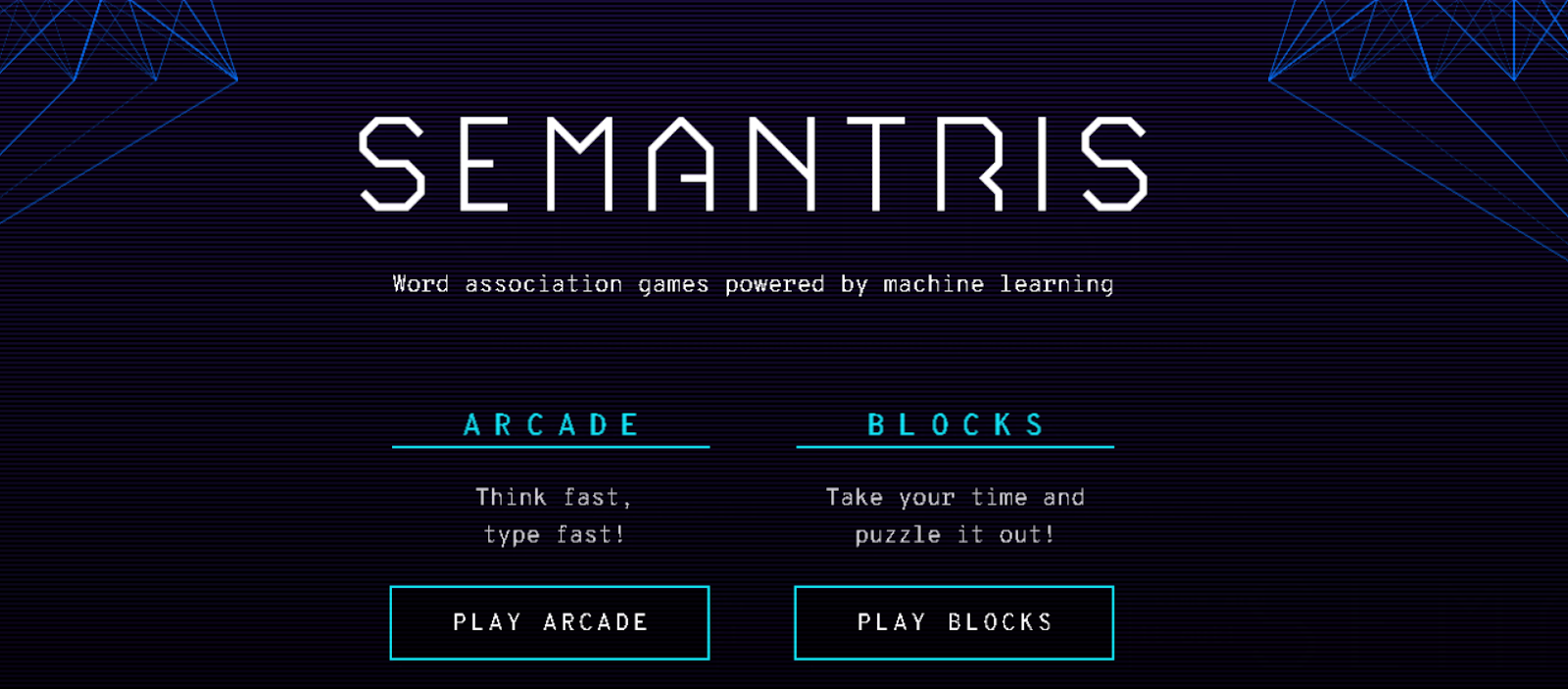
The premise is simple: the AI serves up words in a Tetris-like stack that creeps toward a critical line.
My task is to pick a block with a word and type an association to it. If accepted, the blocks vanish, scoring points and pushing back the end. After around ten tries, I couldn’t last more than five or six minutes.

Human or not?
The next day I opted for a flash bout with a hidden opponent. Each round of Human or not? lasts exactly two minutes.
The aim is to use probing questions in chat to guess your opponent before time runs out. The program can pair real users or a human with an AI, faintly recalling the old “Chatroulette”.

I didn’t expect such a simple loop to hook me: I played more than 20 rounds trying to catch the AI out. My “win” rate was ~30%. In half the cases the person on the other end was real.
Create from the four elements — Infinite Craft
Continuing with free browser-based AI games that wouldn’t overload the dacha internet, I arrived at Infinite Craft—a sandbox from Neal.fun.
The game turns each user into a creator, inviting you to mix basic elements to unlock new objects and concepts.

Starting with four elements—fire, water, earth, air—and their combinations, I created recipes by dragging items onto the canvas. For instance, combining fire and water yielded steam; rain and sun made a rainbow.
After crafting 17 elements, the repetition set in; I wanted to try a new AI distraction.
Rock, paper, scissors
The next AI game evoked an old source of quick dopamine. Rock, paper, scissors was our childhood way to draw lots and settle disputes.
What Beats Rock emulates the old mechanic but lets you add any item that beats the previous one. In the classic version, rock beat scissors, and paper yielded to the latter. In this AI game you must keep inventing items until you lose.
Thus by stage four I beat scissors with a hammer.

Takeaways on the way back
It was time to return to urban chaos. On the way back I replayed the holiday in my head, weighing time with nature and, of course, the curious encounters with AI. I wondered what would happen next with the remains of the ancient demon Tagralot—and whether I’d clear a new level in Semantris.
I picked games that were easy to run in a browser, without installs or heavy computation. Next time I might graduate to prettier shooters.
The experiment in recreating childhood emotions was a bust—foolish to expect otherwise, perhaps. What genuinely surprised me was the interaction with AI. The games not only cheered and amused me; they helped me focus when needed and train useful skills.
Perhaps the system of the future rests on the synergy of three elements: human, nature and artificial intelligence.
Рассылки ForkLog: держите руку на пульсе биткоин-индустрии!