


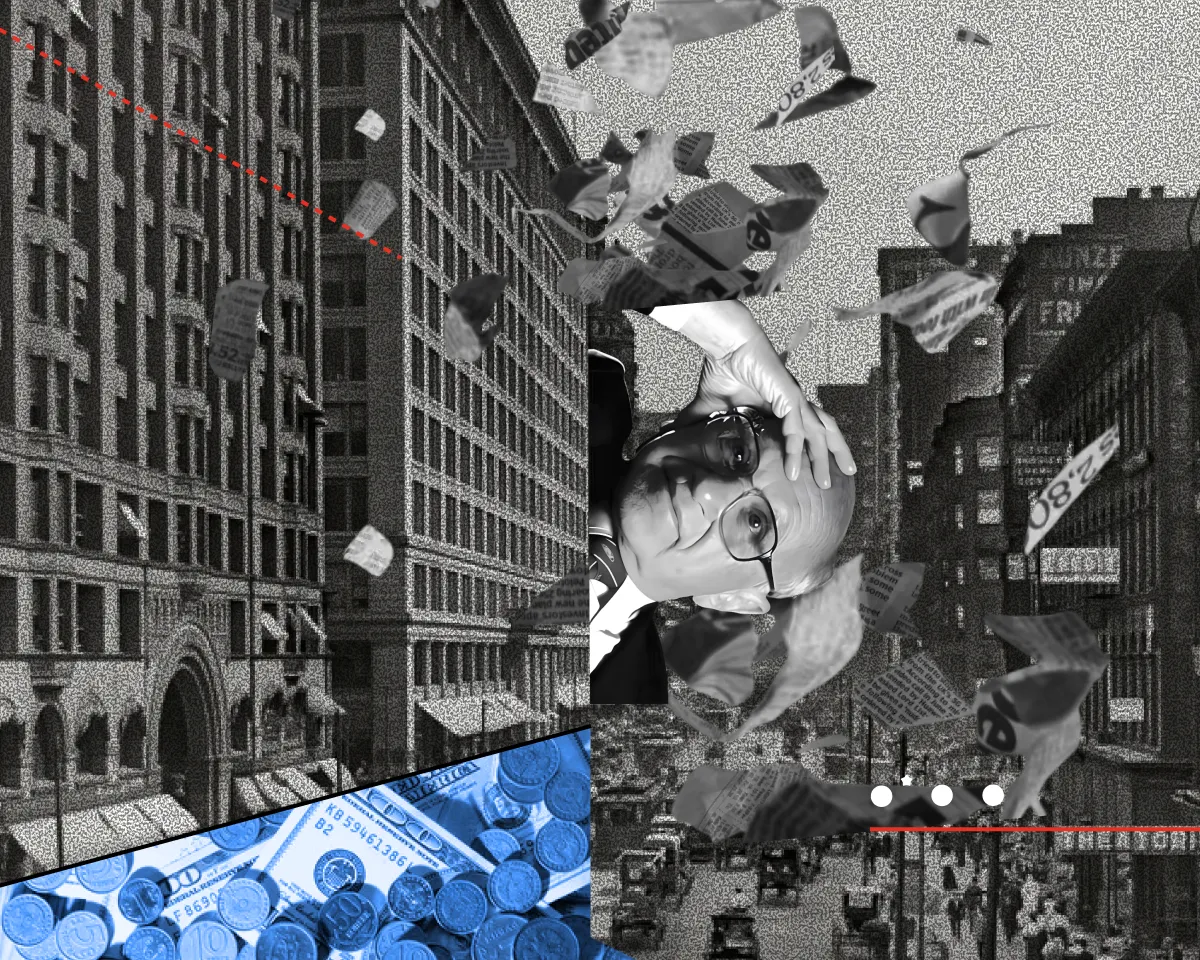
How markets became dogma—and then cracked
Economics has its tales of triumph and failure, but few schools of thought have left as deep a mark as Chicago. In the 20th century its ideas captured the minds of politicians, economists and entire nations.
Yet critics, not only on the left but also among classical liberals, argue that the Chicago School monopolised economic theory, elevating the free market into a universal remedy for everything from dictatorships to poverty. Such dogmatism, they contend, helped usher in a series of crises whose consequences will linger for years.
ForkLog examines how Chicago became synonymous with neoliberalism, why it is criticised and what alternatives are proposed by adherents of more traditional liberal doctrines.
From Knight to Friedman: the making of an intellectual superpower
The Chicago School emerged in the 1920s thanks to Frank Knight, who saw the market not only as a mechanism of exchange but as a motor of individual freedom. Its true ascent came in the mid-20th century, when Milton Friedman, George Stigler and Gary Becker turned earlier insights into a full-fledged intellectual force that set the tone for global economics. Their ideas rested on three pillars:
- Monetarism. Friedman argued that economic stability is achieved by controlling the money supply (for instance, by fixing its growth at 3–5% a year).
- Rational expectations. Economic agents act on all available information, allowing markets to find equilibrium on their own.
- Critique of Keynesianism. Chicago economists rejected the ideas of John Maynard Keynes, deeming state intervention ineffective and harmful.
Stigler developed the theory of regulatory capture, showing how public institutions often serve business interests rather than society’s. Becker extended economic analysis to social realms such as crime and education. Unlike the Austrian School, which insisted on the subjective theory of value, Chicago leaned on rigorous mathematical models and empirical data.
After the Great Depression and the second world war, when interventionist Keynesianism became dominant, Chicagoans had to respond. Many economists, disenchanted with the supposed omnipotence of markets, saw the state as a potent tool for tackling large-scale problems. Keynesian ideas, complex and contradictory at birth, were streamlined by economists at Harvard and MIT into mathematical models that underpinned practical advice.
According to David Colander and Craig Friedman—the authors of Where Economics Went Wrong: Chicago’s Abandonment of Classical Liberalism —in defending the market the Chicago School drifted away from the methodology of classical liberalism, sacrificing scientific objectivity to advance overtly political ideas.
Chicagoans saw Keynesianism and flirts with collectivism as threats to a free society, which to them justified an uncompromising stance. Debates at the school were conducted with “pit-bull ferocity”, and Stigler even proposed dropping the history of economic thought from curricula so that young economists would not question market principles.
This approach helped shift Chicago’s ideas from the fringes to the mainstream. A key moment was Friedman’s article The Methodology of Positive Economics (Methodology of Positive Economic Science), in which—borrowing Keynes’s distinction—he excluded from analysis the the ‘art of economics’, claiming that policy disputes could be settled within strict science.
The school’s ideas resonated with leading politicians. In the 1980s Ronald Reagan in the United States and Margaret Thatcher in Britain enacted Chicagoan principles: deregulation, privatisation and tax cuts. Strong growth burnished the school’s reputation. Chicago economists became stars, advising governments and setting the tone of academic debate.
But, as Colander and Friedman note, the school turned the market into dogma and economics into ideology. Much as Freudianism, in the words of French psychoanalyst Florent Gabarron-Garcia, shifted from a method of inquiry into a “religion”, Chicago promoted the market as a universal fix, brooking no doubt. That broke with the classical liberalism of John Stuart Mill, which married support for markets with concern for social values and justice. Critics say the loss of that balance still distorts economic science.
Neoliberalism in practice: Chile, Thatcher and global reform
The Chicago School tested its ideas in the real world, and its influence spread far beyond academia. One emblematic case was Chile under Augusto Pinochet. University of Chicago alumni, dubbed the “Chicago Boys”, implemented monetarist policies, privatisation (including a unique pension system based on private funds) and deregulation.
On paper the results impressed, showing steady development and macroeconomic stability. But behind the headline figures lay widening inequality, poverty for a large share of the population and social tension. Reforms ignored local context, producing mixed outcomes.
In Thatcher’s Britain, Chicagoan ideas underpinned the privatisation of state firms and the curbing of trade unions. Efficiency rose, but industrial regions withered and social stratification deepened. The promised prosperity accrued to the few while the working class slid into crisis.
Globally, Chicago’s principles were embedded in the Washington Consensus, promoted by the IMF and the World Bank. Market liberalisation, cuts to public spending and openness to foreign capital became standard prescriptions for developing countries. Negative episodes soon followed:
- Russia in the 1990s. “Shock therapy” and opaque privatisation led to economic chaos, the political rise of oligarchs and soaring inequality. Weak institutions could not support market reforms;
- The Asian crisis of 1997–1998. IMF policies, rooted in Chicagoan principles, deepened downturns in South-East Asian countries such as Thailand and Indonesia by discounting the peculiarities of local financial systems.
There were successes, too. The deregulation of US airlines in 1978, inspired by Chicago, cut fares and boosted competition, making flying cheaper. Yet such examples did not win over the school’s detractors.
The critique of dogma: where markets fell short
Critics of the Chicago School, including Nobel laureate Joseph Stiglitz and the “modern Marx” Thomas Piketty, point to its excessive faith in market rationality and its neglect of real-world frictions. Stiglitz emphasised that information asymmetry—when one party to a transaction knows more than the other—renders markets imperfect and calls for public oversight. In Capital in the Twenty-First Century and Capital and Ideology, Piketty showed that neoliberal reforms amplified inequality by concentrating wealth in few hands.
The Turkish economist Dani Rodrik has also criticised Chicago’s universal recipes for ignoring local context, breeding instability in Latin America and Africa.
Another weakness is the neglect of externalities such as environmental damage. Left unregulated, the free market often shifts the costs of pollution onto society—painfully apparent in the 21st century amid mounting climate problems.
Behavioural economics, developed by Daniel Kahneman and Amos Tversky, punctured the notion of a fully rational agent, showing that market participants are swayed by emotions and cognitive biases. That undermined Chicago’s models, built on idealised assumptions.
The 2008–2013 recession was a culmination of global problems linked to neoliberal policy. Deregulation of financial markets, inspired by Chicagoan ideas, inflated a speculative bubble that burst across the world economy. The crisis showed that markets do not always self-correct and that the absence of oversight can be ruinous.
Trust in the school waned, opening the way to alternatives such as New Keynesianism and the aforementioned behavioural economics. Chicago underestimated the complexity of social systems; dogmatism left its theory vulnerable to real-world shocks.
Classical liberalism: the forgotten balance
Mill’s classical liberalism offered balance. The British thinker called economics a “moral science” that should guide markets to serve society rather than dictate to it.
He backed free markets but advocated progressive taxation, workers’ rights and social reforms to ease inequality. The state, for Mill, should act as an arbiter ensuring a balance between individual liberty and the common good.
The Chicago School discarded this complexity, making the market the sole yardstick of success. Colander and Friedman note that such simplification detached economics from human experience, fixating on abstract models. Classical liberalism, by contrast, recognises the importance of culture and society. Scandinavian democracies, for instance, successfully pair market economies with robust social protection, yielding high living standards and low inequality. These models show how Mill’s ideas can work today.
Debates about a universal basic income or stronger safety nets in the age of automation also echo the classical tradition. They highlight the need for flexibility and attention to vulnerable groups—traits Chicago’s approach lacked. Classical liberalism offers a more humanist alternative, combining markets with social responsibility.
Lessons for 21st-century economics
Today the Chicago School retains sway in microeconomics, but its monopoly over economic thought has ended. The 2008 financial crisis and the rise of inequality exposed the limits of its theories.
The contemporary mainstream is pluralist, combining market mechanisms, state regulation and interdisciplinary approaches such as behavioural economics.
The chief lesson of the Chicago School is the danger of dogma. Faith in markets as a universal solution resembled religious zeal, where doubt amounted to heresy. Economics in the 21st century demands flexibility, attention to human behaviour and focus on social and environmental challenges.
Classical liberalism, with its emphasis on balance, remains pertinent—a reminder that economics is not only equations, but a living system in which people play the central role.
Text: Anastasia O.
Рассылки ForkLog: держите руку на пульсе биткоин-индустрии!