




Building a cryptocurrency exchange or swap service is a complex undertaking that involves assembling a team, working with regulators and developing software: wallets, trading engines and KYC services.
The technical stack can be simplified with ready-made WL solutions. Together with the vice-president of the Estonian company Eqwali, Vyacheslav Khashchevoi, we explain how to integrate digital payments into a business and quickly launch a crypto service.
What you need to launch a crypto exchange
As a rule, a cryptocurrency swap service consists of the following modules:
- frontend. The graphical interface that provides users with information and tools to interact with the platform and execute exchange operations;
- core trading platform. Software for monitoring transactions and configuring cryptocurrency and fiat rates, fees and exchange routes. It maintains customer records and stores their identification data;
- crypto wallets. They can be external or internal, and are needed to receive, store and withdraw cryptocurrencies;
- fiat gateways. Any external payment systems, banks and payment institutions. Used for fiat deposits and withdrawals — via bank transfer, card or e-wallet;
- liquidity provider. Integration with a larger exchange where cryptocurrencies are purchased and positions hedged;
- remote verification solution. Implementation of KYC services for the legal provision of services;
- fraud/AML monitoring. This module can check clients against PEP and sanctions lists, and set rules and limits under which transactions are processed automatically or paused for manual review;
- reporting module. Provides data necessary for preparing documents — for clients, accounting, regulators and auditors;
- API module. Integration with other services such as SMS providers via the application programming interface (API).


A ready-made solution
According to Vyacheslav Khashchevoi, developing the infrastructure described above takes a great deal of time and resources. That is why both newcomers and established businesses seeking to add crypto support turn to WL solutions.
Two models are available: software as a service (SaaS) and deployment on the customer’s infrastructure.
“When launching a SaaS solution, all infrastructure is deployed on Eqwali’s servers and branded for the client. This is the faster and cheaper option.
In the case of a self-hosted option, the software is transferred to the client’s ownership and installed on their infrastructure. A huge plus for the customer is full control and autonomy in the project’s development. But there is a minus — a high upfront cost.
Getting a production project live can take from three weeks to several months — depending on the chosen solution, the set of integrations and individual requirements,” — explains Khashchevoi.
For clients who want to retain full control over crypto assets, Eqwali helps deploy self-managed wallet solutions.
“This is a fairly serious process that requires the customer to invest in their own servers and have competent specialists. But only in this way can you achieve autonomy in receiving, sending and storing client assets,” — notes Eqwali’s vice-president.
If rolling out an in-house wallet is too heavy an investment, Eqwali integrates its own custodial wallet, XooCash. The client keeps only the funds needed for operations there. Crypto assets above that threshold are automatically sent to the customer’s cold wallets.
Eqwali’s solution supports bitcoin (BTC), Ethereum (ETH), USDT (TRC-20 and ERC-20), Tron (TRX), Dogecoin (DOGE), Litecoin (LTC), Bitcoin Cash (BCH) and Dash (DASH).
“However, in practice the value of an exchange service depends less on the variety of cryptocurrencies than on the fiat on- and off-ramps in the countries it targets. Our company has extensive experience integrating various payment systems, as well as a large set of ready-made integrations,” — emphasizes Khashchevoi.
Eqwali offers an authentication system based on the OpenID standard to create a single account across several unrelated services. According to Khashchevoi, this allows users to switch seamlessly between multiple resources, and enables the client to develop an entire ecosystem rather than just a crypto swap service.
Eqwali integrations in practice
In 2024 the company delivered white-label solutions for Bpay and PayWRX.

Bpay (Moldova). Users can create wallets, buy/sell cryptocurrency for Moldovan leu and transfer it to external addresses.
“An interesting solution we managed to implement was embedding a crypto-exchange service into an existing e-wallet infrastructure, taking into account local legislation. Moldovan citizens can get a bank card, as well as exchange and store cryptocurrency in one app. The implementation took just over four months,” — comments Eqwali’s vice-president.
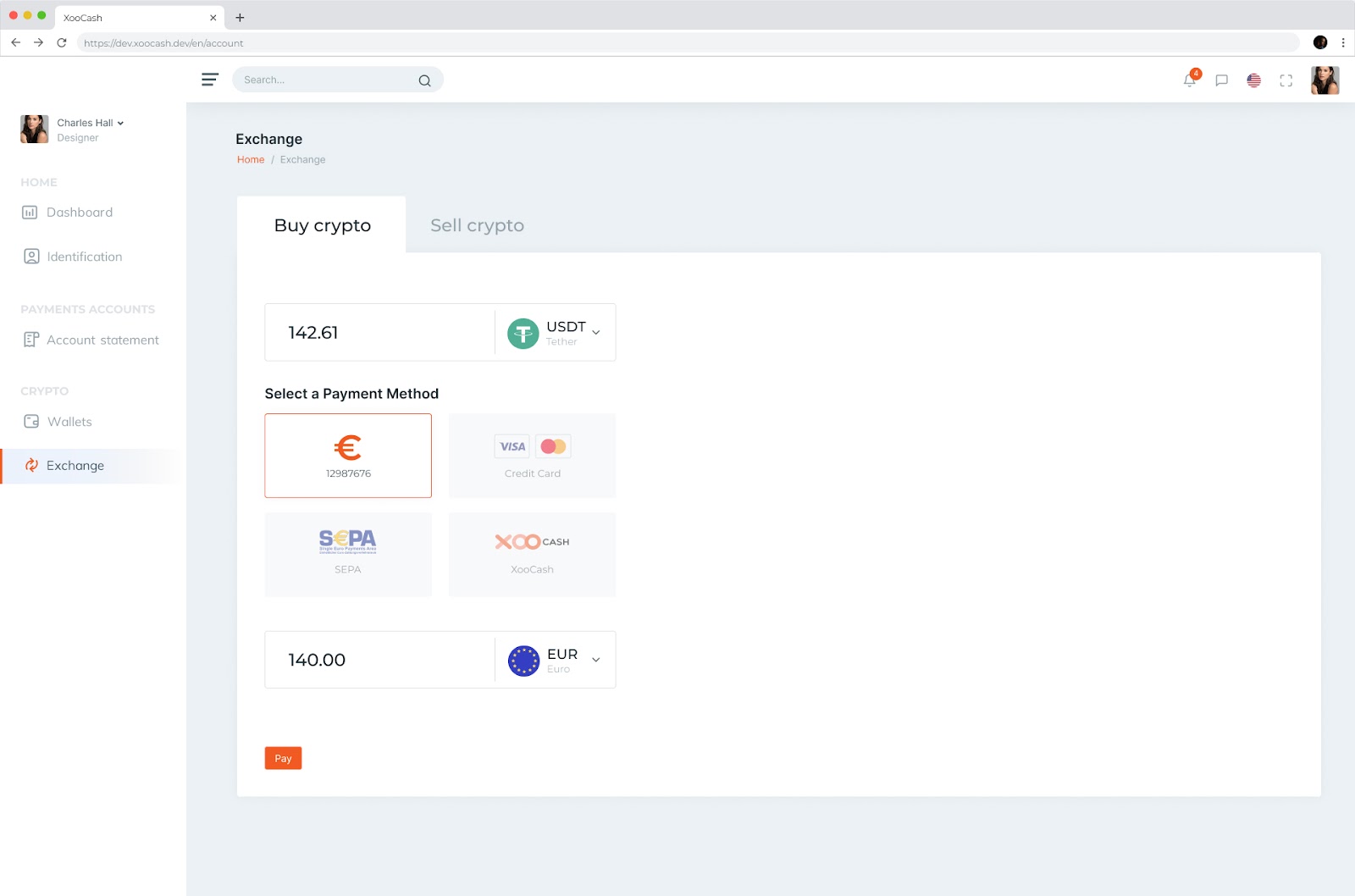
PayWRX (Canada). A comprehensive SaaS solution with support for KYC and SMS providers, Visa/Mastercard and SEPA, internal cryptocurrency wallets and fiat accounts.
“Eqwali is an IT company that proved itself not only at the project’s launch, but also constantly supports and develops its product, implementing enhancements for our specific requirements,” — says PayWRX president Alexey Telepna about the integration.
The project has been operating for five months and targets businesses that need cryptocurrency services.
Conclusions
Implementing digital payments and launching a cryptocurrency exchange/swap service requires complex software composed of several interconnected components: wallets, APIs for integrating KYC services and other systems.
You can build it in-house or turn to companies such as Eqwali for a white-label solution. The latter option simplifies and accelerates setup and also minimises the likelihood of errors that could lead to losses or the loss of client funds.