



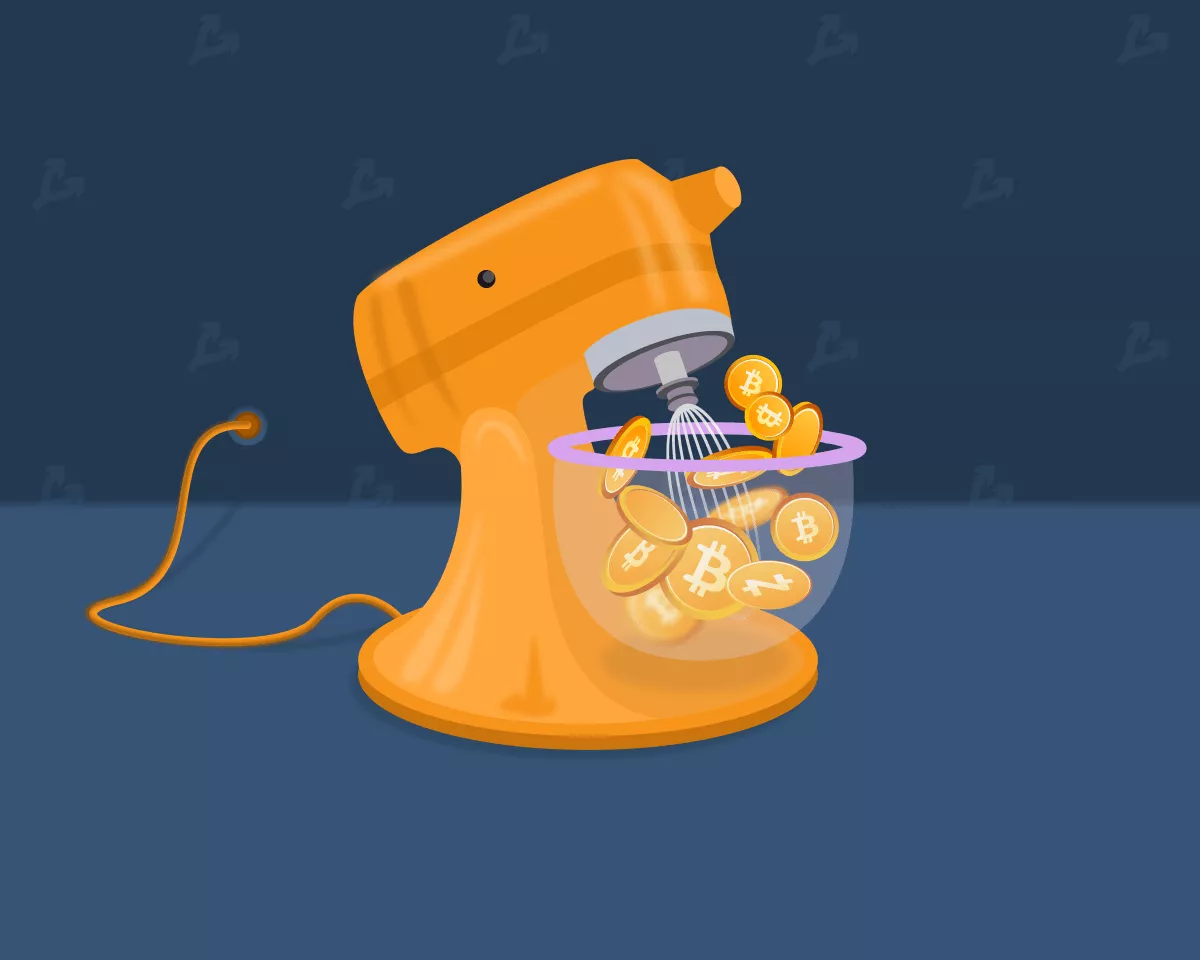
An annual ForkLog survey showed that 14.5% of readers want to use bitcoin mixers but do not understand how they work. At first glance, bitcoin mixing seems complex: taint analysis, clusters, analysis of similar volumes… In fact, it is simpler: mixers swap your bitcoins for coins belonging to other users.
Together with the bitcoin mixer Mixer.Money, we explain coin mixing: what it is for, how it works, and how much it costs.
How scammers locate wallet owners
Bitcoin are stored on the blockchain as UTXOs (Unspent Transaction Outputs).
UTXOs are like banknotes: 1 BTC in a user\’s wallet may consist of ten UTXOs of 0.1 BTC, two UTXOs of 0.5 BTC, or any other combination of UTXOs.
When a user sends bitcoins, the network creates new UTXOs.
Example: Alice has 1 BTC stored as a single UTXO. She sends Bob 0.3 BTC. The network creates records for two new UTXOs:
- UTXO2 for 0.3 BTC. They now belong to Bob;
- UTXO3 for 0.7 BTC. These coins returned to Alice.
Blockchain explorers such as Blockchain.com automatically process records of UTXO creation. From this data they establish the transaction trail that the bitcoins have passed through.
Because of UTXOs, attackers can trace transaction chains, determine the wallet owner\’s identity, and then blackmail them or steal bitcoins using social engineering.
Simple bitcoin mixing
Bitcoin mixers cleanse users\’ bitcoins: they mix UTXOs to break the sender-to-recipient chain. As a result, attackers cannot trace the real origin of the transaction.
Typically, mixers offer several coin-mixing modes. They differ in cost, the duration of the coin-cleaning process, and the level of protection against blockchain analysis.
Mixer.Money mixes coins in three modes: \’Mixer\’, \’Full anonymity\’ and \’Exact payment\’.
The \’Mixer\’ mode provides basic anonymity — protects against manual transaction analysis. The service fee for mixing is 1–1.5% of the transfer amount plus 0.00035 BTC. Mixing takes about two hours.
When users send coins to the Mixer.Money address, they enter the premixer. The premixer breaks the users\’ UTXOs into pieces to better mix the transactions. This can be likened to breaking large banknotes into smaller ones.
Example of simple coin-mixing: Alice sends 1 BTC to the mixer and specifies Bob\’s address. The mixer takes Alice\’s UTXO, withholds the fee, and sends Bob UTXOs from other users in the premixer. The Bitcoin network records that Bob received 0.99 BTC, which previously belonged to several unrelated addresses.
The \’Mixer\’ mode has drawbacks:
- it does not protect against advanced blockchain analytics such as taint analysis. Under such an approach, services look for pairs of transactions with similar amounts and timing. The first transaction—the user sent bitcoins to the mixer. The second—the mixer sent clean bitcoins to a new user wallet;
- the user risks receiving dirty bitcoins tied to hacks and fraud. Large exchanges may block deposits or request the user\’s Bitcoin history.
Complex bitcoin mixing
In the \’Full anonymity\’ mode, Mixer.Money sends the user \’clean\’ bitcoins from major exchanges.
For better mixing, the user receives coins at two addresses. For example, when mixing 1 BTC, the service will send 0.242 BTC to one address and 0.745 BTC to the other. Mixer.Money randomly selects the sending times and the ratio of transaction amounts to complicate cluster analysis and taint analytics.
Cluster analytics services track UTXOs belonging to different addresses that ended up in one transaction — a cluster. Most likely, the transactions involving different UTXOs were signed by a single owner. Analytics services check the addresses in the cluster for a transaction sent from a verified crypto exchange account. This is how they identify the owner of the main wallet.
Taint analytics services check addresses linked by chains of transactions. Simple mixing does not protect against such analysis. After thorough cleaning, the analytics service will not find a link between the sender and recipient of bitcoins.
The cost of coin cleaning in \’Full anonymity\’ mode consists of two parts:
- transaction fees — 0.0007 BTC;
- mixer service fee — 4–5% of the transaction amount. The service selects a random percentage from this range to complicate the analysis of similar volumes.
Example of complex coin-mixing: Alice sends 1 BTC to Mixer.Money and specifies two addresses for returning coins. The service sends Alice\’s UTXOs to the premixer to mix them with bitcoins from other users. Then Mixer.Money transfers the mixed coins to an exchange and returns to Alice the \’clean\’ bitcoins from investors\’ wallets.
In \’Exact payment\’ mode, the user also receives coins from investors to two addresses. He can choose the amount to send to the first wallet. Mixer.Money deducts the mixing fee from the transaction to the second address.
Are bitcoin mixers safe to use?
Bitcoin mixers do not store user data and automatically delete information about requests. In addition, Mixer.Money generates a new bitcoin address for each request to reduce the effectiveness of taint analysis.
Mixer.Money checks random UTXOs for internal statistics. According to the service, less than 10% of transactions are linked to illicit activity. The remaining transactions are sent by users who want to maintain the anonymity of their Bitcoin addresses.
Often, mixers merely mix UTXOs in the premixer, and users risk receiving their own coins back. In the \’Full anonymity\’ and \’Exact payment\’ modes, Mixer.Money sends users \’clean\’ bitcoins that have passed checks on exchanges.
In these modes, the service obtains cryptocurrency via the Jambler.io platform. It purchases bitcoins from exchange users and passes the coins to partner mixers. Investors receive bitcoins from the premixer and 1% of the sale amount.
Conclusion
Mixers help holders of Bitcoin preserve their anonymity. With them, investors can cash out bitcoins while keeping their main address private.
Such services take on the technical complexities. The user only needs to enter the recipient address to receive coins and send bitcoins.
The only drawback of bitcoin mixers is the slow coin-cleansing process. When sending bitcoins to an exchanger via a mixer, make sure the order for the exchange will be active for at least six hours.
Subscribe to ForkLog news on Telegram: ForkLog Feed — all the news feed, ForkLog — the most important news, infographics and opinions.