



Hyperliquid Surpasses $4 Trillion Milestone and Launches Prediction Market Testing
Hyperliquid's trading volume surpasses $4 trillion; prediction markets tested.
The cumulative trading volume of perpetual futures on the Hyperliquid platform has exceeded $4 trillion. It took the project three years to reach this milestone.
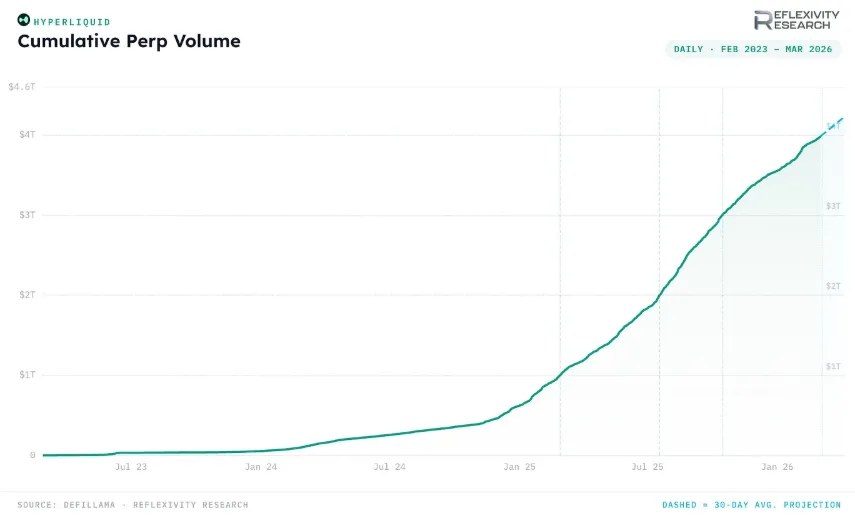
The growth rate of volumes is accelerating. The first trillion dollars took the exchange 733 days, the second 141 days, the third just 88 days, and the fourth was reached in 141 days.
The buyback volume of the Hyperliquid Assistance Fund surpassed $1 billion 15 months after the launch of the HYPE token. The project has permanently removed 41.71 million coins from circulation, accounting for 4.17% of the total issuance. At the current rate, these assets are valued at $1.35 billion.
Analysts at Reflexivity Research highlight the effectiveness of the platform’s cyclical tokenomics: increasing trading volumes generate more fees, which are directed towards buybacks and asset burning. This steadily reduces the market supply of HYPE.
Launch of Prediction Markets (HIP-4)
Developers at Hyperliquid have launched the HIP-4 protocol in testnet, with prediction markets as the main innovation. In the initial phase, users have access to binary options on basic HyperCore prices.
The new contracts have an expiration date, are fully collateralized, and operate within a fixed price range without leverage and liquidation risks.
The system architecture supports markets with multiple outcome options. However, upon mainnet launch, developers will limit themselves to one-day binary options on Bitcoin and the HYPE token.
The main goal of the current phase is to verify technical reliability, debug smart contracts, and settlement processes. The API for the launched markets operates similarly to the spot market, and the relevant documentation has already been published.
The team has urged the community to test the protocol and report any bugs found.
HYPE at $150
Former BitMEX CEO Arthur Hayes believes that by August, the price of the HYPE token could rise from the current levels of around $34 to $150. He sees the main growth driver as the liquidity shift from centralized exchanges (CEX).
To achieve this goal, Hyperliquid’s projected annual revenue must jump from March’s $843 million to $1.4 billion. According to Hayes’s calculations, the target is achievable: the platform needs to “capture” an additional 4% of the derivatives market from CEX, in addition to the current 6%.
The token’s price is also supported by the built-in economic model—Hyperliquid directs 97% of its income to buy back HYPE from the open market. Increasing trading activity directly transforms into demand for the coin.
Democratization of TradFi
Hayes noted the popularity of macroeconomic instruments. Amid growing demand for traditional assets, the daily trading volume of perpetual contracts on oil (CL-USDC) on the platform exceeded $1.29 billion. The instrument surpassed the ETH-USDC pair ($1.24 billion) in volumes.
Contracts based on oil, gold, silver, and US stock indices already generate about 10% of Hyperliquid’s revenue. Hayes expects that further development of this segment will increase the exchange’s income by 160% in the coming months.
Technical Analysis and Unlocking Consequences
The family fund Maelstrom, associated with Hayes, previously accurately predicted a drop in HYPE’s price due to the unlocking of tokens worth $11.9 billion. Since then, the asset has depreciated by about 40%.
From a technical analysis perspective, a “cup and handle” pattern is forming on the daily HYPE chart. A confident breakout of resistance at $35.5 opens the way to a short-term target of $50.
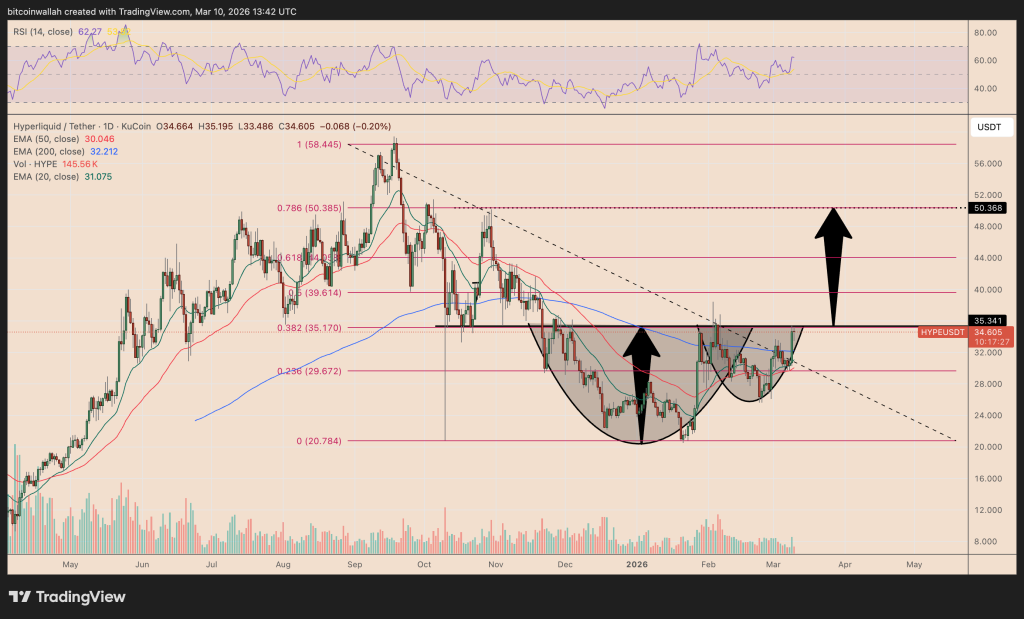
If buyers fail to maintain momentum, the price may retreat to support around $30. Here lies the 0.236 Fibonacci level and the 50-day exponential moving average.
Earlier, on March 9, an analyst known as Darkfost described the rise in oil as an unfavorable factor for the leading cryptocurrency.
Рассылки ForkLog: держите руку на пульсе биткоин-индустрии!