



IBM Declares the Dawn of Practical Quantum Computing
Quantum computing is moving from labs to real-world applications.
Quantum computing is transitioning from laboratory experiments to real-world applications, according to Petra Florisoon, IBM Quantum’s Global Sales Director, as reported by Maeil Business.
At the IBM Quantum Connect APAC conference in Seoul, she confirmed plans to achieve the first verified instances of quantum advantage by the end of 2026.
Florisoon also announced the development of a large-scale fault-tolerant quantum computer, IBM Quantum Starling, by 2029. It will be capable of executing quantum circuits involving 100 million gates on 200 logical qubits. The system is being developed at a facility in Poughkeepsie, New York.
After 2033, the company plans to transition to the Blue Jay device with 2000 logical qubits and 1 billion operations.
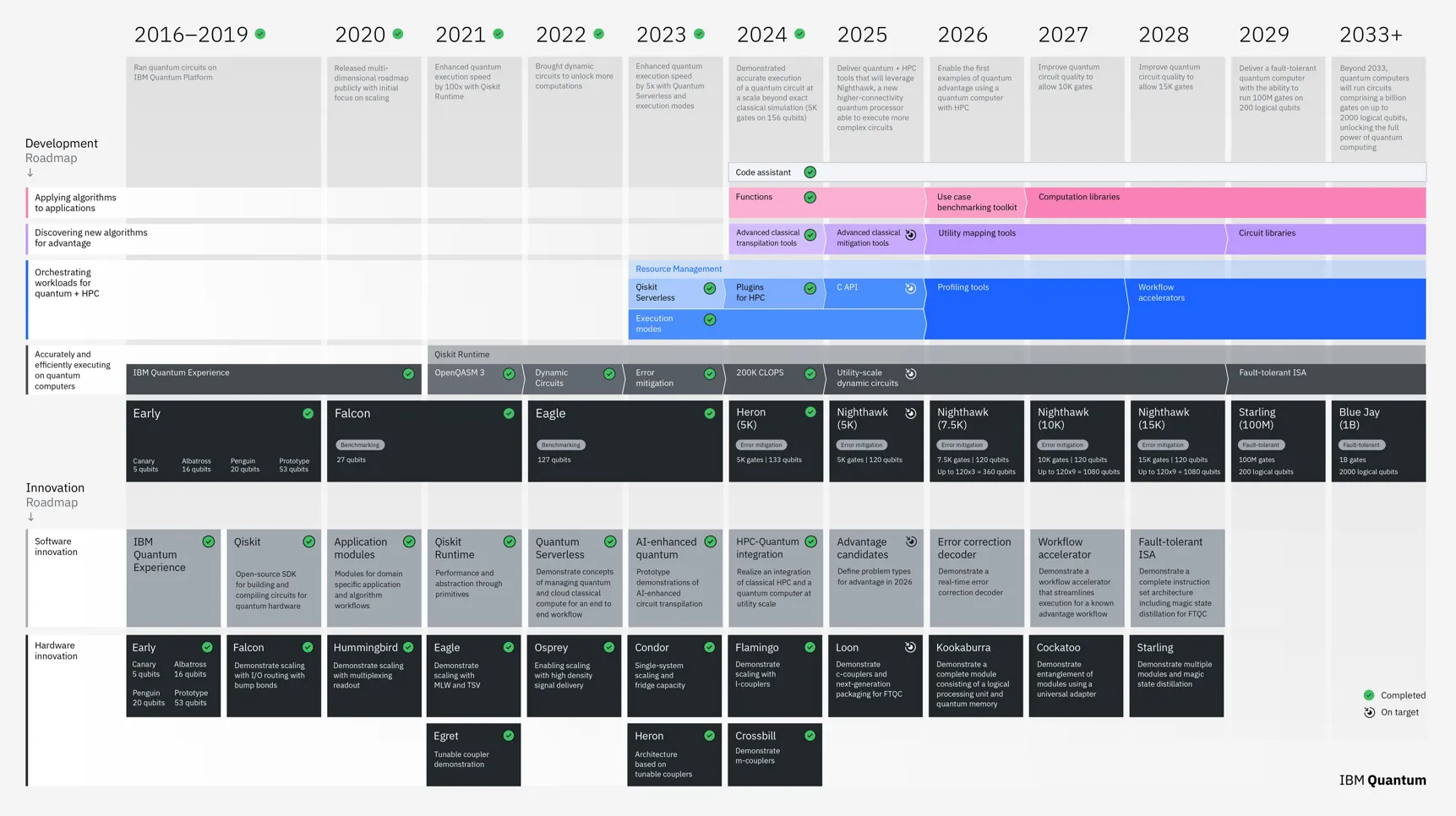
According to Florisoon, quantum computing is “no longer a technology of the future.” IBM is currently promoting the concept of “quantum utility”—a stage where such systems provide practical benefits to businesses and research centers, although they do not yet surpass classical computers in all aspects.
The next stage is quantum advantage—a situation where such a computer solves a problem faster, cheaper, or more accurately than classical methods.
As a prime example, the company cited a joint project with Cleveland Clinic, RIKEN, and IBM. Researchers modeled a protein-ligand complex consisting of 12,635 atoms. The company claims this is the largest heterogeneous quantum-classical electronic structure calculation to date.
The calculations used two IBM quantum computers and two supercomputers. The work simultaneously involved a QPU, CPU, and GPU.
This allowed them to:
- scale the system by 40 times;
- increase accuracy by 210 times;
- utilize up to 94 qubits.
Another case involves Australia’s Q-CTRL. The company claimed it completed a materials science task on the IBM Quantum platform more than 3000 times faster than the classical approach.
The quantum algorithm completed the task in about two minutes, whereas the classical calculation took over 100 hours. There is no independent verification of these data yet.
International Partnerships
IBM has paid special attention to Asian infrastructure. Since November 2024, IBM Quantum System One with a 127-qubit Eagle processor has been operational at Yonsei University in South Korea. The company describes the system as part of the national research infrastructure in quantum technologies.
In Japan, the firm collaborates with the RIKEN institute. In 2025, the partners integrated the Fugaku supercomputer with IBM Quantum System Two, featuring a 156-qubit Heron processor.
RIKEN described the project as the first deployment of IBM Quantum System Two outside North America.
In May, Saudi Aramco and Pasqal launched access to the first quantum computer in Saudi Arabia and introduced the Quantum Computing as a Service platform.
Рассылки ForkLog: держите руку на пульсе биткоин-индустрии!