



Since the December 2024 agreement with the IMF on a credit program, El Salvador’s government has not purchased the leading cryptocurrency. This is stated in a report by the international organization.
According to the document, the government wallet Chivo “does not adjust its bitcoin reserves in line with changes in client deposits.” Since the app does not sell assets, this leads to “insignificant” discrepancies (no more than 1%), creating the impression of cryptocurrency accumulation by the country’s public sector, noted the Fund’s experts.
The Latin American government plans to obtain a $1.4 billion loan from the IMF under a 40-month program. With additional financing from the Inter-American Development Bank and other regional structures, the total package could exceed $3.5 billion.
As part of the agreements with the Fund, El Salvador’s authorities committed to adjusting the existing bitcoin strategy. In January, lawmakers made the necessary changes to regulations, which included:
- the government’s withdrawal of support for the Chivo wallet;
- payment of taxes only in US dollars;
- restriction of digital gold transactions for the public sector;
- voluntary acceptance of cryptocurrency payments for private entities.
However, contrary to the agreement, the country continued to accelerate its cryptocurrency reserves, according to the head of the National Bitcoin Office, Stacy Herbert. At that time, the authorities held 5980.8 BTC.
In May, the IMF warned the government to cease cryptocurrency purchases, stating a “staff-level agreement” had been reached.
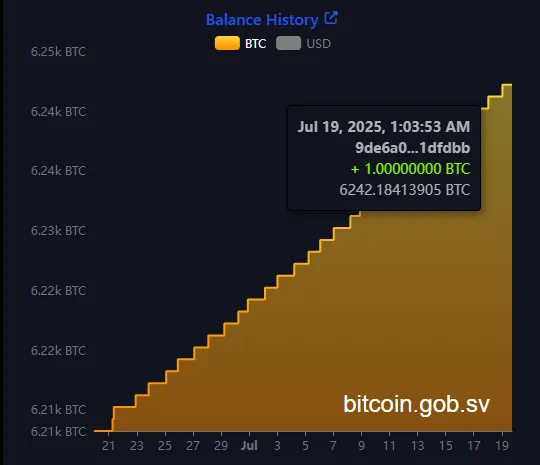
Meanwhile, according to data from the Bitcoin Office, digital gold inflows continued regularly. On July 19, the authorities added another 1 BTC to the balance, bringing the reserves to 6242 BTC.


The IMF report includes a letter of intent dated June 11 addressed to IMF head Kristalina Georgieva. In the message, El Salvador’s Central Bank President Douglas Pablo Rodriguez Fuentes and Finance Minister Jerson Rogelio Posada Molina assured:
“In accordance with program commitments, the stock of bitcoins held by the public sector remains unchanged, and we are taking steps to reduce fiscal risks by scaling back the role of the Chivo wallet and rethinking the BTC project.”
Since 2021, El Salvador has been mining the leading cryptocurrency at a state geothermal power plant. The initiative was launched in a test mode about a month after the law recognizing bitcoin as legal tender came into effect.
In June 2023, the authorities announced the Volcano Energy project with a capacity of 241 MW, which envisaged the use of renewable energy sources for mining digital gold. One of the investors was Tether, the company behind the USDT stablecoin.
In May 2024, it was revealed that the enterprise had produced a total of 473.5 BTC.
In October 2023, El Salvador announced the launch of its own mining pool, Lava Pool.