




Stablecoins pegged to the US dollar “stablecoins” could accelerate the process of dollarization in countries with high inflation, undermining central banks’ control over capital flows, according to a report by the IMF.
The cross-border nature of stablecoins could simplify remittances and payments but also complicate monetary policy and financial stability in emerging markets. A new IMF report explores the challenges and opportunities. https://t.co/eVss5tPsFn pic.twitter.com/ERq3MwxPTz
— IMF (@IMFNews) December 4, 2025
Experts believe stablecoins could hasten the abandonment of national currencies by the public and businesses in countries with unstable economies.
“Stablecoins could accelerate dollarization, increase capital flow volatility by bypassing established restrictions, and fragment payment systems into isolated segments if technical compatibility is not ensured,” the document states.
The risk is particularly high in countries experiencing a crisis of confidence in the local financial system. In such conditions, fiat-pegged digital assets can quickly transform from a means of settlement into a full-fledged alternative to the national currency.
The warning comes amid the active growth of the stablecoin sector. The report’s authors noted that since 2023, the capitalization of the two largest coins — USDT and USDC — has tripled, reaching a combined total of $260 billion.
Trading volume soared to $23 trillion in 2024.


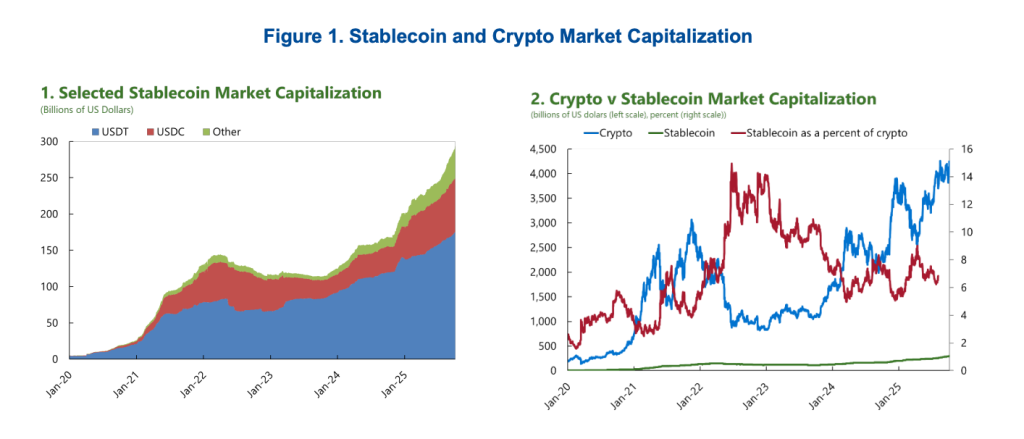
The geography of stablecoin use is uneven. Asia has become the absolute leader in transaction volume.
However, relative to the size of the economy, these assets are most actively used in Africa, the Middle East, and Latin America—regions historically prone to dollarization and the replacement of national currencies.
Potential and Risks
The IMF also acknowledged the positive potential of the technology. In many developing countries, digital services are being adopted faster than traditional banking.
Analysts believe that with proper regulation, stablecoins can:
- enhance competition in the financial market;
- reduce costs for transfers and payments;
- increase the accessibility of financial services.
However, these advantages come with macro-financial risks. The main threat is the potential for mass exodus from assets.
User doubts about the backing of stablecoins could trigger avalanche-like sell-offs. To meet obligations, companies would be forced to urgently sell their assets (often government bonds), which could cause turmoil in global financial markets.
The pseudonymous cross-border nature of stablecoins could also weaken capital flow controls, facilitate illegal financing, and degrade the quality of macroeconomic data. The global distribution of holders, often unknown due to non-custodial wallets, complicates crisis monitoring and the development of regulatory measures.
A Challenge for Regulators
Regulation of the sector is becoming clearer but remains inconsistent. The IMF report compared approaches in Japan, the US, the EU, and the UK, revealing differences in almost all areas—from issuer and reserve requirements to the admission of foreign players.
Such fragmentation encourages regulatory arbitrage: companies choose jurisdictions with the most lenient rules. This creates unfair competition and reduces the effectiveness of sector oversight.
The Fund concluded that stablecoins are “a phenomenon that will be with us for a long time.” However, whether they become a source of stability or a risk factor depends directly on the global community’s ability to develop unified standards.
In late November, the Bank for International Settlements warned of financial risks due to RWA.