


Impact of the Federal Reserve’s March Rate Decision on the Cryptocurrency Market: Expert Insights
Historically, Bitcoin has shown an inverse relationship with the Federal Reserve’s base rate. Analysts predict that the upcoming meeting of the regulator on March 20 could pose a significant barrier to the growth of the cryptocurrency market.
In comments to ForkLog, experts explained the macroeconomic pattern and shared their forecasts.
The Rate and Bitcoin
U.S. monetary policy has long influenced the digital asset industry. During its tightening in 2018, Bitcoin underwent a correction. A similar price relationship was observed during the bear market of 2022-2023.
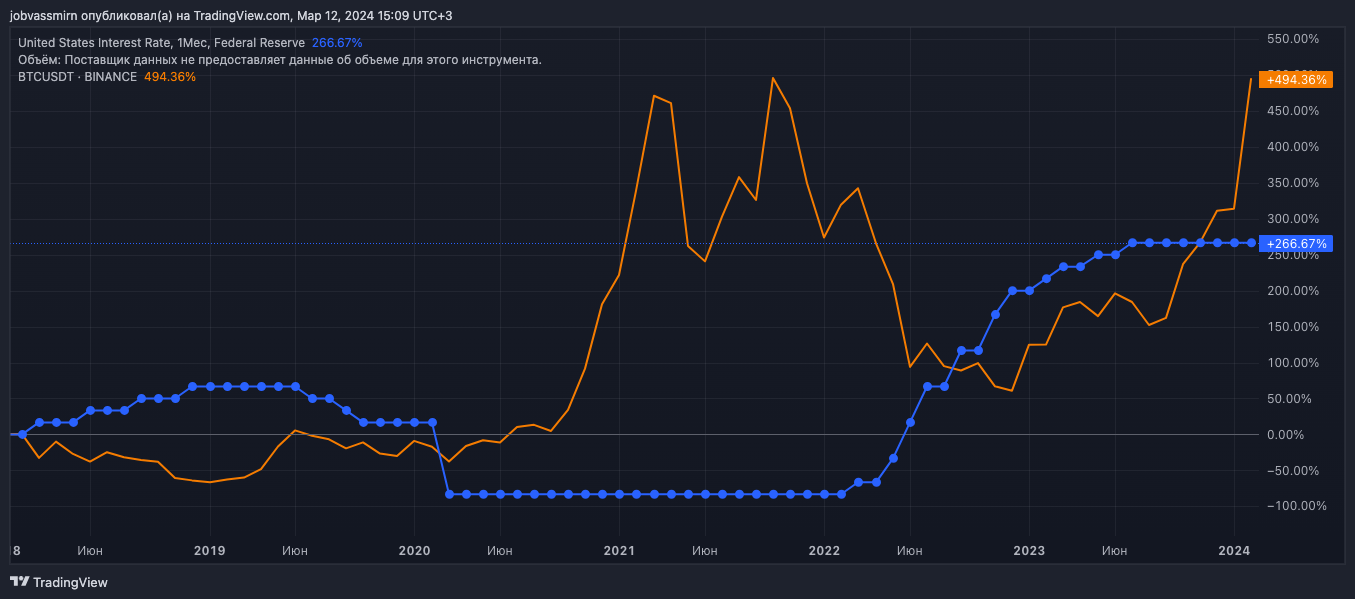
It can be concluded that a low key rate encourages investments in riskier assets like the leading cryptocurrency. Consequently, an economic recession and subsequent rate hikes prompt market participants to shift towards more traditional safe instruments.
“Bitcoin’s price is closely correlated with liquidity volume and borrowing costs, as it is essentially a risky asset. The more liquidity and cheaper money, the faster risky assets grow,” explained trader Vladimir Cohen.
However, recent macroeconomic data releases have not significantly impacted the digital gold’s quotes. February’s slower-than-expected inflation led to a shift in expectations for the Fed’s rate cut from May to June. Bitcoin temporarily corrected by 3% but quickly regained its previous levels.
According to Cohen, the leading cryptocurrency already demonstrated an “anomalous situation” last year, maintaining positive dynamics despite the tight monetary policies of most central banks.
This is attributed to large institutional investor purchases ahead of the launch of spot Bitcoin ETFs in the U.S. The cryptocurrency rose on expectations of high demand, the expert added.
“The Fed is expected to start lowering the rate, so investors are gradually shifting from conservative instruments to risk. Moreover, this coincided with the ETF launch and the upcoming halving. In other words, there is currently a combination of factors that have influenced the cryptocurrency market and will continue to do so,” added trader Artem Zvezdin.
Future Fed Policy
Most market participants agree that the Fed will leave the key rate unchanged following the March meeting, emphasized Anton Toroptsev, regional director of the CommEX exchange in Russia and the CIS.
“The American economy shows no signs of recession: the labor market is steadily improving, and inflation is gradually declining. However, since consumer price growth has not yet reached the target 2%, the Fed prefers not to rush with easing monetary policy,” he explained.
As of February, the U.S. consumer price index rose from 3.1% to 3.2%. With the regulator’s target values still distant, Toroptsev believes that a rate cut is likely to occur in June or, less likely, in May.
“A rate cut will positively impact Bitcoin, as its price is now supported by demand for spot Bitcoin ETFs. As a risky asset, they will only benefit from a credit policy easing, as bond yields will decrease after the rate cut, and capital will start flowing into riskier and more profitable stocks,” stated the top manager.
According to the Fed’s own statements, three rate cuts are planned for 2024, but participants in the American market hope for four, the speaker noted.
They may be spread out over time to allow the regulator to assess the impact on the economy. Therefore, one of the cuts should occur in the first half of the year.
“Since few expect a rate cut following the March meeting, this event will not have a strong effect on Bitcoin’s price. However, there may be a period of increased volatility during the [Fed] meeting and the announcement of the decision,” added the regional director of CommEX.
Given the current situation, there is a possibility that the rate will not be lowered in June, and the Fed will continue tightening monetary policy, Cohen believes. In this case, Bitcoin’s growth will halt, and there will be a risk of a significant correction in the cryptocurrency market.
Medium-term Prospects
Zvezdin is confident that a rate cut will enhance the positive dynamics of cryptocurrencies. Moreover, growth in the current bull cycle will be “faster and more powerful,” with a peak for Bitcoin at $200,000.
According to Cohen, no rate cuts are expected in March and May, but this is already priced into the leading cryptocurrency:
“The market consensus implies the first policy easing in June. The industry will closely study and react to the comments of Fed members after the meeting.”
Toroptsev emphasized that Bitcoin and the cryptocurrency market do not exist in a vacuum and are linked to the state of the global economy. Significant shocks affect the digital gold’s price, so the correlation with the stock market will persist.
However, Toroptsev noted that due to the similarity between Bitcoin and gold, in the event of economic downturns, the former will be able to recover faster and transition to growth as an analogue of a safe-haven asset.
“Everyone is now waiting for the April halving, after which a period of volatility may occur, with Bitcoin’s price range significantly widening. Quotes may drop by 20%, and then, judging by historical data, a phase of more stable growth will begin,” suggested the regional director of CommEX.
Toroptsev also considered an alternative scenario without a significant drop due to spot Bitcoin ETFs. Demand from funds will support the cryptocurrency’s price and prevent it from fluctuating significantly.
An indirect influence on Bitcoin will also come from the SEC‘s decision on applications to launch ETH-ETFs. If approved, this will boost the already high optimism in the cryptocurrency market and trigger a new wave of growth, the expert concluded.
Analysts at Coinbase have pointed out risks to Bitcoin’s further growth, highlighting the Fed’s policy and the halving among them.
JPMorgan has also predicted a correction of the leading cryptocurrency to $42,000 following the reduction of miners’ rewards.
Рассылки ForkLog: держите руку на пульсе биткоин-индустрии!