




The Reserve Bank of India (RBI) has advised the government to include a proposal for linking the CBDCs of BRICS member countries in the summit agenda. This was reported by Reuters, citing its own sources.
The initiative aims to simplify cross-border trade and payments in tourism and could reduce dependence on the US dollar.
The next BRICS summit will be held in India this year. The organization comprises ten countries, including the original five members: Brazil, Russia, India, China, and South Africa.
Journalists noted that the intention to bypass the dollar might provoke dissatisfaction from the US administration, which has already warned against such attempts. President Donald Trump previously labeled the alliance as “anti-American” and threatened to impose additional tariffs.
The RBI’s proposal is based on a declaration adopted at the 2025 BRICS summit in Rio de Janeiro. The parties emphasized the need to ensure payment system compatibility to enhance mutual trade efficiency.
The Russian Ministry of Finance announced the development of the BRICS Bridge platform for settlements in national currencies, including digital ones.
China-Led CBDC Payment Solution Expands 2,500-Fold
All major members of the bloc are implementing national digital currency projects, but China has made the most progress with its e-CNY.
According to the Atlantic Council, digital yuan transactions have surged over 800% since the pilot’s launch in 2023, exceeding $2.3 trillion.


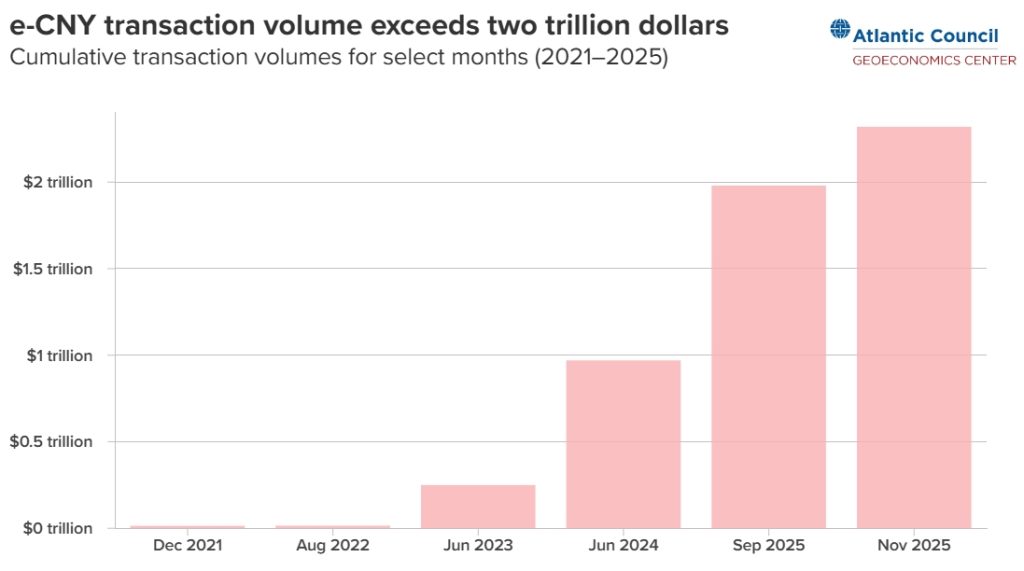
To expand the asset’s domestic use, Beijing employs a strategy combining interest income and functionality similar to stablecoins, while maintaining sovereignty and regulation.
At the wholesale level, China continues to develop the mBridge platform project—a solution for cross-border CBDC payments. The initiative was initially launched by the Bank for International Settlements (BIS) Innovation Hub. Participants included regulators from China, Hong Kong, Thailand, the UAE, and Saudi Arabia.
During initial experiments, mBridge processed only 164 transactions totaling about $22 million. In October 2024, BIS exited the project.
Since then, activity on the platform has surged. Under the guidance of partner central banks, mBridge conducted over 4,000 cross-border transactions worth ~$55.49 billion. This represents a growth of more than 2,500 times compared to 2022.
The digital yuan accounts for 95.3% of the total transaction volume.
“Collectively, these events indicate a gradual expansion of yuan internationalization through digital infrastructure. […] The mBridge project is unlikely to directly challenge the dollar’s dominance, but it may gradually weaken it in specific corridors, sectors, and use cases,” experts at the Atlantic Council concluded.
Rather than directly seeking to displace the American currency, China and its partners are building parallel settlement systems, reducing reliance on existing ones, they noted.
As reported, the US might lose the digital race to China due to strict stablecoin regulations, according to Coinbase. SkyBridge Capital founder Anthony Scaramucci expressed a similar view due to the ban on yield-bearing “stablecoins” in the Clarity Act bill.