



The cryptocurrency exchange CommEX could be a technical vehicle for the transfer of Binance’s Russian business arm, according to ForkLog’s interviews with experts.
Who are CommEX?
CommEX launched on September 26, and little is known about it so far.
Introducing CommEX! ?
We’re thrilled to announce our launch today. With leading crypto exchange experience in Spot, Futures, Simple Futures and P2P markets your trading experience will be revolutionized.
Stay tuned for more, coming soon! ⏰
?https://t.co/ear49VDTOD pic.twitter.com/JpC4Hi9UDX— CommEX (@CommEX_com) September 26, 2023
According to the Terms of Use, CommEX Holding Limited is registered on the Seychelles Islands. For resolving legal disputes, Hong Kong law applies. Binance uses a similar practice .
The official site states that CommEX is backed by some “leading venture crypto-investors”.
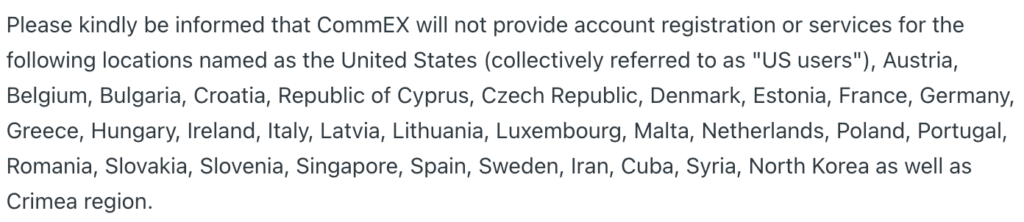
The exchange does not provide services to US residents, the EU (except Finland), Singapore, Iran, Cuba, Syria, North Korea, and to people living in Crimea.


As of writing, besides spot trading, CommEX offers futures products and a P2P service with 25 USDT trading pairs.
According to BestChange senior analyst Nikita Zuborev, the domain was acquired from resellers only on 22 September.
“In the documents they have a numbering problem, as if everything was put together in a hurry. The chat for the Russian-speaking community appeared literally before my eyes, when the previously English-language chat was overwhelmed by Russian-speaking users,” he told ForkLog.
At present, the owners, managers and beneficiaries of the company are not known with any certainty. Therefore, experts do not rule out that Binance simply “switched the signage under regulatory pressure, while inside everything remains as it was.”
“Otherwise, why would anyone offer discounts on trading BNB? It’s roughly like if McDonald’s loyalty cards continued at ‘Vkusno i Tochka’,” reasons Sergei Mendeleev, CEO of Indefibank.


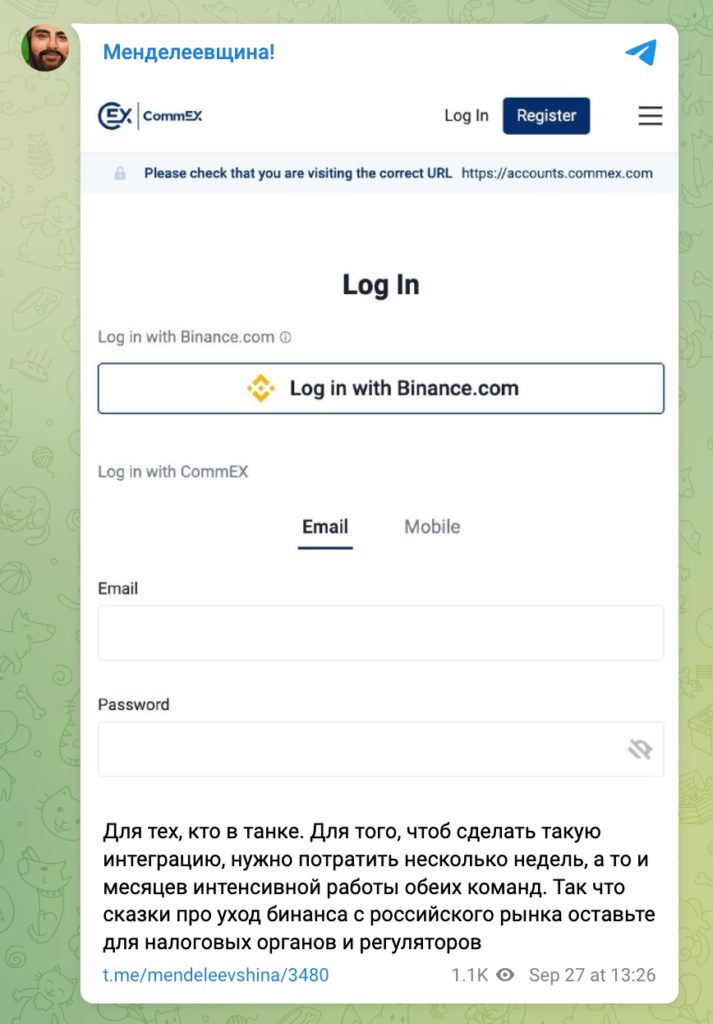
Founder and CEO of the BitOK service Dmitry Machihin agrees:
“CommEX is a technical vehicle created specifically to take the ‘Russian’ part of Binance and thus preserve the business.”
According to him, buyers were Kazakh citizens, “former staff from the Eurasian Commodity Exchange.”
“The Kazakh structure will nominally or practically own the user base that will remain with the ‘new Russian-Kazakh’ Binance after a year, without a right of repurchase,” Machihin wrote in his Telegram channel.
Binance in Kazakhstan owns a subsidiary BN KZ Technologies, which in autumn 2022 received a license from the regulator. In addition, the exchange had announced plans to launch a local Bitcoin platform in the country by mid-2023.
In a ForkLog comment, Binance representatives stressed that “neither the exchange nor its executives own shares or participate in CommEX’s profits.”
Earlier media found that under a similar name there is a commodity exchange in Kazakhstan.
On the domain commex.kz there indeed was previously hosted the site of the Eurasian Commodity Exchange (ECX). Their support email address is still at support@commex.kz. ForkLog requested comments from ECX.
Nevertheless, administrators of the exchange’s Russian-language chat said that the similar name to the Kazakh legal entity is a “coincidence.”
According to them, the crypto exchange is registered in the Seychelles and is oriented toward Asia and the CIS. Each region has a separate team.
All products and services of CommEX will operate in Russia without restrictions, according to the exchange’s representatives in RBC.
In the near future, ruble-denominated deposits will be available to users. The current withdrawal limit without verification is 2 BTC. KYC is required only for P2P and fiat operations.
CommEX will also release a mobile app for iOS and Android.
What should Russian Binance clients be wary of?
According to Nikita Zuborev, when transferring verification data from one company to another, clients could face loss or leakage. Interaction difficulties with support are not ruled out if funds are transferred between exchanges.
There may also be problems with anti-money laundering checks in other services.
“If funds from Binance wallets have a reasonably good reputation, what risks will there be for transactions from the wallets of the new company — unknown. Here one should recall the so-called Garantex, whose sanctions overnight made thousands of wallets toxic — even if the users themselves are law-abiding, before the law all their cryptocurrency became linked to drug trafficking,” the expert noted.
Additionally, in the coming weeks the number of phishing and fraud targeting Binance users could rise. Zuborev recommended refraining from dealing with both trading platforms until the situation clears up.
Andrey Tugarin, founder of the GMT Legal law firm, noted that on the Seychelles there is currently no clear regulation of the crypto market, so the regulator there is relatively lenient.
“But once [sectoral legislation] appears, it remains unclear how this will affect Russian users who migrated there,” he added.
Earlier, Binance representatives told ForkLog that Russian citizens legally residing in other countries will be able to use the exchange’s services and products, provided they comply with sanctions rules.
Will there be an outflow of funds from Binance?
Experts surveyed forecast a “serious outflow of funds” from the Russian segment. According to Zuborev, the uncertainty will prompt investors to worry about the safety of their funds.
“This outflow will not be critical for the business, but it will certainly be noticeable. The most affected could be the P2P segment, which will be forced to change its ‘registered address’ to other platforms,” explained him.
However, the analyst did not rule out that over time many users will return, “but not earlier than it becomes clear that this is absolutely safe and will not create new risks.”
Andrey Tugarin reminded of the overall negative news backdrop around Binance.
“Right now every piece of news about Binance seems to multiply the negative consequences for it due to the exchange’s problems and lawsuits with the U.S. regulator. All this, taken together, creates an unfavourable backdrop for the company, but it should be noted that an alternative is still offered for Russian users,” the lawyer said.
Impact on the Russian market and prices
On this question, experts agreed that Binance’s departure will not significantly affect the Russian crypto market, and only a “small portion of users” will discontinue using the platform.
They do not expect consequences for the prices of major cryptocurrencies either.
“This is a fairly neutral piece of news; it may not affect charts at all. While there is a small potential impact if Russian users start closing futures positions en masse, that could theoretically trigger a local trend,” Nikita Zuborev said.
The only ones this could affect are Binance’s partners.
“The question is what will happen, for example, with Cryptorg [the broker used by Binance]; will it be able to continue operating in the Russian market,” Sergei Mendeleev said.
Binance itself believes that the decision to leave Russia will have limited impact on its global business, as the company has long been gradually reducing its presence there.
Recall, in light of initial reports about Binance halting activity in Russia, experts described such a scenario as “unlikely,” because it would be unprofitable for the cryptocurrency exchange itself.
Among the main factors they listed: a noticeable drop in platform activity after the departure of Russian users and the impact on the company’s reputation in other countries.