




In 2023, the cryptocurrency industry began to recover from the severe upheavals of the previous year. Some companies and projects managed to rebound after a prolonged downturn, while others faced a bleaker outcome.
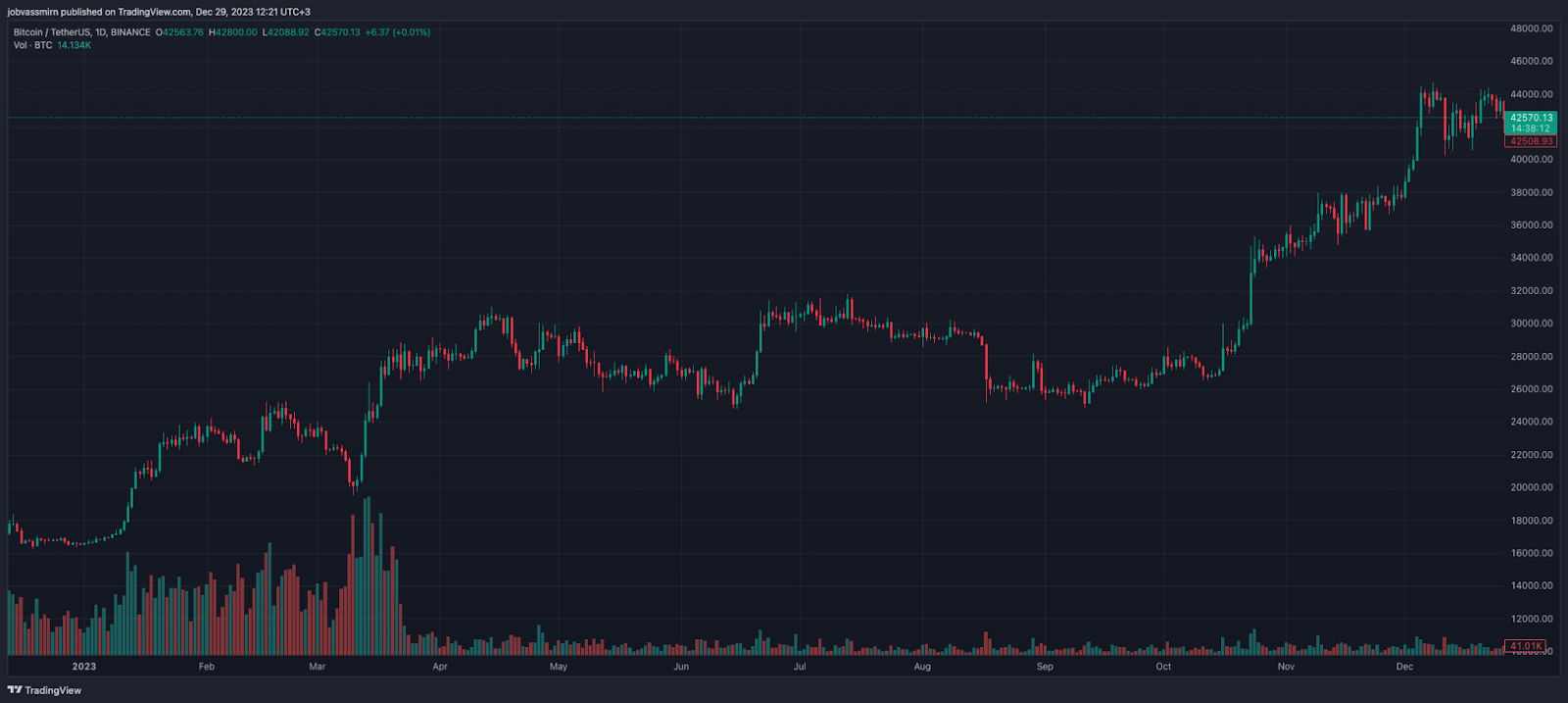
A “thaw” gradually set in: Bitcoin showed resilience and eventually surged to $44,000, marking a 150% price increase since January.
The past year resolved several important issues, such as the fate of the founder of the collapsed FTX, but also created new challenges for the market and its participants.
Events
End of the Crypto Winter
In November 2022, the leading cryptocurrency tested an annual low of around $17,000, with altcoins following suit. Simultaneously, the market capitalization fell below $1 trillion. The decline occurred amid FTX’s liquidity crisis and the announcement of its acquisition by competitor Binance.
However, Bitcoin did not linger long at its local bottom — on January 9, the asset’s quotes exceeded $17,000.
By February, it had risen to $24,000. Talk of a “warming” began in March when the Fed once again raised the key rate, yet digital gold managed to hold at $28,000.
From that point until mid-autumn, Bitcoin traded in the $25,000–30,000 range. On October 16, the coin’s quotes broke through the upper resistance level, following a fake approval of a spot ETF based on digital gold from BlackRock, and began active growth.
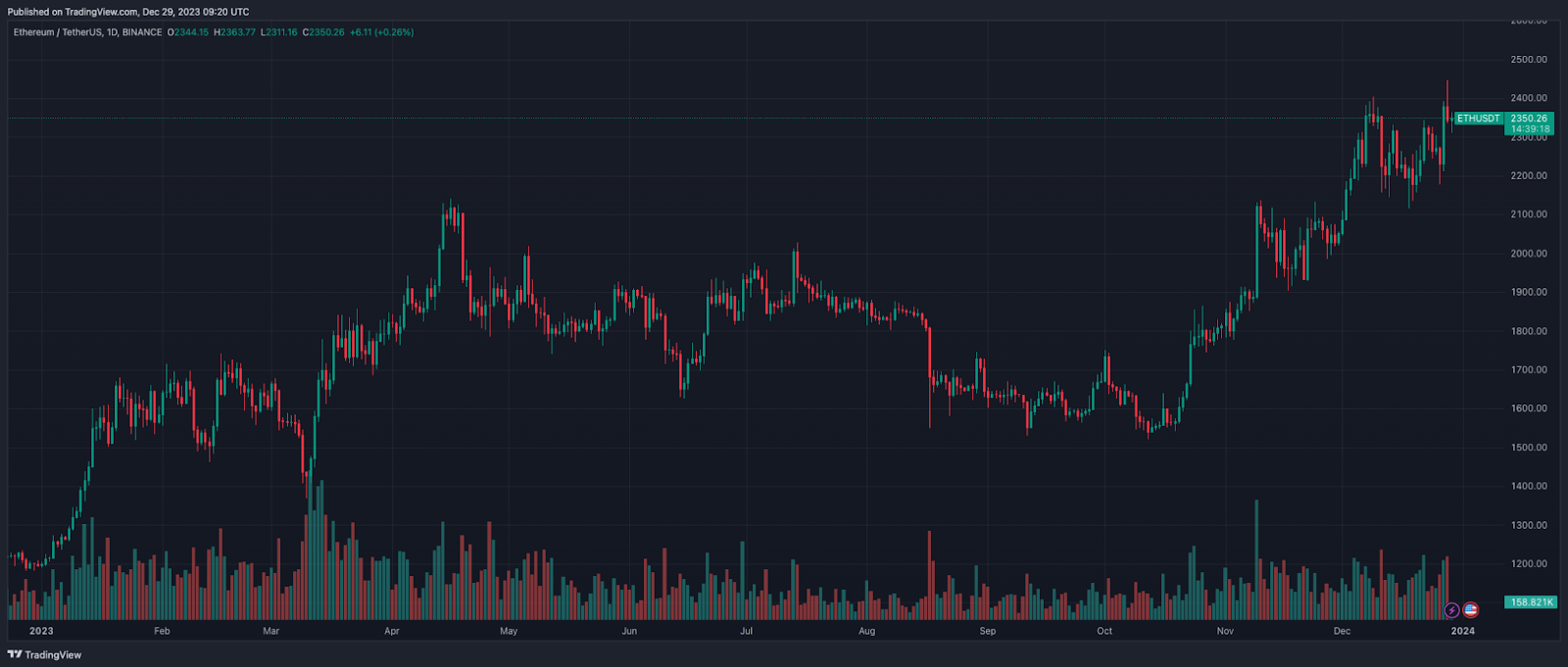
Compared to the first cryptocurrency, Ethereum showed less activity, adding only 97% over the year — reaching $2350.

By the end of the year, the total market capitalization reached $1.75 trillion.


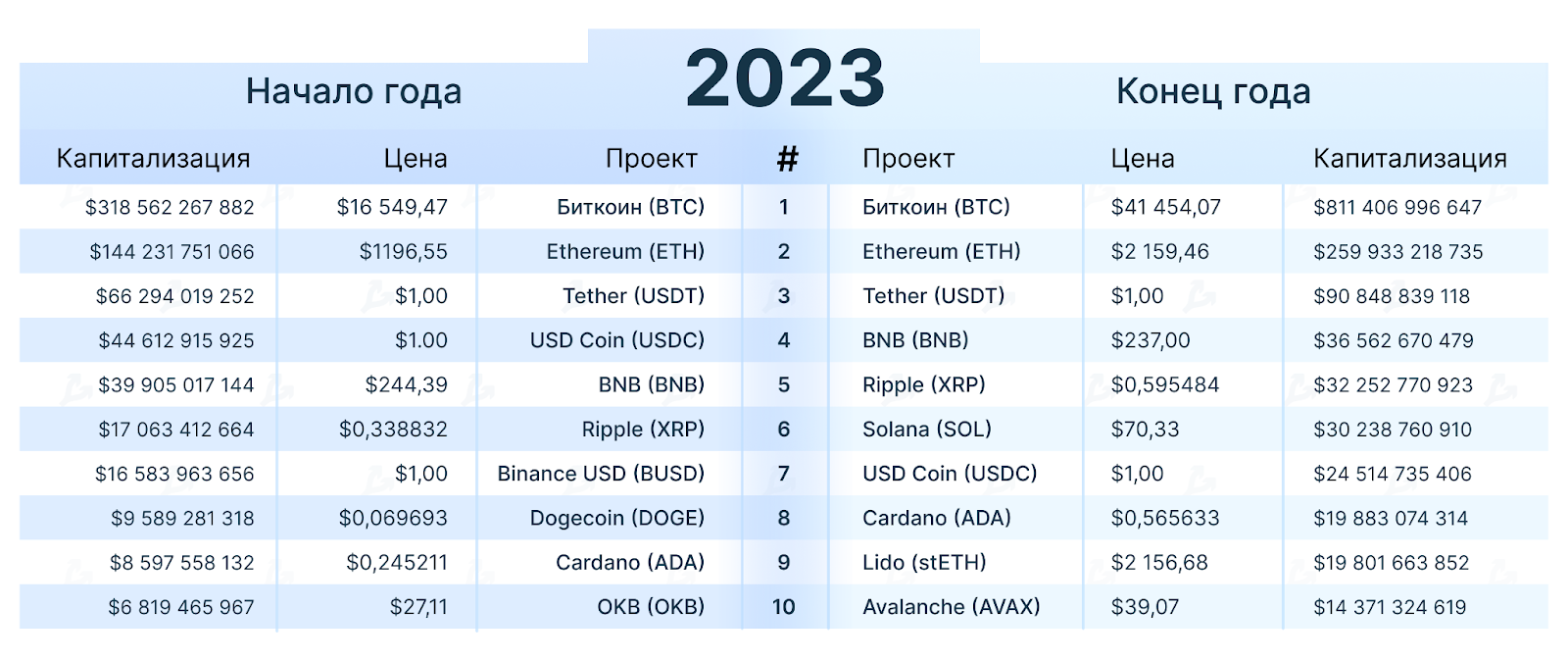
However, over the past 12 months, several altcoins managed to outpace Bitcoin in growth. Among them: SOL (+1000% since January), AVAX (+270%), and ADA (+150%). All three coins entered the top 10 by capitalization.
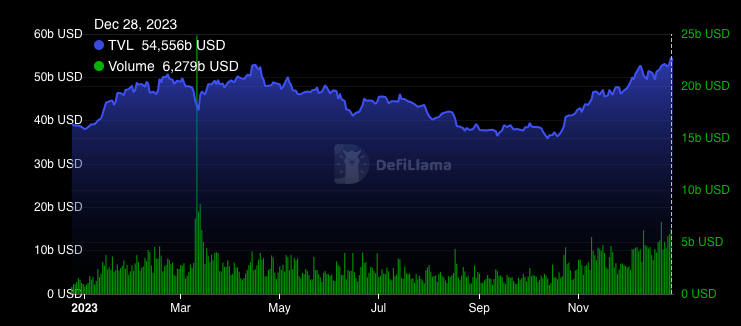
The DeFi sector showed restrained growth. The total value locked (TVL) in decentralized protocols increased by 42% from $38 billion to $54 billion since January.

After nearly two months of growth, the market faced a slight correction in mid-December. On December 11, Bitcoin fell below $42,000 and entered a flat phase, consolidating in this range. Some analysts suggested further price declines.
JPMorgan experts expressed confidence that the crypto winter is not yet over. In their view, its end will be marked by the recovery of venture funding.
Challenges for Binance
For Binance, the largest cryptocurrency exchange by trading volume, 2023 was likely the most challenging year in terms of regulation in its six-year history.
Binance had previously faced scrutiny from authorities in various countries, but U.S. agencies decided to finally “clamp down” on the company and its former CEO Changpeng Zhao (CZ).
On March 27, the CFTC accused the platform of violating derivatives trading rules and operating without a license. According to the regulator, Binance was aware that its clients included sanctioned individuals.
On June 5, the SEC sued the exchange and Zhao. The agency filed 13 charges, including the sale of unregistered securities. Later, the regulator filed a motion to freeze the digital assets of the U.S. division.
A week and a half later, the parties reached an agreement on client funds in the U.S., and the exchange resumed withdrawals.
Binance and CZ made several attempts to dismiss the CFTC and SEC lawsuits, but the strongest blow came in late autumn. On November 21, reports emerged of the company’s agreement with the U.S. Department of Justice, under which the exchange agreed to pay fines totaling $4.3 billion.
The deal involved charges against Zhao for money laundering, financial fraud, and sanctions violations. Zhao stepped down as CEO, admitting guilt in part for non-compliance with anti-money laundering laws. He will also pay $50 million. Richard Teng became the new CEO of the exchange.
The former head of Binance posted a $175 million bail to remain free until sentencing on February 23, 2024. However, the court prohibited him from returning home to the UAE, citing a flight risk.
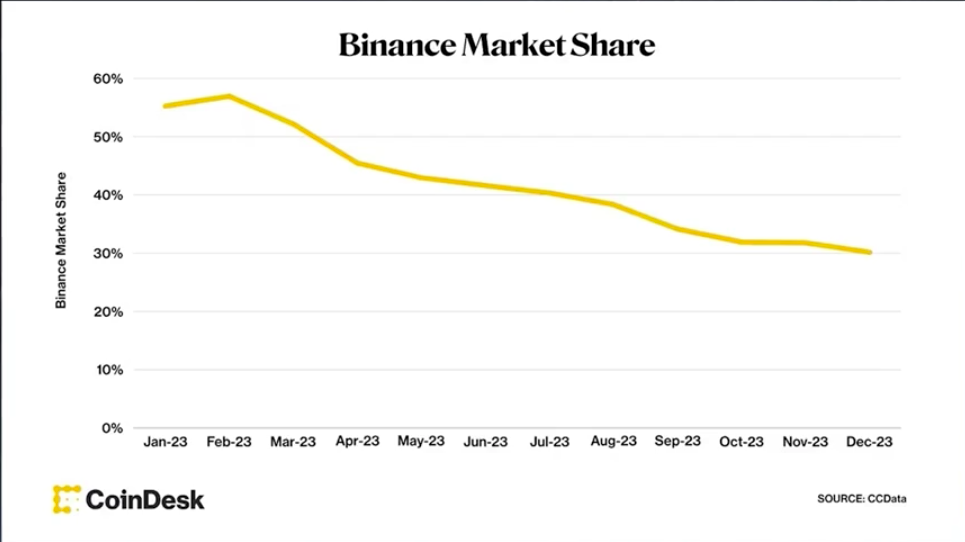
Throughout the year, due to endless legal battles, Binance’s financial performance consistently declined.
According to CCData, the exchange’s market share in December was only 30.1% compared to 55% in January. By September, the platform’s spot volumes had decreased by more than 70%, from $474 billion to $114 billion.

Additionally, Binance had to exit the Russian jurisdiction, selling its local business to CommEX. On November 15, the cryptocurrency exchange completely stopped accepting deposits in Russian rubles.
Sam Bankman-Fried Behind Bars
For FTX founder Sam Bankman-Fried (SBF), 2023 was arguably even worse than for Binance.
In December 2022, he was arrested in the Bahamas and extradited to the U.S., where the Justice Department charged him with eight criminal offenses. A few days later, SBF was released on a $250 million bail and placed under house arrest.
He spent the next six months at his parents’ home with an ankle bracelet, preparing for the upcoming court hearing scheduled for early October.
During this period, the number of charges against him increased to 13. They included various types of fraud, conspiracy to defraud, money laundering, bribery, and violations of U.S. campaign finance laws.
Later, prosecutors dropped charges related to politicians as part of a deal with the defense. However, the FTX founder did not plead guilty to any of the charges.
On August 8, two months before the hearing, house arrest turned into imprisonment for SBF. The court revoked the previous measure at the prosecutors’ request.
They claimed that while free, Bankman-Fried contacted witnesses, used a VPN allegedly to watch the Super Bowl, and shared personal notes of former Alameda Research head Caroline Ellison with journalists.
The trial began on October 3. The process, during which Ellison, FTX co-founder Gary Wang, and the exchange’s engineering head Nishad Singh gave testimony, was brief.
Bankman-Fried also decided to testify before the jury against his lawyers’ advice. However, he failed to convince the independent panel — on November 2, SBF was found guilty on seven counts, including money laundering, fraud, and conspiracy. He faces a maximum sentence of 115 years in prison, with sentencing scheduled for March 28, 2024.

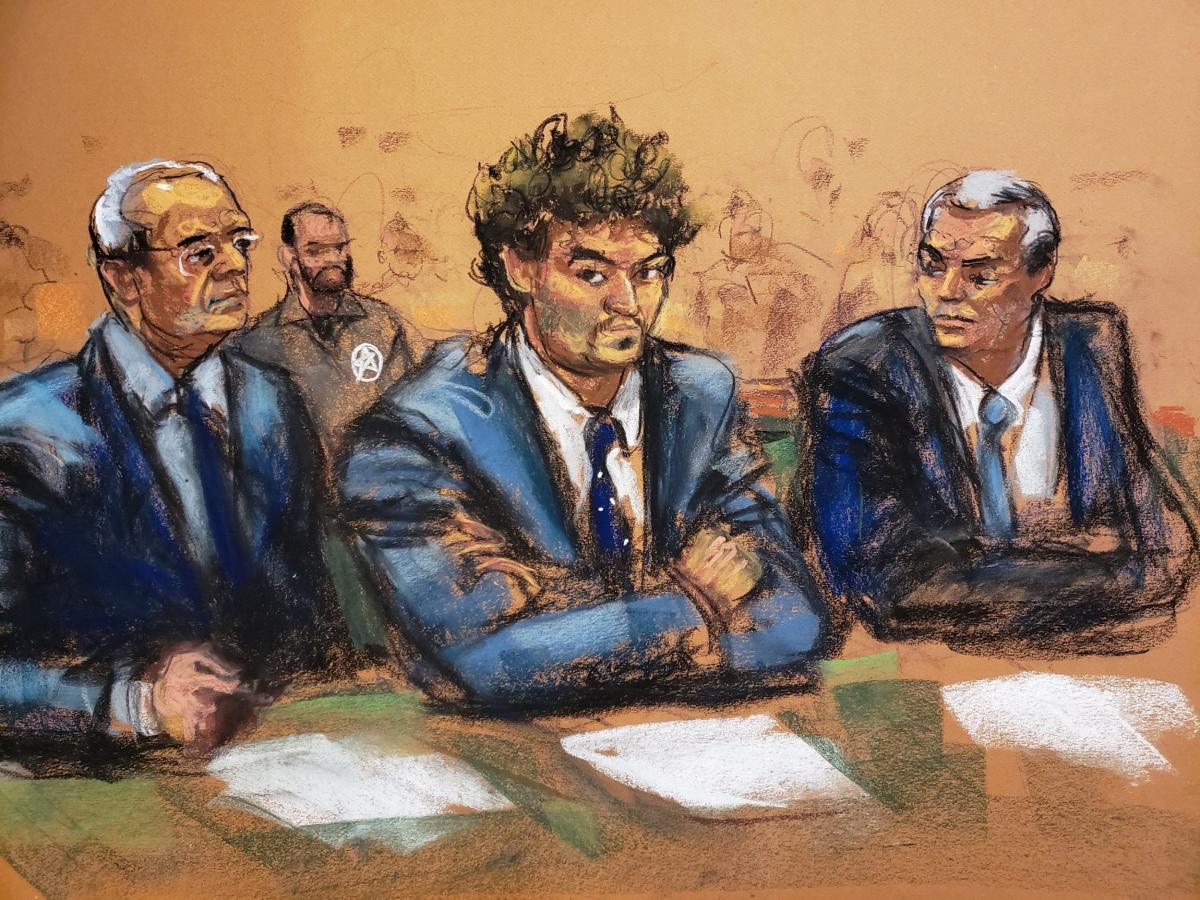
The FTX founder was imprisoned in the Brooklyn jail (New York). According to WSJ, he shared a cell with former Honduran President Juan Hernandez and gave investment advice to guards on cryptocurrency.
Blogger Tiffany Fong interviewed former mobster Gene Borrello, who was incarcerated with Bankman-Fried. He said that initially, SBF was “out of his element” and was a target for attacks due to his timid nature and “body of an 80-year-old man.”
In December, SBF’s legal team leader David Mills admitted that winning the trial was “virtually impossible,” given the testimony of the exchange founder’s closest colleagues.
Regarding the company’s status, in October, the new management and creditors approved a compensation plan for clients. By mid-2024, FTX users could receive claims payments totaling $9.2 billion.
Simultaneously, the exchange’s management began considering restructuring options. Even SEC Chairman Gary Gensler supported the relaunch of the trading platform.
In December, FTX presented a revised plan for returning funds to clients, according to which assets would be valued at the rate at the time of the bankruptcy filing — November 11, 2022. The proposal must go through a voting stage.
Launch of Base
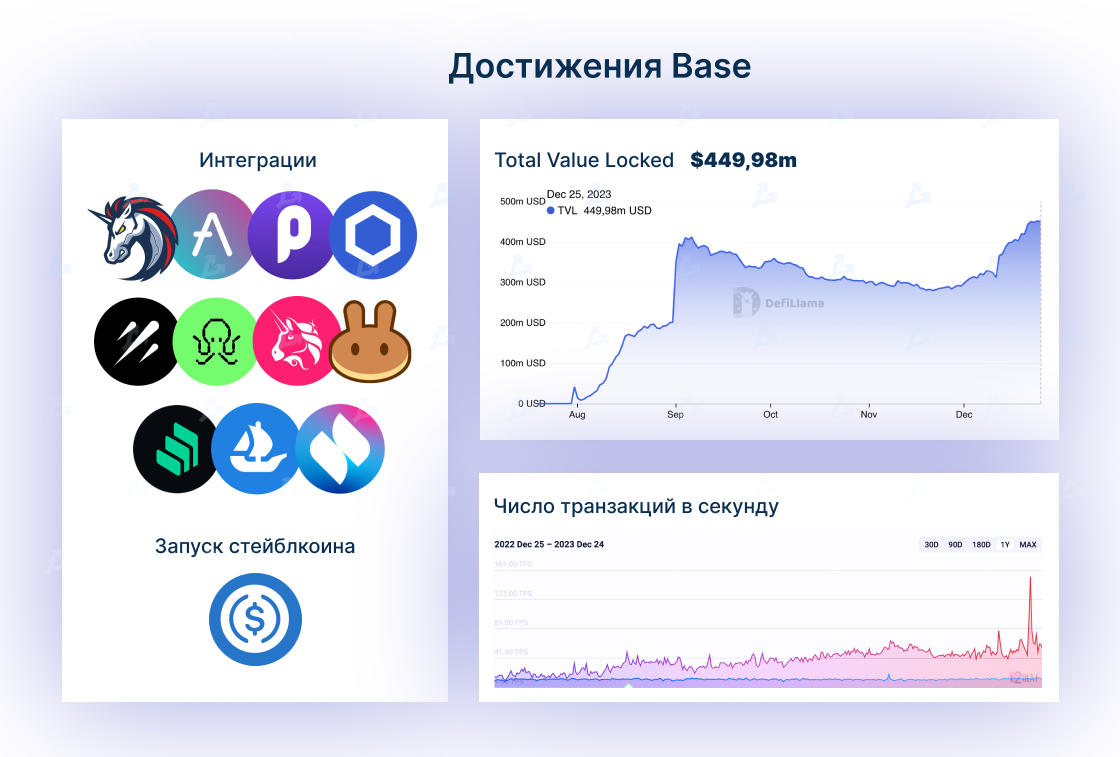
On February 23, the American Bitcoin exchange Coinbase launched the test network of the second-layer solution Base, developed based on the OP Stack architecture from Optimism.
The platform is positioned as a “secure, low-cost, and developer-friendly way to create decentralized applications.” It operates as an Ethereum rollup network.
The mainnet opened on August 9, along with functionality for interacting with non-fungible tokens (NFTs).
According to CoinGecko, fees on Base are 10 times lower than on the main Ethereum network.
Coinbase CEO Brian Armstrong and other L2 solution developers stated that the project does not intend to issue a native token, although the community still hopes for an unexpected airdrop.

Do Kwon’s Arrest
Co-founder and CEO of Terraform Labs (TFL) Do Kwon, allegedly responsible for the collapse of the Terra ecosystem and the UST stablecoin, also fell into the hands of authorities.
On March 23, he was arrested at the airport in Montenegro’s capital while attempting to fly to Dubai using forged documents. The arrest was made at the request of law enforcement agencies in Singapore, South Korea, and the U.S., where he faces fraud charges from the SEC and the New York Federal Prosecutor’s Office.
In July, Kwon was released under house arrest, with bail set at €400,000 ($436,000). Before that, South Korea urged Montenegro to extradite the TFL head to his homeland, but the U.S. also claims extradition rights.
Later, the court found Kwon guilty of document forgery and sentenced him to four months in prison. He did not plead guilty, placing all responsibility on an unnamed agency from Singapore.
Simultaneously, the Swiss government blocked about $26 million in Bitcoin and other cryptocurrencies linked to Terraform Labs and Kwon.
In November, the Podgorica court approved his extradition to both South Korea and the U.S. The final decision on the priority side will be made by Montenegro’s Minister of Justice.
In December, Kwon was kept in prison until February 15, 2024, at the request of the countries seeking extradition, and later authorities canceled the extradition decision.
Notable Victories
On June 13, Ripple achieved a partial victory in its case against the SEC, which had been ongoing since 2020.
Judge Analisa Torres ruled that programmatic sales and other distributions of XRP tokens do not constitute investment contract sales. However, according to the decision, the distribution of the asset among institutional industry participants violated securities laws.
A significant fact was that the case revealed documents related to a 2018 speech by former regulator employee William Hinman.
In his old speech, the former director of the agency’s corporate finance department stated that for certain reasons, Bitcoin and Ethereum are not securities. These materials not only solidified Ripple’s position but also provided the rest of the crypto market with an additional argument.
Nevertheless, the SEC attempted to challenge the court’s ruling, but Torres rejected the appeal. She found that the Commission did not provide sufficient evidence, and the arguments presented would not “substantially advance the final resolution of the case.”
Ultimately, the regulator dropped all charges against Ripple co-founder Chris Larsen and CEO Brad Garlinghouse. The parties reached a settlement agreement.
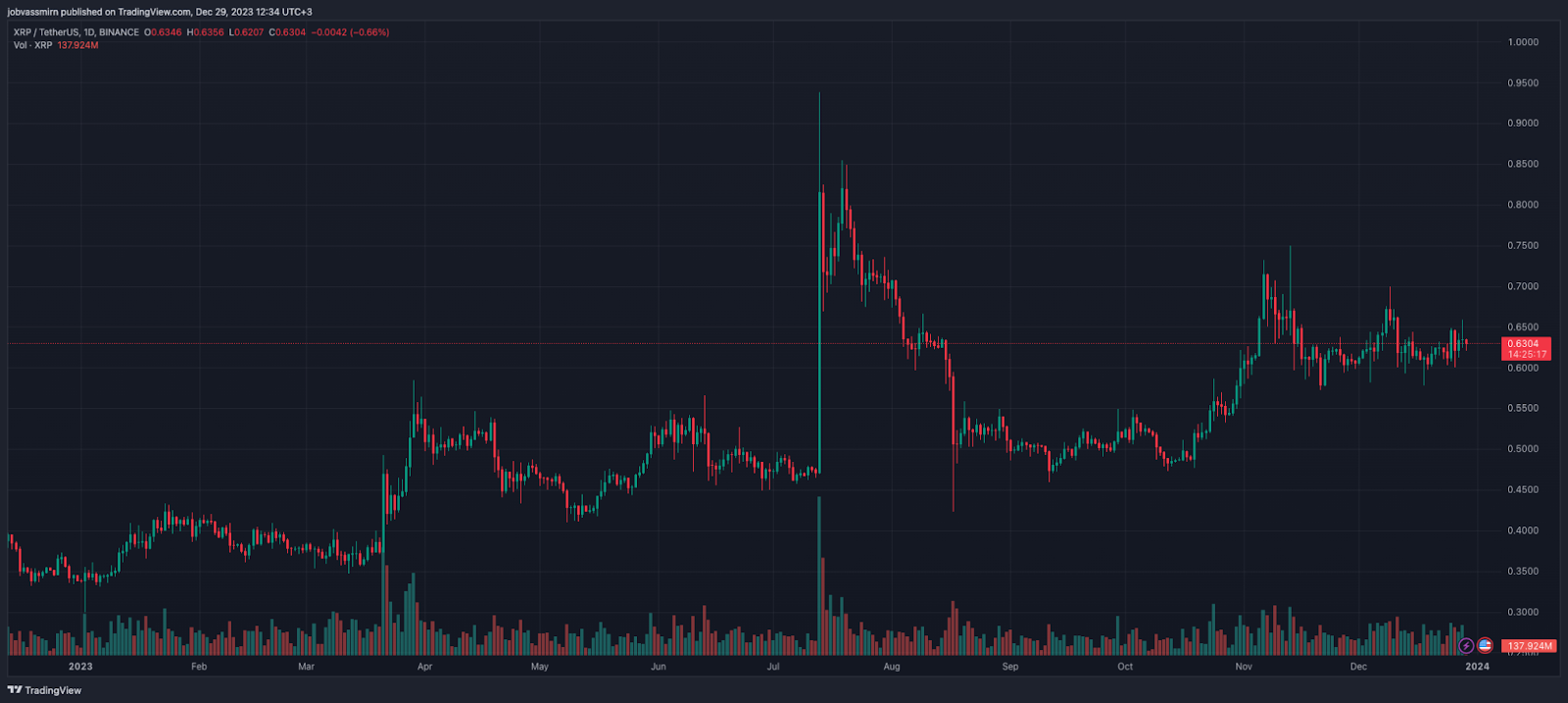
The outcome of the proceedings positively affected the XRP price. Over the past 12 months, the token rose by 65% to $0.63.

Another defeat for the SEC was the verdict in favor of Grayscale. In June 2022, the asset manager sued the regulator for refusing to convert its flagship trust, the GBTC, into a spot Bitcoin ETF.
The firm had submitted the corresponding application back in October 2021. In August 2023, the court granted Grayscale’s motion and ordered the Commission to reconsider the decision. Later, the appellate court officially upheld the ruling.
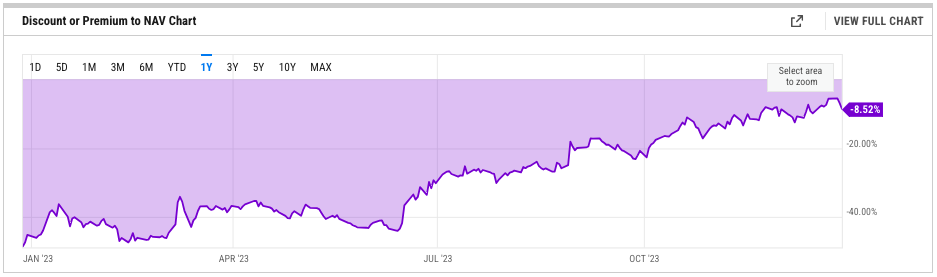
By the end of December, the GBTC discount to net asset value narrowed to 8.52% amid expectations of a Bitcoin ETF launch. At the beginning of the year, the figure was 48.31%.

Trends
The ETF Race
Attempts to implement a spot exchange-traded fund based on the first cryptocurrency in the U.S. have been ongoing for a long time. Until 2023, the SEC inexplicably refused to launch the instrument, despite the existence of futures products.

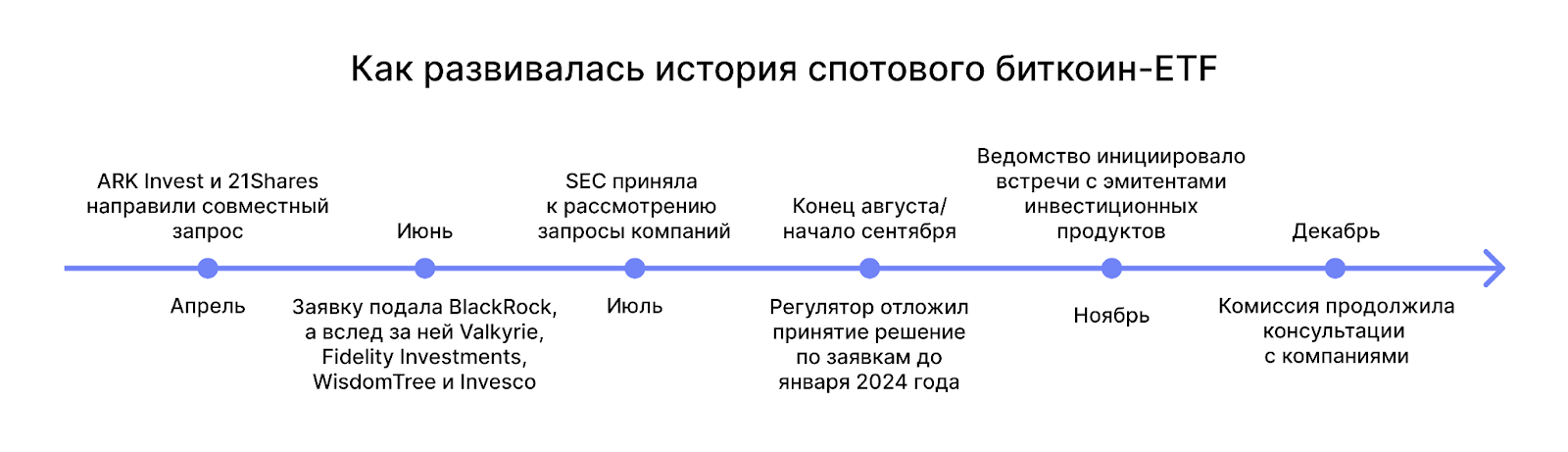
Firms have not forgotten about the second-largest cryptocurrency by capitalization. In November, BlackRock submitted an application to the SEC to register a spot Ethereum ETF. It was followed by Fidelity Investments.
Among other firms that submitted requests:
- VanEck (launched the Ethereum Strategy ETF on the CBOE in September);
- Valkyrie (SEC postponed the decision);
- 21Shares and ARK Invest (SEC postponed the decision);
- Grayscale Investments (SEC postponed the decision);
- Invesco and Galaxy Digital (joint application under review).
Staking
In 2022, Ethereum activated The Merge update — the blockchain transitioned to the Proof-of-Stake consensus algorithm. Users gained access to staking, but withdrawals were only possible after a hard fork.
This moment came on April 13, 2023, with the launch of Shapella on the mainnet.
Initially, validator withdrawals exceeded deposit volumes, but the trend quickly reversed. By the end of April, the TVL of liquid staking protocols reached $17.8 billion, surpassing the DEX figure for the first time.
The Shapella update had little impact on ETH prices, sparking only increased interest in staking.

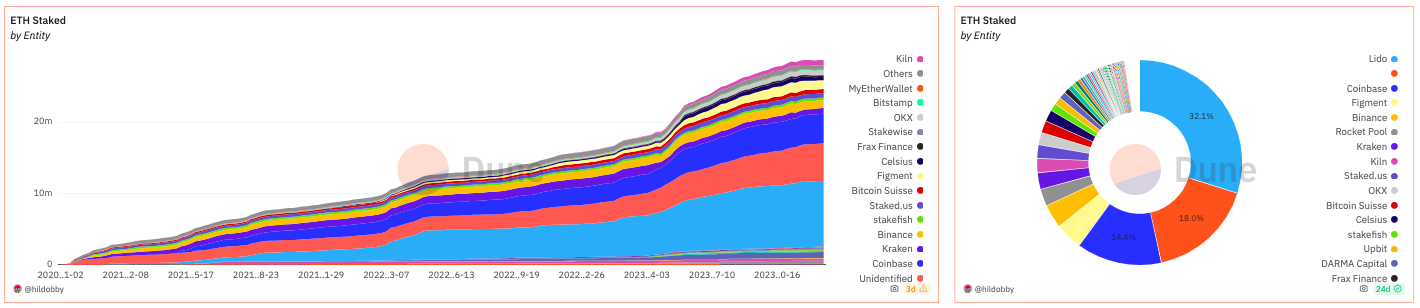
The most popular LSD provider was Lido Finance. After the hard fork, its TVL grew rapidly. With the release of the second version of the protocol in May, the ability to withdraw Ethereum from staking by burning stETH was introduced.
Lido’s share quickly reached 30% of the total ETH locked, raising concerns among market participants about network security.

Nevertheless, by mid-autumn, analysts recorded a decline in demand for Ethereum staking. According to a Coinbase report, in October, the validator queue emptied for the first time since the hard fork launch. Simultaneously, the yield from coin locking decreased.
In late November, Glassnode experts noted the first reduction in ETH staking and an increase in the number of exiting validators. This led to a decrease in the number of locked coins and slowed emission.
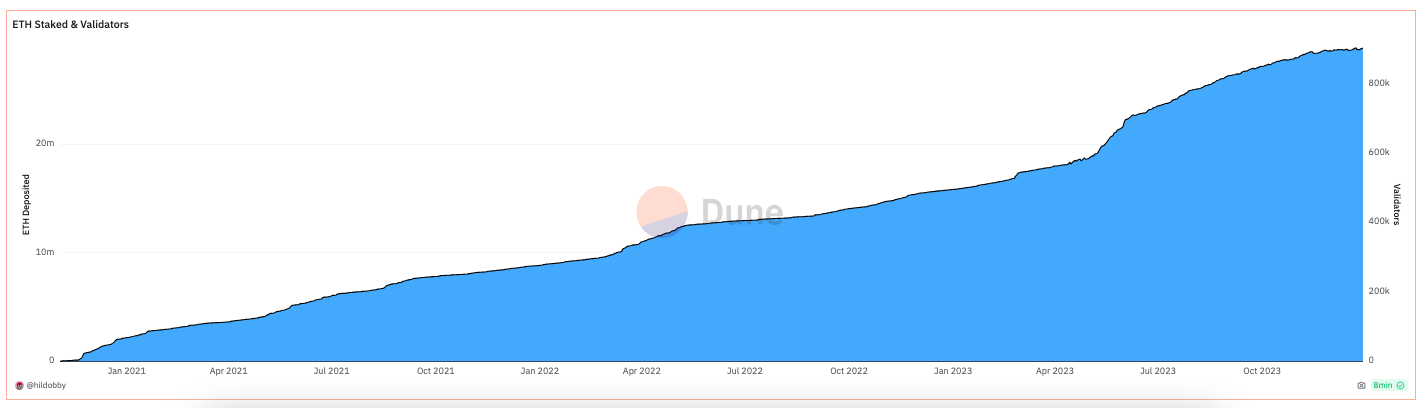
According to the Dune dashboard, by the end of the year, the volume of assets in staking amounted to 28.86 million ($68.11 billion) — about 24% of the total emission.
Return of Meme Coins
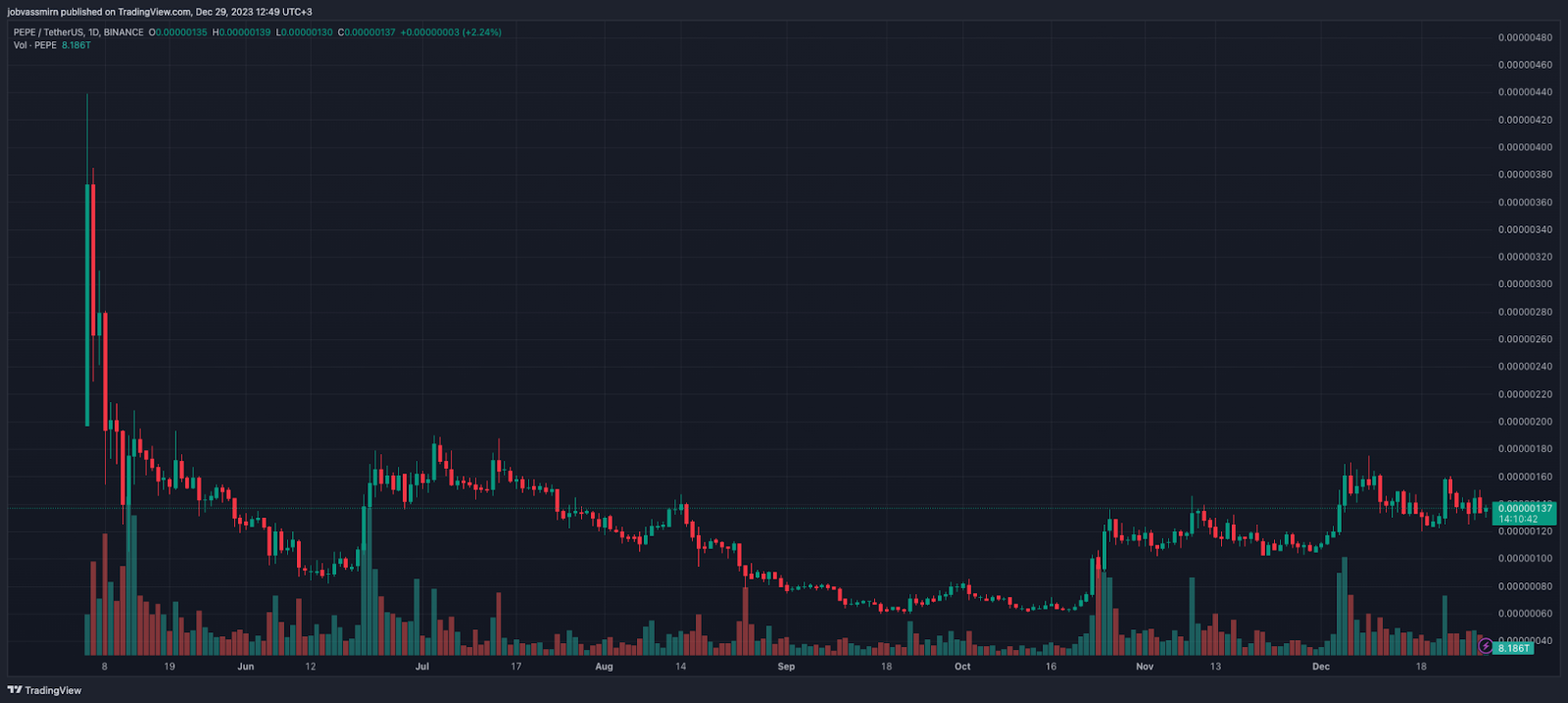
In April 2023, the market was once again swept by a wave of meme cryptocurrencies. This time, the community was stirred not by a dog but by a frog: in April, the PEPE token surged more than 200% in a day, with its market capitalization exceeding $110 million.
One user managed to turn $260 into $2 million in a week of trading the meme coin. There were also reports that an MEV bot made ~$1.5 million in profit in pairs with the meme token, spending $1.3 million on gas.
At launch, PEPE faced liquidity issues and, consequently, withdrawal problems. But the coin quickly gained popularity — on May 5, Binance announced the listing of PEPE and another meme cryptocurrency, FLOKI. Following the news, both tokens rose by 40% and 60% respectively within an hour.
However, after being listed on the trading platform, the asset’s quotes declined along with the hype around it. In late summer, PEPE’s price plummeted by 20% following reports of a potential scam.
Later, the project’s developer accused former team members of stealing $15 million.
Despite the negative backdrop, PEPE still attracted some traders for its high volatility and leverage opportunities. Its daily trading volume exceeds $100 million on average.
On the wave of popularity of the new “meme favorite,” many other similar tokens began to appear. At one point, the total unrealized profit of the ten largest holders of the Milady (LADYS) coin reached $20 million.
In July, the Base network was also flooded with meme tokens, some of which showed a hundredfold increase. Traders began buying little-known coins like BALD, COIN, and BASED using the decentralized exchange LeetSwap.
On July 30, more than half of the platform’s daily trading volume was in BALD operations — a coin referencing bald Coinbase CEO Brian Armstrong. In two days, the asset grew by almost 40,000%.
But such a situation did not go without scammers, as some developers executed liquidity-draining schemes and disappeared with investors’ funds.
By the end of the year, the “old-timer” Dogecoin reminded of itself. In November, the community proposed sending a physical wallet with DOGE tokens to the Moon as part of the Peregrine Mission One mission by the space company Astrobotic.
On its 10th anniversary, December 6, the asset reached a yearly high of $0.102, rising by almost 17% in 24 hours.
Bitcoin NFTs
Despite the ongoing decline in the non-fungible token market, the emergence of the Ordinals and BRC-20 protocol in the Bitcoin network in January breathed new life into the media format on the blockchain.
Users gained the ability to place images and other types of data in the ecosystem without using a separate token or sidechain. Thus, Bitcoin NFTs emerged.
In less than a month, the project gained immense popularity, with over 100,000 “inscriptions” issued by mid-February. The protocol fork also migrated to Litecoin.
However, discussions about the impact of Ordinals on the first cryptocurrency’s network began even then. Opponents of the technology argued that the protocol could overload the blockchain, which happened in September and November.
Nevertheless, many platforms added support for Bitcoin NFTs and BRC-20, including Binance and OKX. By the end of May, the number of created “inscriptions” exceeded 10 million.
Summer was not particularly productive for Ordinals. However, the technology’s analog migrated to Ethereum, and in the first week, the trading volume of “digital artifacts” exceeded $1 million.
In July, the Bitcoin protocol team introduced a new BRC-69 format, which reduces the cost of issuing NFT collections.
On the wave of a new autumn surge in Ordinals’ popularity, developers of other protocols were inspired and created their analogs. These include Polygon, TON, Avalanche, and Fantom. The launch of solutions in these networks caused a surge in transactions and overload.
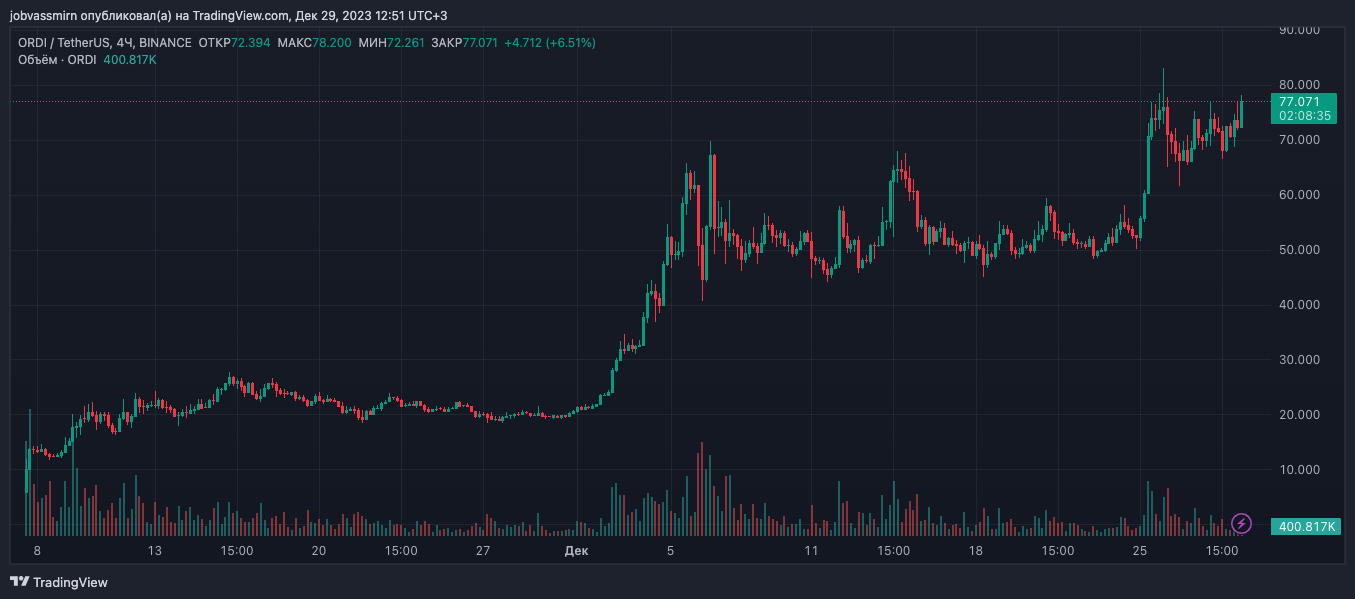
As of December 29, the meme token ORDI, created on the Ordinals protocol, sharply rose to $77, adding 275% in monthly terms.

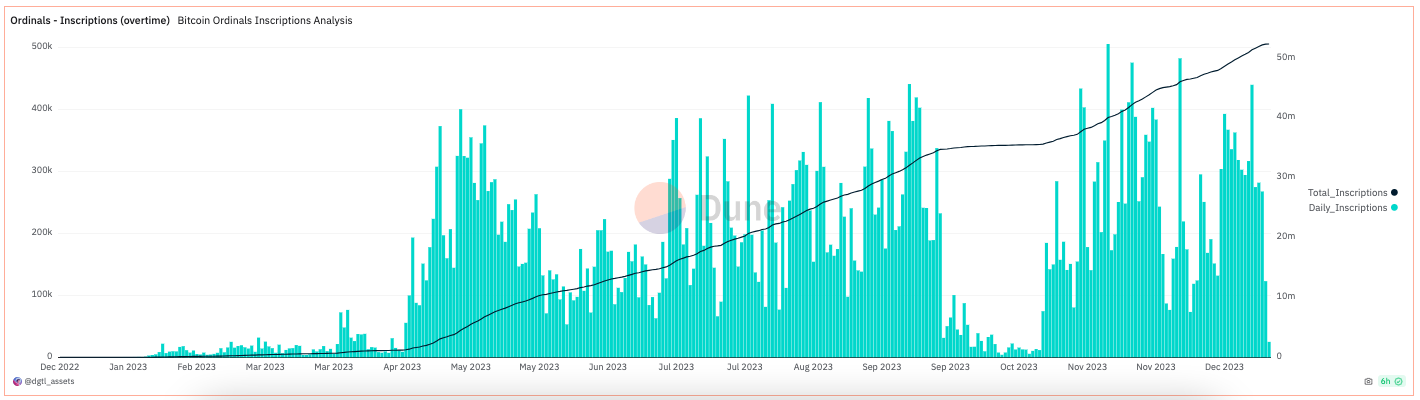
According to the Dune dashboard, in recent months, the number of “inscriptions” created daily averages over 100,000. By the end of the year, more than 52 million Bitcoin NFTs had been issued, with approximately $221 million spent on fees.

However, not everything is smooth for Ordinals. Bitcoin Core developer Luke Dash Jr. criticized the project for clogging the network and called for the censorship of BRC-20 format transactions.
Later, based on his statements, the U.S. National Vulnerability Database marked “inscriptions” created in the protocol as a cybersecurity threat to the first cryptocurrency’s blockchain.
***
Over the past 2023, the industry gradually recovered from the crypto winter and began to show positive dynamics again. New directions, projects, and developments emerged.
One hopes for a calm and stable 2024, but it is safe to say that the digital asset sector has already established itself and is unlikely to disappear even in the event of unfavorable developments.
Stay with ForkLog. Happy New Year!