




On 30 January 2025, Tether announced the launch of USDT on Bitcoin’s layer-two Lightning Network (LN).
Although Paolo Ardoino has said that for the company any blockchain “is just a transport layer”, it has always openly championed the first cryptocurrency. Tether regularly allocates up to 15% of net profits to buy BTC and invests in the development of mining technologies.
Their alliance may now move up a gear. Oleg Cash Coin examines how and why USDT has returned to Bitcoin’s network.
New DeFi
In recent years the average investor has come to see bitcoin as a slow, lumbering giant whose accessibility shrinks with each halving cycle. In the popular imagination BTC has stuck as digital gold and a hedging tool, not as a payments network.
Nor is Bitcoin a popular ecosystem for smart contracts and DeFi applications. And decentralised finance itself is still perceived as an extension of 2016–2018 experiments rather than a mature market without intermediaries.
In 2017 the Bancor platform presented the concept of liquidity pools, which later underpinned modern DEXs. In 2019 the EtherDelta exchange launched with a standard order book. Around the same time the first lending protocol, Aave, appeared, and MakerDAO presented the concept of a collateralised on-chain asset.
The boom in the new DeFi can be traced to the start of the pandemic in 2020, when the first liquidity arrived. The popularisation of retrodrops played a role, as did Ethereum with its smart contracts and the ERC-20 standard, which proved to be an excellent tool for sourcing liquidity via quick listings on any DEX and CEX.


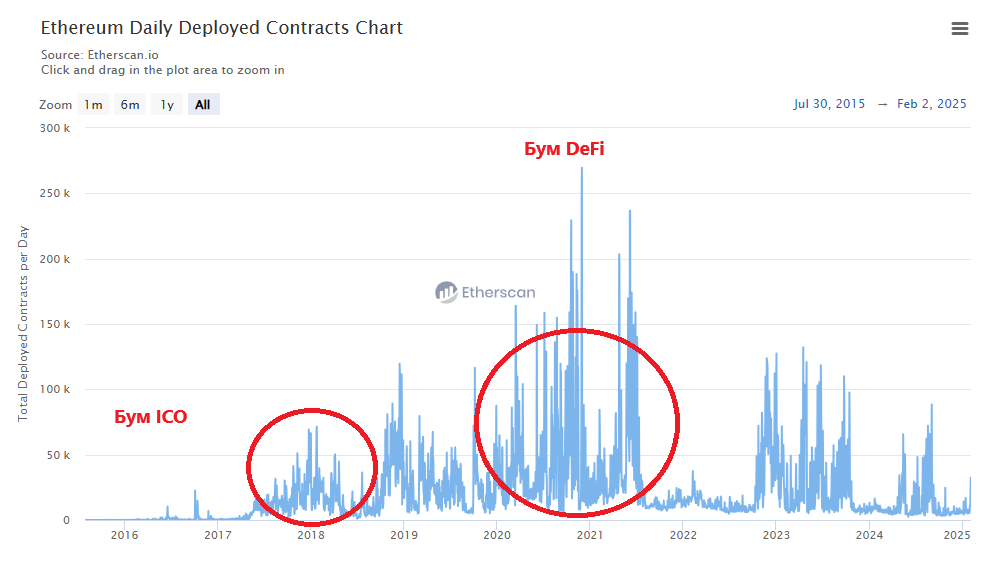
Do not forget that Bitcoin itself is a decentralised financial application that allows transactions without intermediaries. To be part of DeFi, it is not necessary to build an AMM-based DEX like Uniswap or to launch a collateral mechanism via smart contracts.
We also live in a reality where stablecoins have ceased to be merely a trading asset or a way to get into dollars—they are already a payment instrument and a savings vehicle, used worldwide as proxy currencies.
Without Tether, the Lightning Network would likely have found it much harder to compete with other DeFi applications and narratives. Now “lightning” holds a near-perfect tool for attracting liquidity—USDT. And the new U.S. administration, which has declared stablecoins almost a national development priority, will give Lightning Network an adoption boost.
“A stablecoin is a synthetic dollar. If it allows payments to be made faster or cheaper, I am all for it,” said Federal Reserve Board member Fed Christopher Waller.
It is important to note that stablecoins have already become the most used cryptoassets and have significantly reshaped market structure.

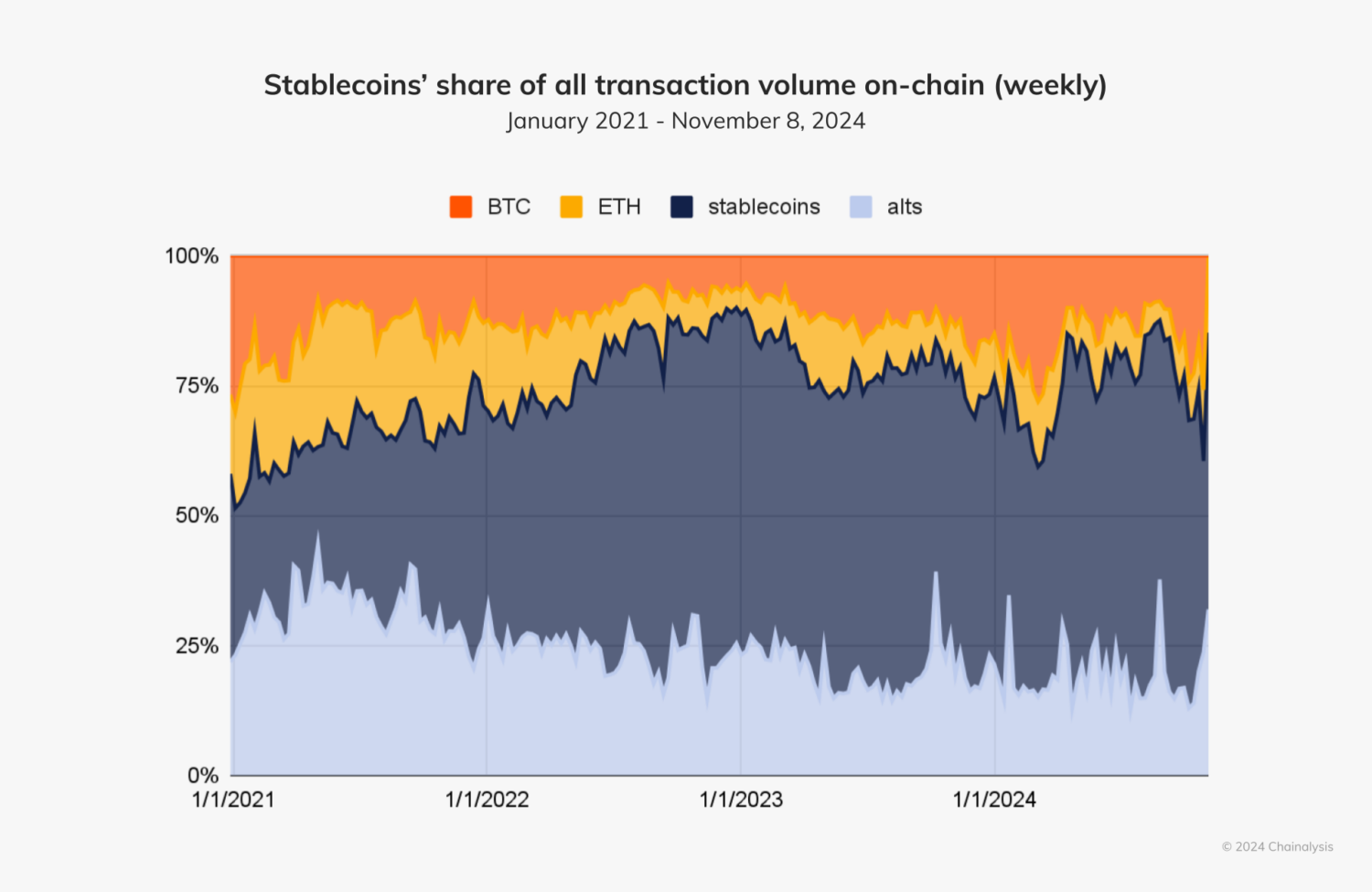
Stablecoins are gaining momentum as a medium of exchange and store of value globally, filling gaps left by traditional currencies, especially in regions with limited access to the dollar. And as regulators’ attitudes towards crypto soften, stablecoins “are becoming the central element of blockchain technology shaping the future of finance,” notes Chainalysis.
What are altcoins for
In the new reality, one of the main tools for the development of any network is the use and adoption of stablecoins. This is evident even on Ethereum.

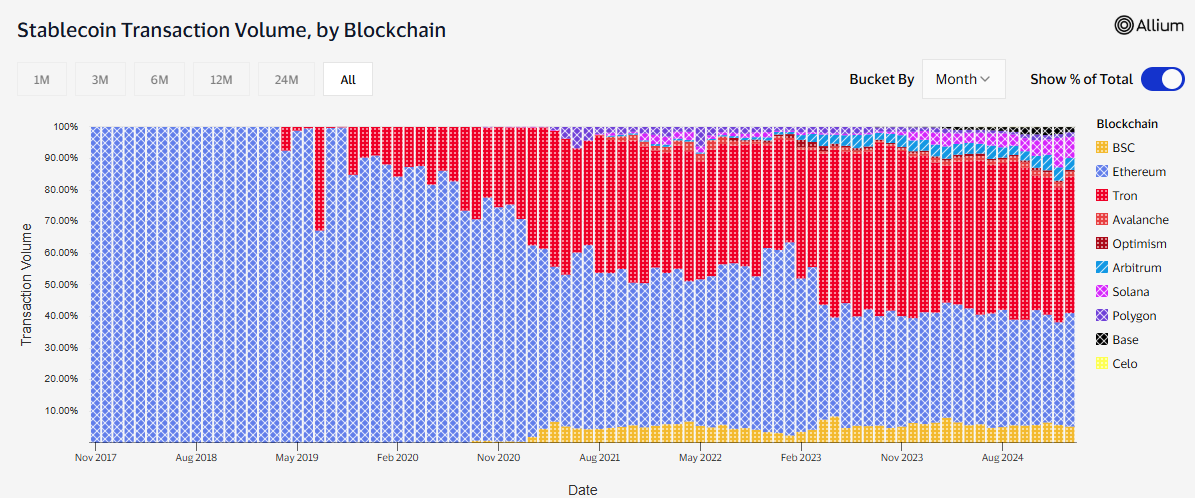
The chart above shows the share of stablecoin transaction volume across networks: since 2020 Ethereum has been losing dominance in this market and now accounts for about 33%. And in the total number of stablecoin transactions, its share is down to just 5%. The trend is clear.
Over the years while stablecoins were flowing out of Ethereum, the ETH coin itself became one of the weakest among top-100 crypto projects by market capitalisation.

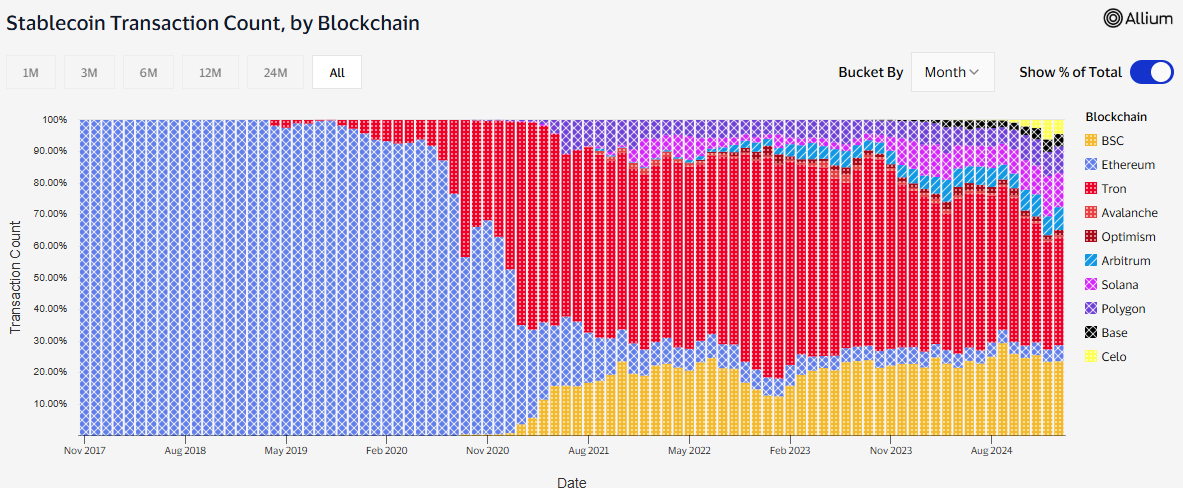
This points to an interesting prospect for LN, which is effectively unconstrained in scaling. Lightning’s structure differs markedly from familiar L1 and L2 altcoin networks, as it has no mechanism for increasing base fees during peak loads.
LN operates without validators and creates communication channels between any network participants who join independently at any time.
It is also a wholly different kind of DeFi. Here participants are paid for renting out liquidity without the permanent losses inherent in liquidity pools. Not to mention that fees in LN are tens or even hundreds of times lower than those of competitors.
How this will work under real-world scaling remains to be seen. A revolution in the coming months is unlikely: in Bitcoin’s network, change takes years.
Nevertheless, as Lightning Labs head Elizabeth Stark noted, “a new era for stablecoins has begun.” The joint initiative with Tether could not only become the basis “for a wave of transactions by AI agents” but also turn Bitcoin into a network with many tokens on board.