




The Klin platform has begun exiting all its Ethereum validators after the SwissBorg exchange hack. The Daily Gwei founder Anthony Sassano warned the Ethereum validator exit queue could swell in the coming days.
Getting ahead of the fud before it festers…
The validator exit queue is going to jump up a lot in the coming days (it just jumped up by ~700,000 ETH) because @Kiln_finance has decided to voluntarily exit all of their ETH validators due to security concerns (that are specific… pic.twitter.com/LEFFezkNUC
— sassal.eth/acc 🦇🔊 (@sassal0x) September 10, 2025
On 8 September, SwissBorg suffered a hack in which attackers stole 192,600 SOL worth $41m. The investigation found a vulnerability in the API of the platform’s partner — Klin, which provides staking infrastructure for Solana and Ethereum.
Co-founder Laszlo Sabo said Klin immediately began exiting validators to protect client assets. The process will be phased and take 10–42 days. Users will continue to receive staking rewards throughout.
1/10 🧵 Following our announcement yesterday regarding the Solana incident involving SwissBorg, Kiln is taking additional precautionary measures to safeguard client assets across all the networks.https://t.co/ePKBaStIet
— Kiln 🧱🔥 (@Kiln_finance) September 9, 2025
Following the announcement, the Ethereum exit queue jumped by 700,000 ETH, Sassano wrote. According to Validator Queue, it rose from 616,898 ETH to more than 1m ETH in a day. The average wait increased from 10 to 42 days.
About 35.5m coins are staked—roughly 29.36% of the total supply of the second-largest cryptocurrency.


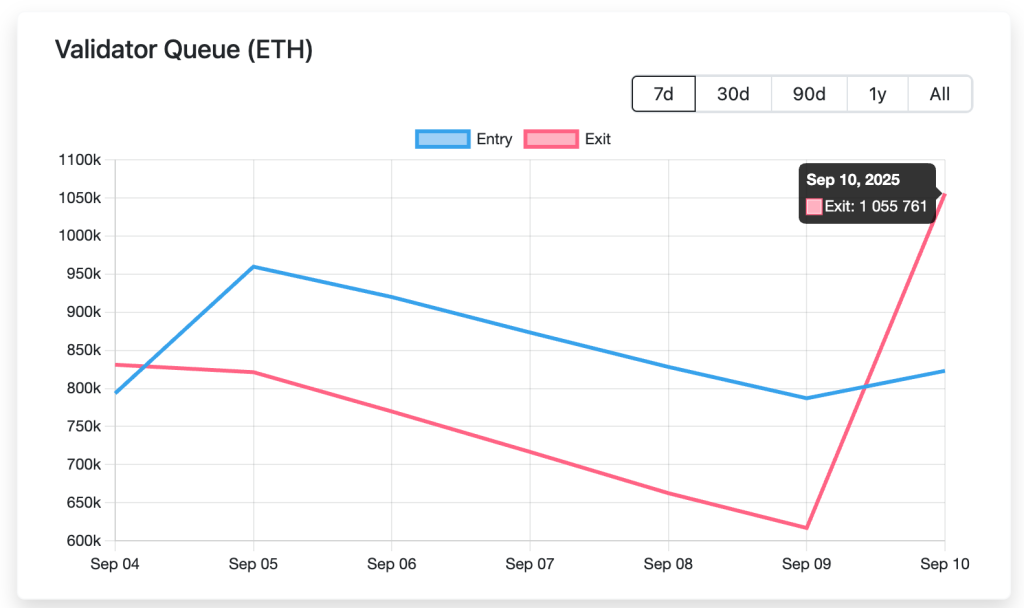
“For context: around 1.6m ETH [~$693m] is staked through the Kiln platform — that is the amount that will be gradually exited from the network,” Sassano added.
Large withdrawals of staked ETH are often seen as bearish, with traders fearing sell pressure ahead. Sassano, however, suggested that Klin would “re-stake the assets using new validator keys”.
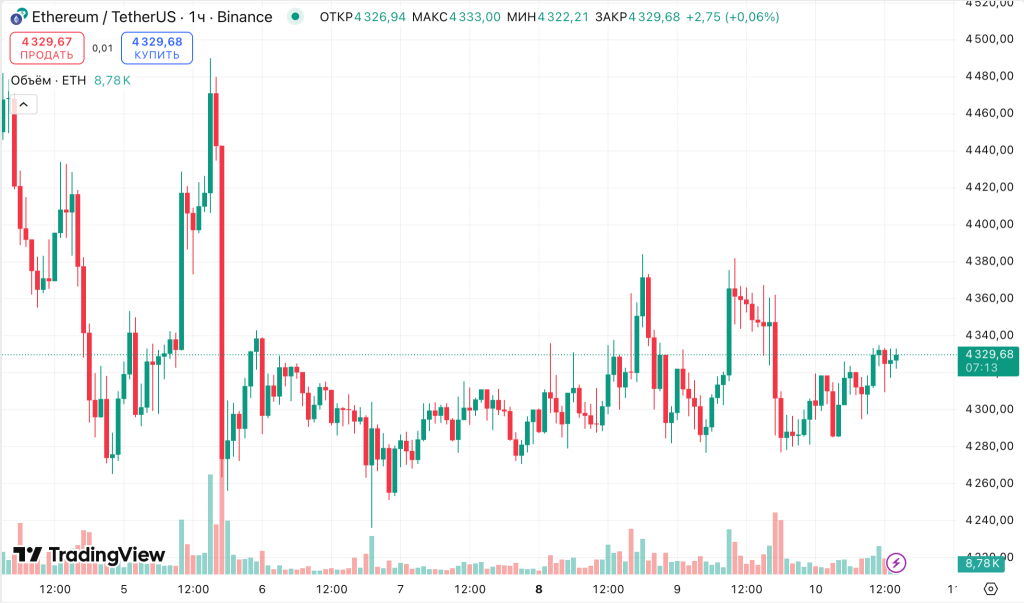
At the time of writing, Ethereum trades around $4,300. The price is down 0.6% over the past 24 hours.


What is happening in the Ethereum market?
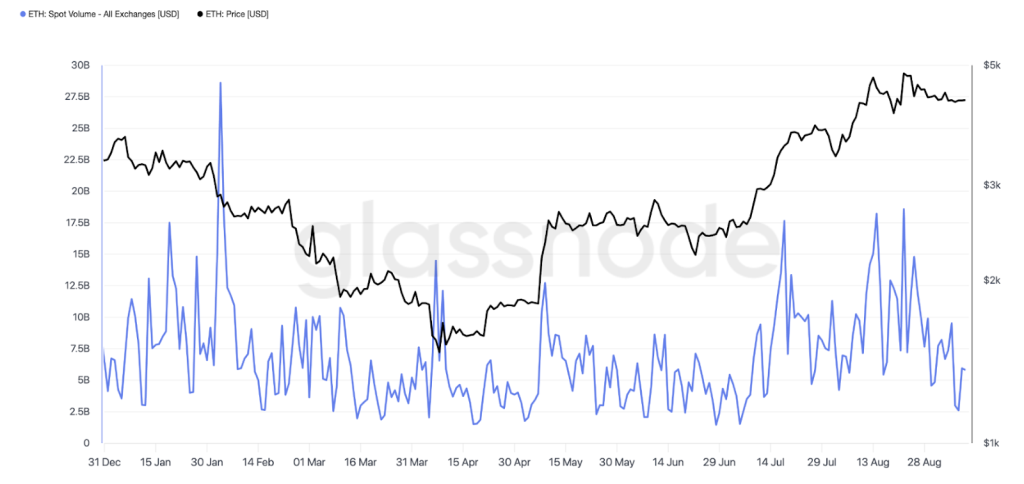
Over the past two weeks, Ethereum has traded in a $4,200–4,500 range amid waning retail and institutional demand. Compared with late August, spot trading volume has fallen by 85% — from $18.5bn on 22 August to $2.6bn on 8 September, according to Glassnode.


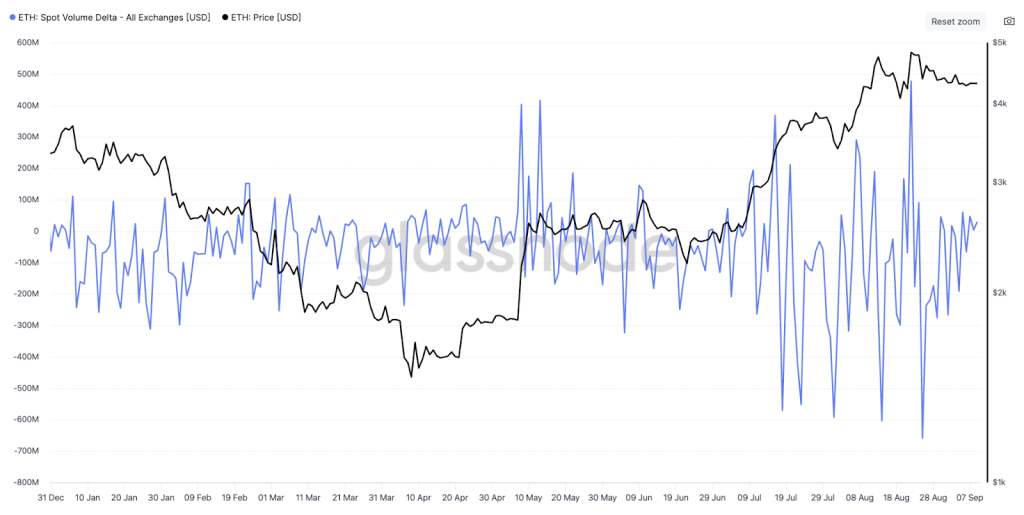
The CVD indicator has stabilised slightly after selling pressure eased. It remains well below the peaks reached in August.


MN Capital founder Michaël van de Poppe reckons the price of the second-largest cryptocurrency could fall to $3,500–3,800.
One leg down for $ETH, tapping the green zone and up only from there.
That would be my ideal scenario. pic.twitter.com/ac0z6HpMB9
— Michaël van de Poppe (@CryptoMichNL) September 6, 2025
Earlier, Santiment analysts also pointed to a shift in trader sentiment, with expectations now for ETH to drop to $3,500. Markets often move against crowd expectations, which may signal an “ideal time to buy”, the experts added.
Crypto investor Ted Pillow identified significant liquidity clusters in the $3,600–4,000 range. He suggested the price could dip to these levels, while allowing that a renewed uptrend may follow the correction.
$ETH has decent liquidity clusters around the $3,600-$4,000 level.
Ethereum price action is also looking weak due to macro uncertainty and weak ETF demand.
It looks like a sweep of lower liquidity could happen before reversal. pic.twitter.com/9Md1S5kP77
— Ted (@TedPillows) September 9, 2025
On 2 September, the amount of Ethereum entering staking exceeded 860,000 ETH worth $3.7bn — the highest since 2023.