



By the end of the decade, over $47 billion in liquidity could transition to Layer 2 solutions on Bitcoin. This estimate was shared by analysts from Galaxy Digital in their Bitcoin L2s report.
The study considers the market share of all wrapped bitcoins in DeFi, native BTC in L2 networks, and BTC locked in staking protocols. According to the report, these segments currently hold 0.8% of all circulating coins. Analysts predict this figure will rise to 2.3% in six years.
“If Bitcoin reaches $100,000 by 2030, the total market for Bitcoin L2 could hit $47 billion, assuming 2.3% of the total BTC supply is locked in them by 2030,” the experts noted.
Since 2018, companies in the segment have attracted approximately $447 million in venture capital, with $174 million raised from January to September 2024. This year, sidechain projects gathered $105 million, while rollups secured $63 million.


Galaxy Digital specialists noted that in the second quarter of 2024, Bitcoin Layer 2 solutions received 44% of all venture investments in the L2 segment, a 159% increase from the same period in 2023.
The authors attribute this trend to the fact that many traditional ventures had not engaged with the Bitcoin ecosystem until 2024. The emergence of Ordinals and BRC-20 in 2023 provided them with new investment opportunities.

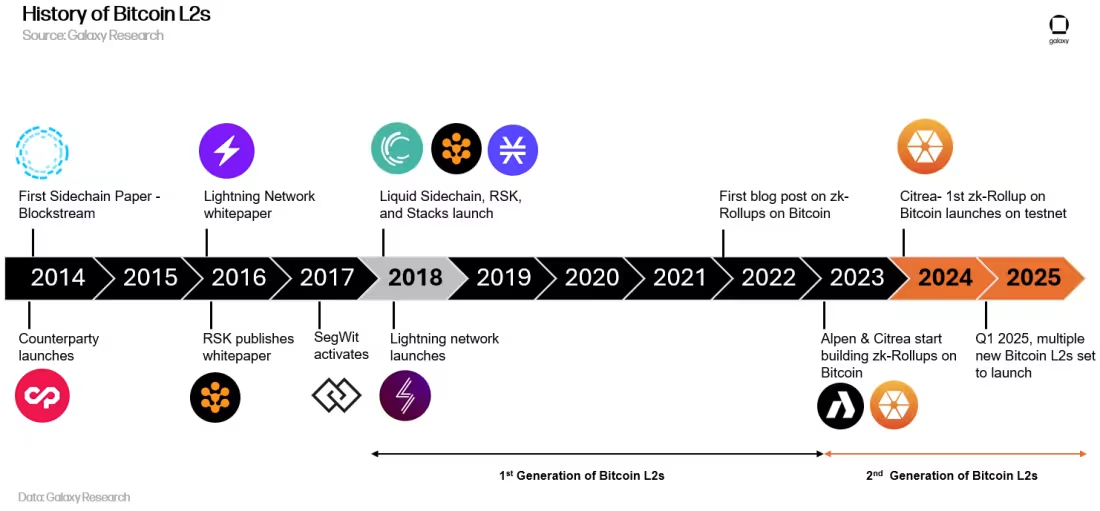
Amid the surge in investment activity in 2024, Galaxy Digital researchers recorded a sevenfold increase in the number of projects in the niche. However, they believe that in six years, the market will be dominated by three to five major players instead of the current 75.
A crucial factor for the long-term adoption of Bitcoin L2 projects will be the DeFi ecosystem:
“To capture a share of the wrapped BTC market, DeFi applications on Bitcoin L2 will need to offer higher yields compared to their Ethereum counterparts. L2 solutions are likely to succeed only if they can capture market share from DeFi applications that accept tokenized versions of BTC, such as WBTC, tBTC, and cbBTC.”
Researchers described Bitcoin L2 as more decentralized compared to counterparts in other ecosystems. They cited the example of WBTC, which faced delisting due to the project’s Bitcoin reserves coming under partial control of Justin Sun’s BitGlobal.
Back in September, Vitalik Buterin shared his views on what scaling solutions should look like in 2025.