




A CryptoQuant analyst using the handle Crazzyblockk says the market may be sliding into an ‘extremely bearish’ phase, judging by the behaviour of investors who have held the leading cryptocurrency for 12–18 months.
Is Bitcoin Shifting Into an Extreme Bearish Market Regime?
“Until Bitcoin reclaims this realized price level with renewed accumulation momentum, market structure continues to favor consolidation, fragile rebounds, and elevated downside risk.” – By Crazzyblockk pic.twitter.com/tBhtkzLkgT
— CryptoQuant.com (@cryptoquant_com) February 2, 2026
Bitcoin is trading below this cohort’s realised price, leaving them in unrealised loss. Historically, sustained trading beneath that threshold has tended to turn a garden‑variety pullback into a structural bear trend.
The analyst flagged weakening accumulation. Balances have risen over the past 30 days, but the pace of buying has slowed markedly, signalling ebbing confidence as dip‑buying loses its zeal.
In this set‑up the realised price acts as stout resistance: rallies invite breakeven selling, adding to supply.
Until price reclaims that baseline and accumulation returns, Crazzyblockk expects consolidation, fragile rebounds and elevated downside risk.
The Fed factor
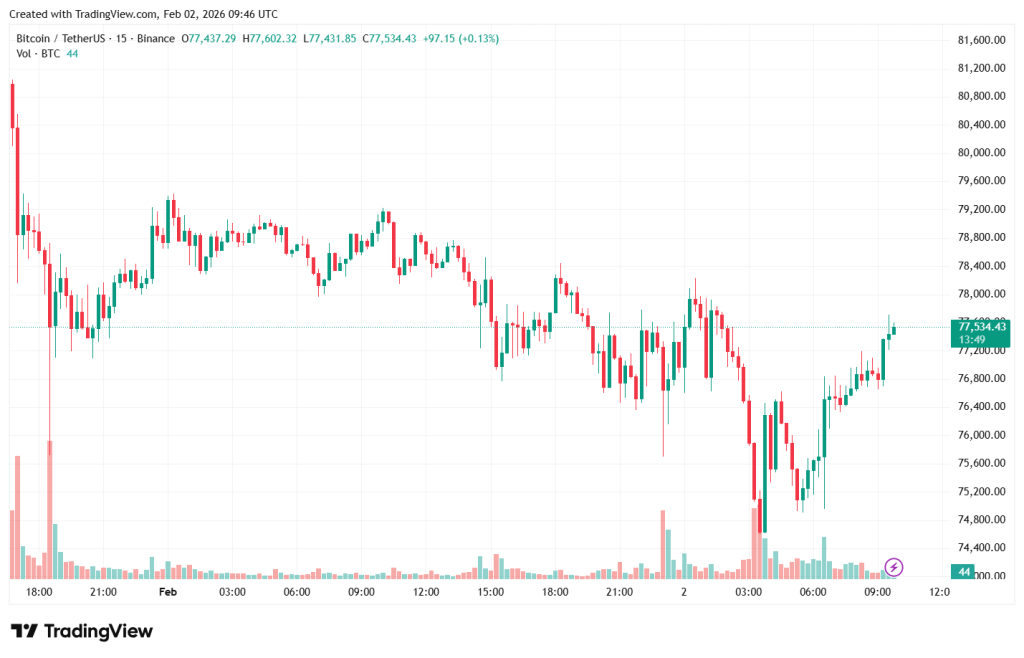
Bitcoin fell below the psychological $80,000 mark. Analysts linked the abrupt drop to personnel changes at the Fed.
QCP Capital said the trigger was the confirmation of Kevin Warsh as the next Fed chair, which markets read as a harbinger of swifter monetary tightening.
The fallout:
- Large-scale liquidations. The drop triggered a wave of forced unwinds of leveraged positions (de‑leveraging). Longs liquidated topped $2.5bn.
- Risk aversion. Sentiment soured amid a fourth straight month of outflows from ETF. Even traditional havens wobbled, with gold and silver pulling back from highs.
- Shifting expectations. Markets are assigning a higher probability to a withdrawal of stimulus under the new chair.
Where is the bottom?
QCP deems $74,500 technically pivotal, as it aligns with 2025’s lows.
Options markets remain cautious: puts outweigh calls, but there is no panic. Softer demand for hedges may suggest investors are beginning to build positions in anticipation of a local bottom.
Analysts outlined key scenarios:
- Bear case: a sustained break below $74,000 risks a retreat to 2024 trading ranges.
- Bull case: a move back above $80,000 would offer the market a respite.
A notable support sits at $76,000 — the average entry price of large institutional players.
At press time, the leading cryptocurrency traded at $77,534, down 1.8% on the day.


Liquidity shortage
A CryptoQuant analyst known as Darkfost pointed to a fundamental issue — a structural lack of liquidity. After a $140bn surge in stablecoins’ market value since 2023, the trend reversed in December, he said.
Stablecoin Flows Collapse
“These dynamics highlight the particularly challenging environment in which Bitcoin is currently operating, weighed down by a persistent lack of liquidity that has now been impacting the market for several months.” – By @Darkfost_Coc pic.twitter.com/UNQAjN1s43
— CryptoQuant.com (@cryptoquant_com) February 2, 2026
Exchange flows reinforce the picture of investors stepping back:
- October: net inflows of stablecoins exceeded $9.7bn, helping propel bitcoin higher;
- Since November: inflows have given way to outflows. More than $4bn has been withdrawn from exchanges, $3.1bn of it from Binance.
Darkfost called this a capitulation by late entrants. A critical juncture was also flagged by a CryptoQuant analyst using the moniker Arab Chain.
Bitcoin on Binance: Elevated Volatility Signals a Critical Market Transition
“Historically, a range z30 reading above +3 has often preceded strong price movements, either in the form of sharp upward breakouts or rapid downward moves.” – By @ArabxChain pic.twitter.com/BjGj90JrCC
— CryptoQuant.com (@cryptoquant_com) February 2, 2026
He recorded a jump in Binance’s z30 volatility gauge above +3. Historically, such readings have preceded strong price moves — either sharp breakouts or swift declines.