




Since early August, the daily volume of XRP sold by long-term holders has jumped 580%—from $38 million to $260 million, according to Glassnode.
Since early August, XRP price has dropped from $3.3 to $2.4 (-27% 🔽).
At the same time, long-term holders who accumulated before Nov 2024 ramped up their spending by ~580%, from $38M/day to $260M/day (7D-SMA)A clear sign of seasoned traders exiting and adding pressure to… pic.twitter.com/q5h02AsdrJ
— glassnode (@glassnode) October 31, 2025
According to the firm, seasoned traders who accumulated before November 2024 have been taking profits. The pickup in selling by this cohort coincided with XRP’s slide from $3.3 to $2.4.
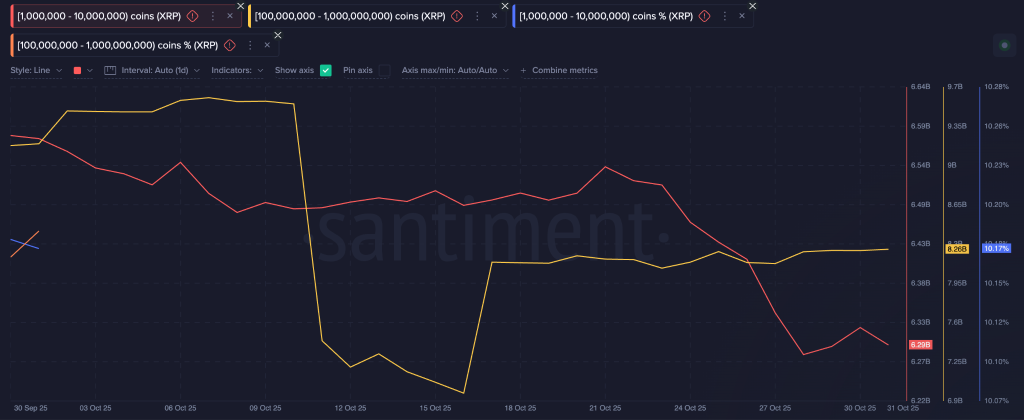
A similar trend is visible among short-term holders: the share of coins aged one to three months has fallen from 12.9% at the start of October to 7.8% now.
Meanwhile, large addresses have begun to accumulate. Over the past two weeks, whales with balances from 100 million to 1 billion XRP increased their holdings from 6.9 billion XRP to 8.24 billion XRP.


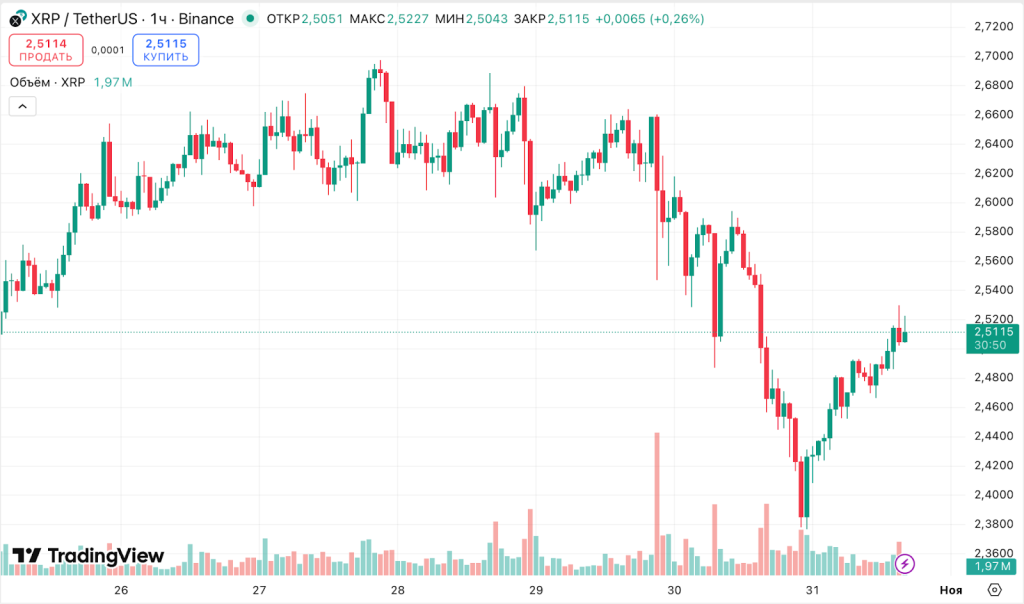
At the time of writing, the cryptocurrency trades around $2.5. The price is up 0.9% over the past 24 hours.


On-chain activity fades and momentum weakens
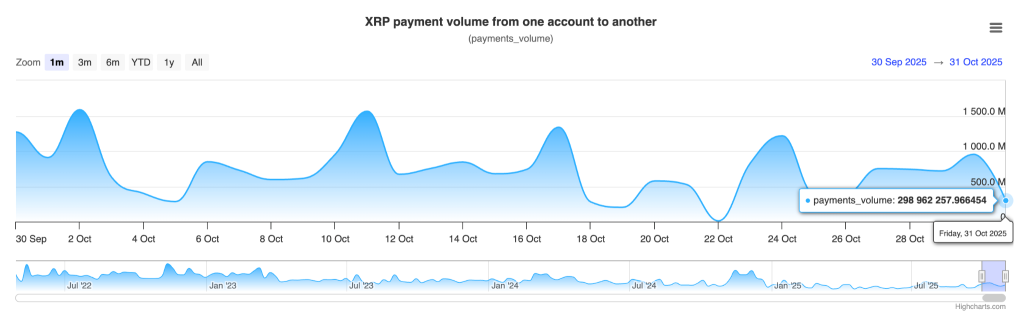
On-chain activity on XRP has dropped sharply. Since early October, the volume of payments—the key utility metric for the XRPL network—has fallen by almost 70%, from 1.5 billion to 298 million.


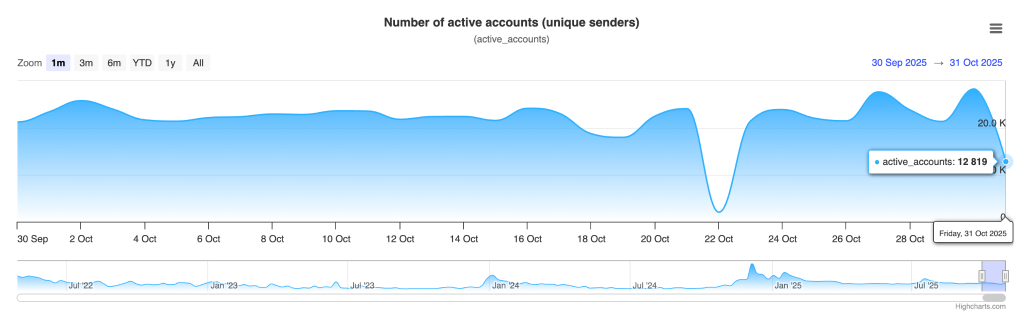
Over the same period, the number of active addresses fell from more than 25,000 to 12,819.


Historically, periods of price stagnation have been accompanied by a prolonged decline in on-chain metrics.
Technically, sentiment is downbeat. According to TradingView, RSI for XRP is at 51—still neutral but tilting bearish. The indicator MACD points the same way. The nearest support area is $2.4.
Renewed debate
XRP’s downward move, coupled with falling on-chain activity, has revived a long-running dispute over the token’s fundamental value. The spark was a post by Scott Melker, host of The Wolf Of All Streets podcast.
I say this with no disrespect, looking for an actual answer.
What is the current pitch for $XRP? The token, not Ripple the company.
Western Union chose Solana for their stablecoin. Swift went with Linea on ETH, which was the selling point I heard for years?
Stablecoins have…
— The Wolf Of All Streets (@scottmelker) October 29, 2025
“What is the current pitch for XRP? I mean the token, not Ripple the company. Western Union ”chose“ Solana for its stablecoin, Swift — Linea on Ethereum. […] What value does XRP represent?” he wrote.
Replies were mixed. Supporters, including XAO DAO co-founder Santiago Velez, argued the asset’s primary role is to serve as a neutral, issuerless bridge currency within XRPL.
“As a native asset, XRP carries only the market volatility characteristic of other digital assets. But this risk can be offset via efficient ”AMM“ and minimal settlement time in operations of rippling. As far as I know, no other major L1 blockchain uses such an architecture, except for XLM (which is a fork of XRP),” the expert noted.
He conceded, however, that “the coin’s adoption is far from the scale at which it is promoted”. In his view, most investors believe in the cryptocurrency’s potential rather than its current level of use.
“The overwhelming part of XRP’s price appreciation is driven by narrative and social consensus. Not by technology, not by partnerships, but by promises of a possible future. We are witnessing the birth of the ‘Internet of Value’ in real time and hope that our assets will realize their potential,” he said, stressing that this is precisely why he chose to invest in the asset.
The user Cripto ISO 22 added that XRP “connects all types of money”, citing recent Ripple initiatives: integration with GTreasury, the launch of RLUSD and a partnership with Evernorth.
The commentator Krippenreiter pointed to an additional use case—institutional DeFi, where locking XRP in smart contracts could materially affect the market balance of supply and demand.
Critics countered that the coin lacks any utility:
“XRP is needed for nothing—it is only sold to pay business expenses and software development. This has nothing to do with the token’s real utility. Banks have already said they are not interested in it.”
Over seven years, Ripple co-founder Chris Larsen earned $764 million from selling the project’s native coin.