



In 2026, the price of the leading cryptocurrency could drop to $40,000, according to a forecast shared by macro analyst Luke Gromen on the Risk Reversal podcast.

Previously, he viewed Bitcoin as a key asset for protecting against fiat currency devaluation. Now, the expert believes that gold and certain stock market sectors have become more effective tools.
“Essentially, only gold and the dollar will win, while everything else will be sidelined,” he stated.
His reassessment of the flagship cryptocurrency was driven by three factors:
- Bitcoin failed to reach new highs against gold.
- The coin broke key moving average levels.
- There are growing concerns in the community about the threat from quantum computers.
According to Gromen, all this has significantly worsened the risk-reward ratio in the short term. During the interview, he repeatedly emphasized the need to reduce positions in the leading cryptocurrency.
Criticism
The community found Gromen’s arguments superficial. An expert under the pseudonym Sina BI Report stated that none of the macro analyst’s reasons for a bearish stance “can be called well thought out.”
None of the reasons Luke gave for his bearish position were well thought out
— quantum: i don’t get it but some people are worried
— recent performance: its not making new high vs gold (good argument for selling at the bottom)
— TA: moving averages broken (meaningless signal)… https://t.co/8yABsHRFvv— Sina 🗝️⚡ BI Report (@Snz_BTC) December 15, 2025
According to him, lagging behind gold and breaking moving averages are typical markers of an attempt to sell during a decline, rather than a justified trend reversal prediction.
On-chain researcher James Check agreed with this view, adding that part of Gromen’s evidence “is based on narratives from X, not on original data.”
“I understand: he doesn’t have time to track the details. But details matter when it comes to a large position — both from an investment perspective and in terms of the role of this asset in his overall macro theory,” he emphasized.
The Danger of a Stable Market
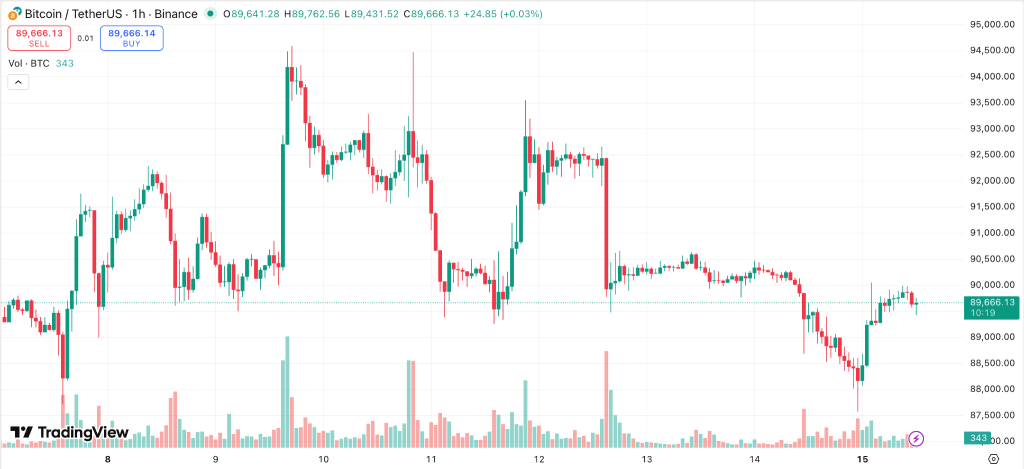
The leading cryptocurrency began the new week with a retreat to $89,000. The asset has been trading in a narrow range for almost a month. At the time of writing, the price of Bitcoin is ~$89,600.


Analysts at XWIN Research Japan have called the current “calm market” dangerous. They referred to the inter-exchange flow pulse (IFP) indicator, which has entered the “red zone.”
Why a Quiet Bitcoin Market Can Be Dangerous: What IFP Is Signaling Now
“Historically, periods when IFP turned red were not defined by orderly trends but by sharp corrections and sudden price swings.” – By @xwinfinance pic.twitter.com/cseSyoqdr4
— CryptoQuant.com (@cryptoquant_com) December 15, 2025
The metric measures how actively Bitcoin is moving from one exchange to another and serves as an indicator of internal market liquidity.
- A high IFP reflects healthy activity. Arbitrage works efficiently, market makers easily replenish order books, ensuring price stability and reducing volatility;
- A low IFP signals a slowdown in the market’s “blood flow.” With thin order books, even minor trades can cause sharp price movements, increasing the overall fragility of the system.
The liquidity decline is exacerbated by historically low amounts of cryptocurrency on trading platforms. Limited supply for sale, on one hand, supports the price, but on the other, depletes order books.
As a result, any price movement is amplified: slippage increases, and volatility spirals. Amid high leverage, the main threat becomes not the trend direction, but the strength and sharpness of price fluctuations.
“History shows that periods of low IFP are associated not with smooth trends, but with sudden crashes and sharp jumps. Therefore, the key risk today is the structural fragility of the market, not bear activity,” the experts concluded.
As reported, an experienced trader who wished to remain anonymous commented to ForkLog on the factors restraining Bitcoin’s growth.