




On 23 February, bitcoin slid to $64,435 in just two hours. Other digital assets fell in its wake.


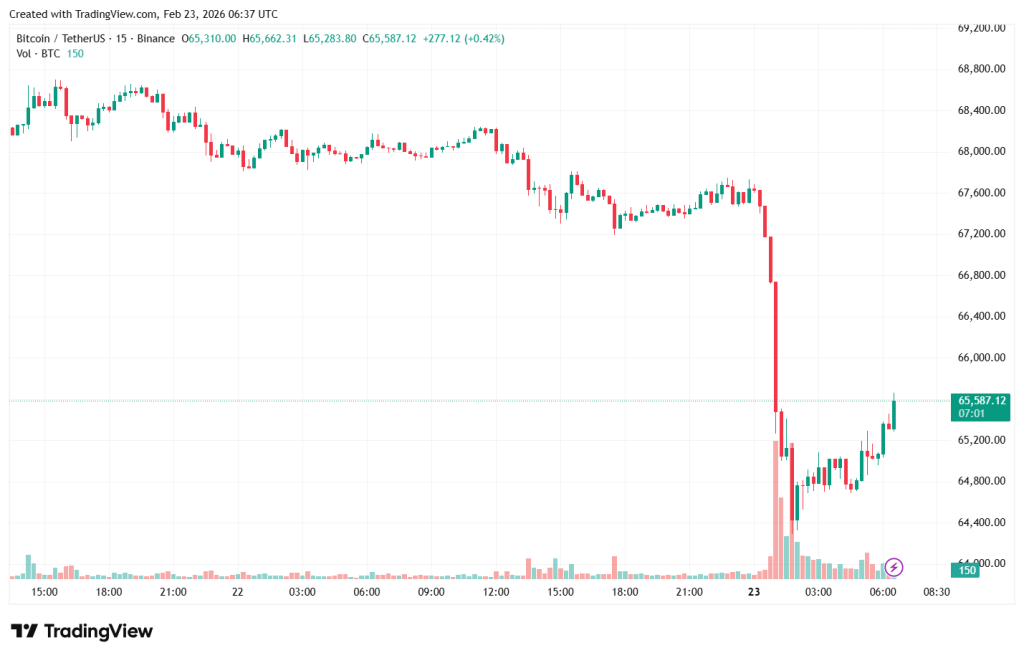
At the time of writing, bitcoin trades at $65,587 (-4.2% over 24 hours).
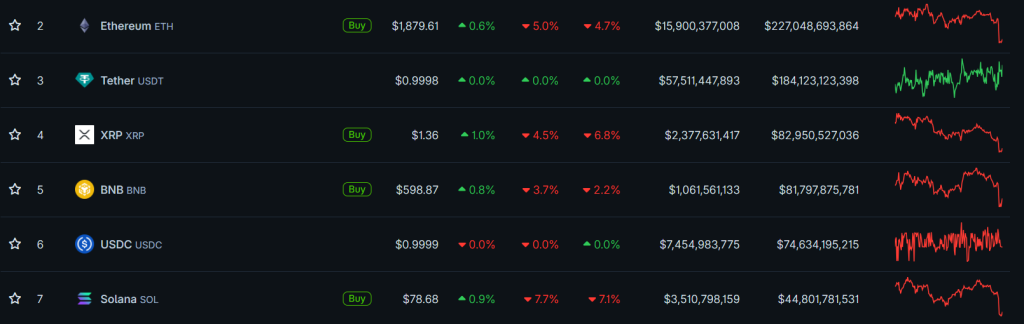
Leading altcoins also retreated: Ethereum fell 5% (to $1,879), XRP by 4.5% (to $1.36). BNB slipped 3.7% (to $598), while Solana lost 7.7% to $78.


Analysts linked the slump to a string of macroeconomic shocks. Mass unrest in Mexico cooled global appetite for risk assets. In the US, the pending home sales index fell to its lowest since 2001.
Pressure on prices intensified after US authorities raised import tariffs from 10% to 15%, sending the dollar and Wall Street futures lower.
Record yen strength also played a role as investors bet the Bank of Japan will turn more hawkish, prompting global funds to cut leverage.
BTC Markets analyst Rachel Lucas noted a lack of liquidity to cushion the impact. Spot trading volumes fell 59%.
Kronos Research CIO Vincent Liu called $60,000 a key support for bitcoin. In his view, a return to the $65,000–66,000 range would stabilise the market, while a break above $70,000 would signal a trend reversal. A rebound could be helped by inflows into ETF products and upcoming US jobless data.
Coin Bureau warned that a drop below $60,000 would spark large-scale liquidations. In that case, trader losses could reach $1.78 billion.
🚨 $1.78 BILLION IN LIQUIDATIONS COULD HIT IF BITCOIN LOSES $60K pic.twitter.com/Jrc0Rv6e8O
— Coin Bureau (@coinbureau) February 23, 2026
Longer-term forecasts remain constructive. Over the past month, large investors have bought 200,000 BTC. Bitcoin’s short-term Sharpe ratio fell to -38.38 — levels seen at bear-market lows in 2015, 2019 and 2022 before strong rallies.
Fear and panic
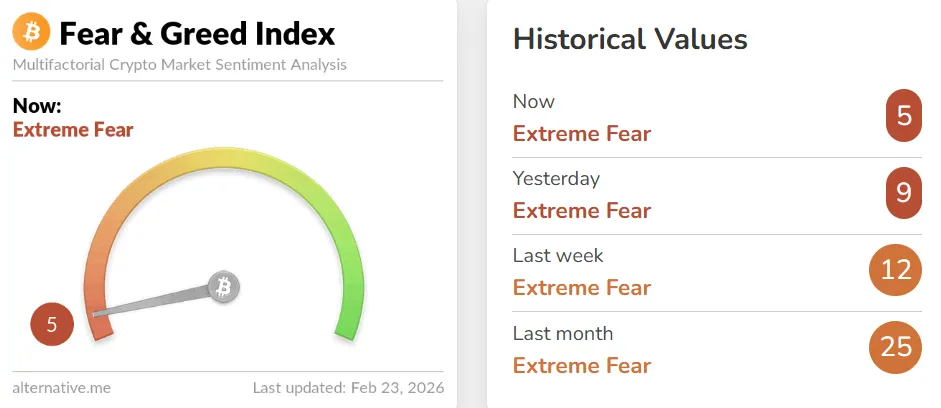
Fear and Greed Index fell to 5 out of 100, an unprecedented low for the series.


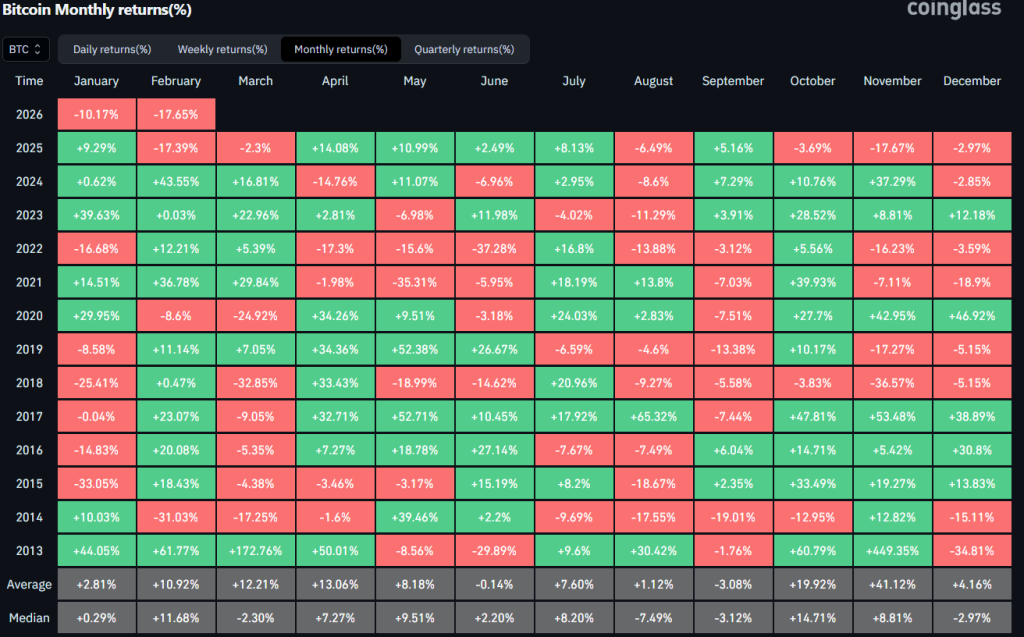
Investor anxiety stems from a prolonged bear trend. If bitcoin ends February in the red, it will be the fifth consecutive monthly decline — the longest losing streak in seven years.


Santiment reported that bitcoin open interest fell to $19.5 billion, half the January peak of $38.3 billion.
📉 Bitcoin just dropped -4.5% in the span of just 2 hours, falling to a market value of $64.2K for the first time since February 5th.
🌊 Many longs have gotten liquidated, and $BTC open interest has dropped to as low as $19.5B, under half of the 2026 peak of $38.3B back on… pic.twitter.com/ujhMRhTXTw
— Santiment (@santimentfeed) February 23, 2026
Analysts highlighted that the drop occurred during a lull in social-media activity. Even so, negative user sentiment hit a two-week high.
After the $65,000 support broke, retail investors succumbed to FUD. Experts noted that such retail panic has historically often catalysed swift price recoveries.
In addition, US Google searches for “Bitcoin to zero” hit a record high.
Insight: U.S. Google searches for “Bitcoin to zero” just hit a record high as $BTC slid toward $60K, a spike that previously aligned with local bottoms in 2021 and 2022. pic.twitter.com/hc3nHsHgsS
— CoinDesk (@CoinDesk) February 22, 2026
Historically, such spikes have preceded swift reversals. In 2021 and 2022, similar peaks coincided with local bottoms.
Risk of sell-offs
Large investors who bought bitcoin over the past six months have accumulated unrealised losses of about $26 billion, according to CryptoQuant analyst Darkfost.
🔴 The level of unrealized losses held by STH whales is becoming increasingly concerning.
At present, roughly $26B in losses are being carried by whales who entered the market within the past six months. This ranks among the most significant levels observed this year.
💥 The… pic.twitter.com/VfAZJ4CCAN
— Darkfost (@Darkfost_Coc) February 22, 2026
He said the current scale of losses among short-term holders is worrying, ranking among the highest this year.
He added that the yearly peak in whales’ unrealised losses was set on 6 February, when, as bitcoin fell below $60,000, the figure reached $32 billion.
Darkfost noted that the main losses are now borne by those who opened positions late in the cycle.
Holding underwater positions erodes confidence. The expert warned that fresh volatility could prompt emotional moves — up to panic selling.
Buterin sells Ethereum
According to Lookonchain, Ethereum co-founder Vitalik Buterin has again stepped up sales of the second-largest cryptocurrency.
vitalik.eth(@VitalikButerin) is selling $ETH faster again.
In the past 2 days, he has sold 1,869 $ETH($3.67M). During that time, $ETH fell from $1,988 to $1,875, down 5.7%.
Last time he sold 6,958 $ETH($14.78M), $ETH dropped from $2,360 to $1,825 — a 22.7% fall.… pic.twitter.com/v2x6Q3ZTme
— Lookonchain (@lookonchain) February 23, 2026
Over the past two days, he sold 1,869 ETH worth $3.67 million. During that period, ETH fell 5.7% — from $1,988 to $1,875.
Analysts also pointed to his previous large sale: Buterin disposed of 6,958 ETH worth $14.78 million, after which the token dropped 22.7% — from $2,360 to $1,825.
Earlier, CryptoQuant analyst Burak Kesmechi outlined four indicators to watch to determine bitcoin’s long-term trend.