



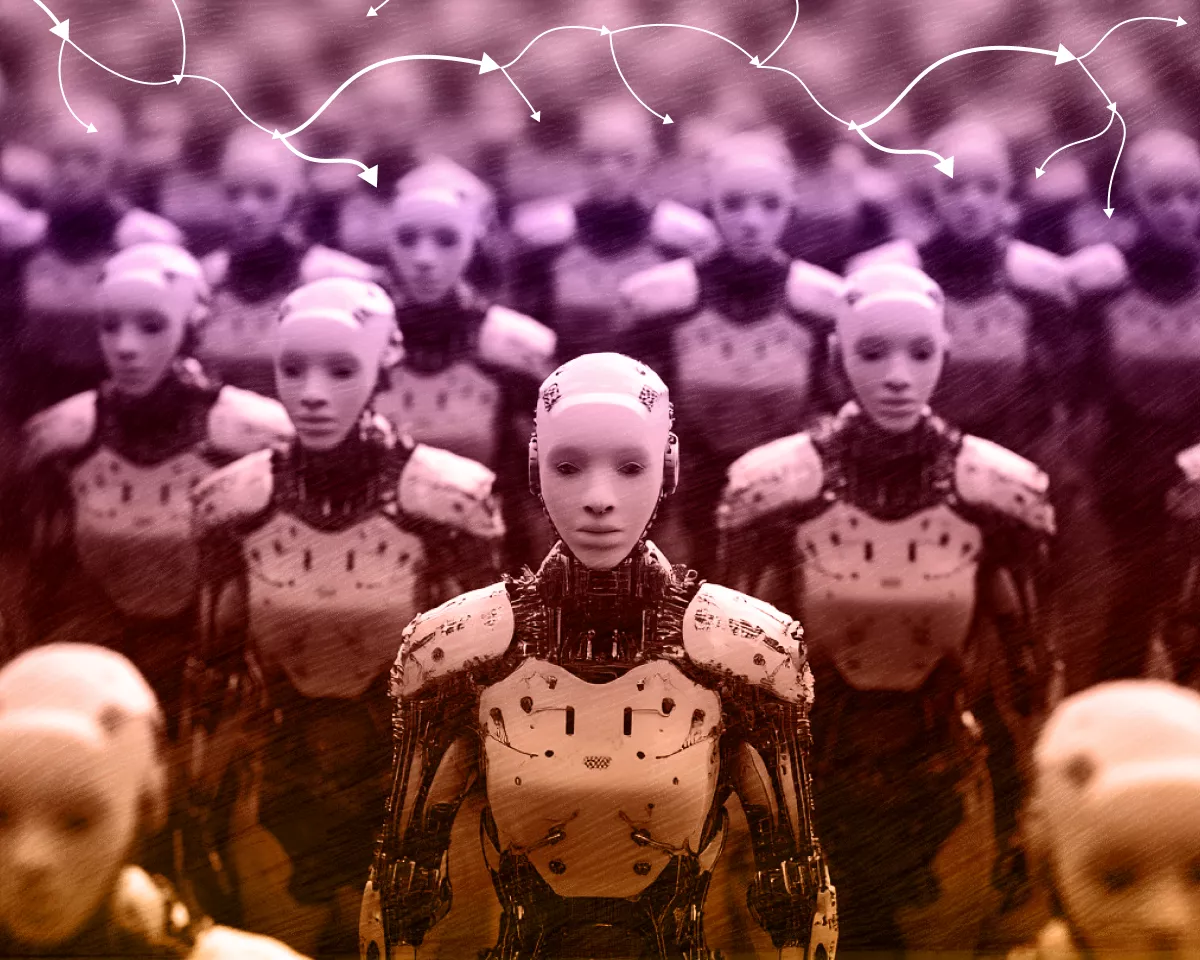
- In China, dozens of humanoid robots are already working in warehouses.
- The state is betting on robotics, allocating funds and procuring machines to spur the industry.
- The risk of mass lay-offs persists, though new jobs could offset it.
Dozens of humanoid robots, overseen by operators, fold T-shirts, make sandwiches and open doors at a vast warehouse on the outskirts of Shanghai, reports Reuters.
The agency spoke with several experts, including Chinese humanoid makers, investors, customers and analysts, to gauge the prospects for and pathways of these metal machines.
According to those interviewed, China aims to extend its lead by focusing on training and refining AI models. Some say the breakthrough by DeepSeek helped materially.
Mass deployment of robots on factory floors would not only sustain China’s economic growth but also reinforce its manufacturing leadership, turning it into a theatre of direct competition with the United States, the agency notes.
How Beijing will handle the risk of mass lay-offs in factories remains unclear. As with earlier industrial revolutions, the creation of new jobs is expected to help absorb the shock.
Amid a trade war with America, a shrinking population and slowing growth, President Xi Jinping underscored the importance of humanoid robots during an inspection of AgiBot machines in Shanghai.


The country is pushing for a new industrial revolution in which bots will carry out many factory tasks.
“Imagine that one day, on our own factory floor, robots will assemble themselves,” said AgiBot partner Yao Maoqing.
State support
Chinese authorities are doling out generous subsidies to humanoid makers. Over the past year more than $20bn has been directed to the sector. Meanwhile Beijing is creating a $137bn fund to support AI and robotics startups.
Reuters analysed hundreds of tender documents and found that the government is also a key buyer.
Other support includes a newly created artificial-intelligence and robotics fund by the city of Shenzhen.
Humanoid manufacturers and component suppliers in Wuhan are eligible for subsidies of up to 5m yuan after hitting procurement and sales thresholds.
In 2023 Beijing’s municipal authorities created a robotics fund that offers up to 30m yuan to companies looking to speed the development of their first products.
Some analysts suggest humanoid robots could follow the trajectory of electric vehicles, whose costs fell sharply over the past decade thanks to state support and mass adoption.
The average bill of materials for a humanoid will be $35,000 by year-end, potentially dropping to $17,000 by 2030 if most parts are made domestically, according to a note by Ming Hsun Lee, head of Greater China autos and industrial research at Bank of America Securities.
Three Chinese humanoid makers offered a similar forecast: a halving of unit costs within a year. For comparison, components for Tesla’s Optimus are $50,000–60,000 owing to key supplies from China.
“Thanks to its extensive supply chain, China has an advantage in markedly lowering the cost of producing humanoid robots,” Lee noted.
He added that by 2030 global sales of bots could reach 1m units a year.
AI and data
Reuters also noted the Chinese government’s investments in data collection.
Robots must interact with the physical world and train on task-oriented datasets for chores such as folding boxes or pouring water into a cup.
In 2024 Shanghai authorities helped set up AgiBot’s data-gathering site. They provided premises free of charge, where about 100 robots work daily under the supervision of 200 people.
The facility yields high-quality data. Parallel sites are being built by the governments of Beijing and Shenzhen.


Humanoid startup MagicLab said its focus on the robots’ “brain” has enabled the rollout of prototypes on production lines for tasks such as quality inspection, materials handling and assembly.
“These breakthroughs lay the groundwork for us to focus on real-world applications in 2025. DeepSeek helped with problem-solving and comprehension, advancing the ‘brain’ of our robots,” said CEO Wu Changzheng.
China’s clearest edge, however, is its dominance in the hardware that makes up a humanoid. Analysts and startups say the country can produce up to 90% of the components, lowering barriers to entry.
“If you have an order in the morning, suppliers can come to your company with materials or products by the afternoon, or you can go straight to their site,” said Zhang Miao, COO of Beijing startup CASBOT.
Jobs at risk
According to the National Bureau of Statistics, about 123m people worked in manufacturing in China in 2023. Social-security expert Zheng Gongcheng warned that the development of robots and AI will affect around 70% of the manufacturing sector, which could sharply reduce contributions to the social-security fund.
Tang Jiang, chief technologist at the government-backed Beijing Innovation Center for Human-like Robotics, said his prototypes target work people do not want to do because it is monotonous or repetitive.
Despite concerns about employment, Beijing sees the technology as key to easing labour shortages in fields such as elderly care, where the problem is worsening as the population ages.
“In five or ten years, robots will be able to tidy an elderly person’s room, pick up a package or even carry them from the bed to the toilet,” said AgiBot’s Maoqing.
The OS problem
Unitree Robotics founder and chief executive Wang Xinxin said the biggest problem facing Chinese humanoid makers is the lack of a mature, unified end-to-end AI system.
In 2025 the sector is shifting to mass production. Those who achieve a breakthrough in technology that lets robots perform general tasks without launching separate programs for specific actions will become the strongest players in robotics, Wang noted.
Six of 11 domestic humanoid makers have planned to ship more than 1,000 units in 2025. Many startups are experiencing “powerful growth momentum” and are “swamped with orders,” Wang said.
Huawei and UBTech team up
Meanwhile Huawei struck a partnership with UBTech Robotics to develop humanoids for factories and households. It aims to “accelerate the transition of robots from laboratory innovation” to “large-scale deployment in industrial, household and other scenarios”.
Both companies plan to collaborate on building “smart” factories with bots and on developing bipedal or wheeled service robots for home use.
As part of the agreement Huawei will also help UBTech build an innovation centre focused on “embodied intelligence” — a form of artificial intelligence in which cognitive processes are embedded in the human body.
In April, 21 humanoid robots took part in the Beijing half-marathon. Not all bots reached the finish; some struggled right from the start.