




Publicly traded mining companies sold approximately 70% of the bitcoins they mined in April. These preliminary figures, based on reports from eight firms, were highlighted in TheMinerMag.


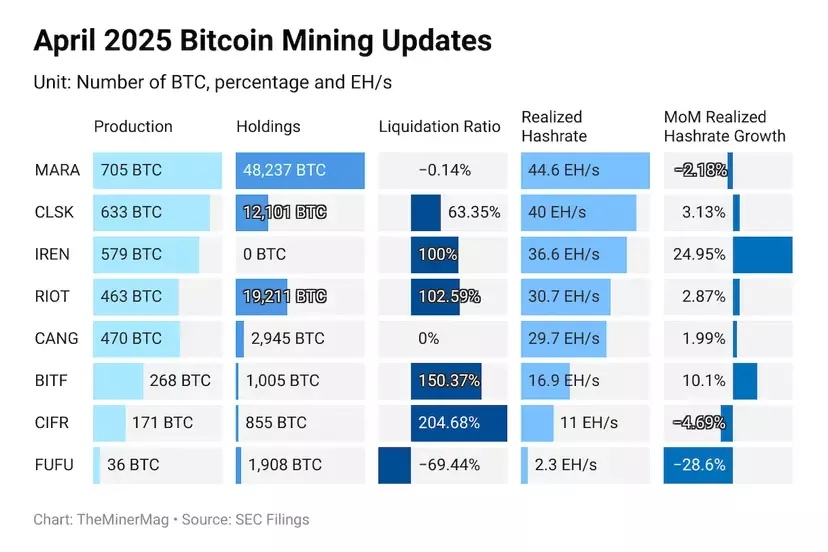
The publication tracks data from 15 public companies in the industry following Bitfarms’ acquisition of Stronghold and the cessation of monthly operational disclosures by Bit Digital, Argo, and Terawulf.
The shift away from last year’s popular HODL strategy became evident in March. The volume of sales reached its highest level since October 2024.
Riot Platforms and CleanSpark officially announced their departure from a 100% retention policy of mined cryptocurrency. Consequently, by the end of April, the former liquidated more than 100% of its mined bitcoins, while the latter sold approximately 65%.
Only three companies — MARA, Cango, and BitFuFu — fully retained their production.
According to BitcoinTreasuries, MARA increased its reserves to 48,237 BTC, second only to Strategy with 555,450 BTC.



Despite moving away from the HODL strategy, Riot and CleanSpark continue to hold 19,211 BTC and 11,869 BTC, respectively.
Mining Profitability Remains Under Pressure
Experts largely attribute miners’ shift to sales to ongoing pressure on mining profitability from network technical parameters. Even amid a rise in Bitcoin’s price above $100,000, hashprice only reached $55 per PH/s per day, significantly below the December local highs of around $63.


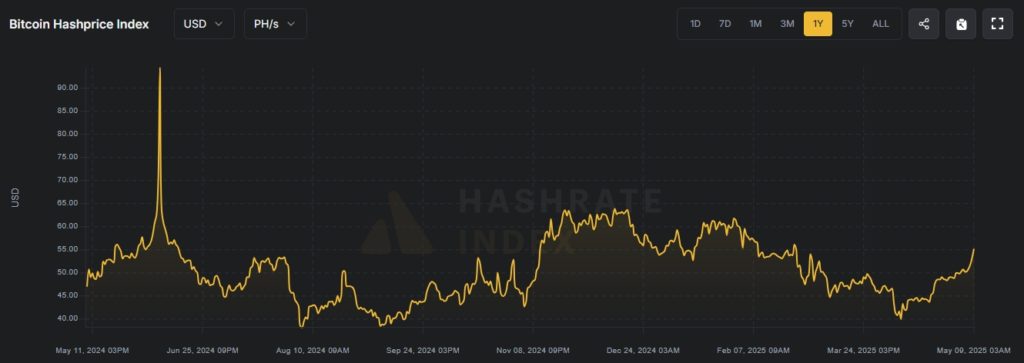
Considering the 3.34% mining difficulty adjustment in May, the indicator has shown an increase of approximately 8.5% since the beginning of the year.
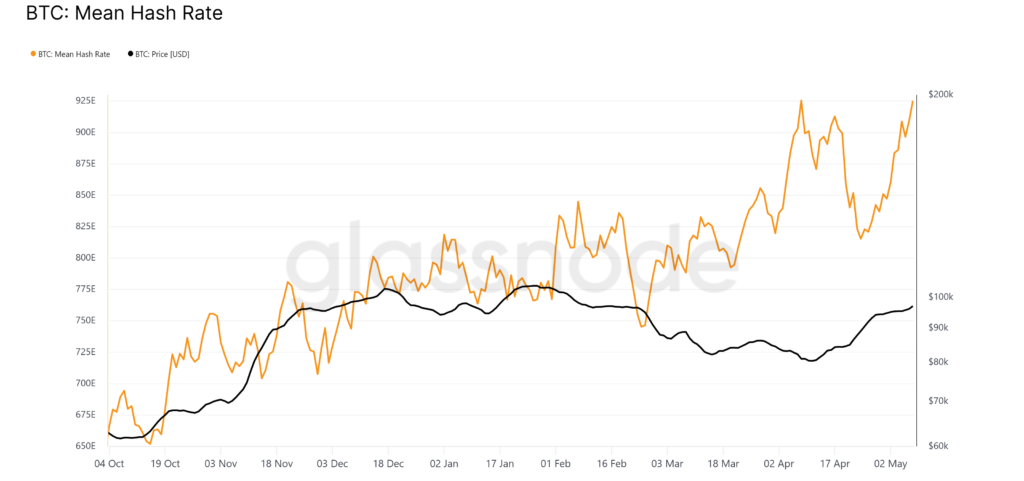
The hash rate (7 DMA) has nearly returned to the record level of 925.43 EH/s, recorded on April 8.


Public miners continued to expand their computational power in April. MARA’s connected hash rate reached 57.3 EH/s, an increase of 5.5% for the month.
IREN reported 40 EH/s — a growth of approximately 8%. The company is closing in on the second-ranked CleanSpark with 42.4 EH/s (unchanged for the month).
Analysts have identified a significant divergence between Bitcoin’s price dynamics and hash rate as a potential risk to network security. CryptoQuant viewed the trend as a sign of strong underlying factors for the leading cryptocurrency.