



Media: Russia suspects Durov of abetting terrorism
Reports: Russia probes Durov for allegedly abetting terrorism.
Russian media report that the actions of Telegram founder Pavel Durov are being investigated under a criminal case for aiding terrorist activity. This was reported by Rossiyskaya Gazeta and Komsomolskaya Pravda, citing the ФСБ.
According to the outlets, the probe under Article 205.1(1.1) of the Russian Criminal Code concerns the dissemination of illegal content. The messenger’s administrators allegedly failed to comply with Roskomnadzor (RKN) orders to remove channels and chats carrying information banned in Russia.
The materials also claim that Telegram is used to commit crimes and “to post materials of extremist and terrorist organisations”.
RKN began restricting the service in summer 2025, citing rising fraud. In February 2026 the authorities intensified the “throttling” of the messenger over non-compliance with Russian law. At the time Durov said that “Telegram stands for freedom of speech and privacy”.
Not the first time
Telegram was already blocked in Russia in 2018. The Tagansky District Court of Moscow fast-tracked a lawsuit by Roskomnadzor and the FSB to restrict access to the messenger.
The reason was the service’s refusal to provide encryption keys. Law enforcement called it “a threat to national security”.
In 2020 lawmakers from the A Just Russia party submitted a bill to lift the block on Telegram. The authors said the messenger was “one of the main information resources” and played an important social role during the COVID-19 pandemic.
A few days later RKN restored access to the service nationwide. The unblocking, however, resulted not from the bill but from Durov’s statement about improving anti-terrorism mechanisms.
A ban in Ukraine?
Ukrainian authorities also cite the use of Telegram for unlawful purposes. One of the first draft laws to regulate the messenger was submitted to the Verkhovna Rada back in 2024.
On 22 February 2026, Iryna Vereshchuk, deputy head of the office of President Volodymyr Zelensky, said it was necessary to consider restricting Telegram in the country after explosions in Lviv. In her view, such messengers are allegedly used to recruit people to commit crimes.
Later, Interior Minister Ihor Klymenko and the deputy head of the СБУ, Ivan Rudnytsky, put forward a similar initiative, СМИ wrote.
At the same time, Klymenko noted that a total ban was not on the table. The main goal, he said, is to minimise crimes that Telegram helps organise.
“Regarding the use of Telegram — this is a question not only for the Ministry of Internal Affairs or the Security Service of Ukraine. This is a question that society should also answer,” he added.
The case in France
In August 2024 the founder of Telegram was detained in France. The authorities said they arrested Durov as part of a sweeping cybercrime investigation, including the unlawful provision of cryptography services and tools.
He was accused of a number of offences linked to organised crime, including complicity in the distribution of drugs and child pornography. The charges also included refusal to provide information in response to authorities’ requests.
In spring 2025 Durov was allowed to temporarily leave France. He later called the detention “a legal absurdity”. The criminal case against the Telegram founder remains under preliminary investigation.
After his release he immediately announced tighter moderation in the messenger and stricter search rules to combat illegal content.
“We seek to engage with regulators to find the right balance [between privacy and security]. Our experience is shaped by our mission to protect our users in authoritarian regimes. But we have always been open to dialogue,” the entrepreneur stressed.
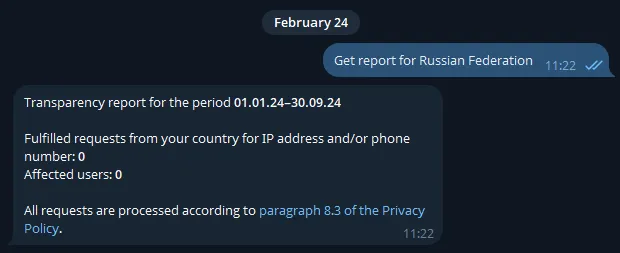
Telegram also discloses IP addresses and/or phone numbers of wrongdoers at the request of authorities, starting from 2018.
You can check the number of processed requests via a special bot, but up-to-date information is unavailable. The data are limited to September 2024.
Digital (un)freedom
More countries are seeking control over the digital lives of their citizens. One of the most contentious initiatives is the EU’s “Chat Control” bill.
The proposal mandates scanning private messages with AI — purportedly to detect child sexual abuse material. It would cover services with end-to-end encryption, including Telegram, WhatsApp and Signal.
The bill also envisages age verification across all digital platforms.
Users have opposed the initiative and launched a campaign called Fight Chat Control. Debates over the document continue.
In Australia, an age-verification system went live in December 2025, covering almost all digital platforms — from search engines and social networks to app stores. In China, digital IDs were launched in July.
In October, Durov warned of the “imminent death” of the free internet.
Рассылки ForkLog: держите руку на пульсе биткоин-индустрии!