



MIT researchers demonstrate intelligent self-assembling robots
Scientists at MIT’s Center for Bits and Atoms launched a project to create robots capable of assembling themselves into larger structures.
The team concedes that the development of such a fully autonomous device will take years, but there are already encouraging results.
The system demonstrated by the researchers comprises large useful structures, made up of an array of tiny identical subunits — voxels. Each of them can transmit energy and data from one device to another.
This enables the construction of architectures capable of withstanding loads and performing work such as moving and manipulating objects.
The prototypes designed by the scientists consist of chains of voxels connected to one another. They can capture and attach additional subunits before moving along a grid for further assembly.
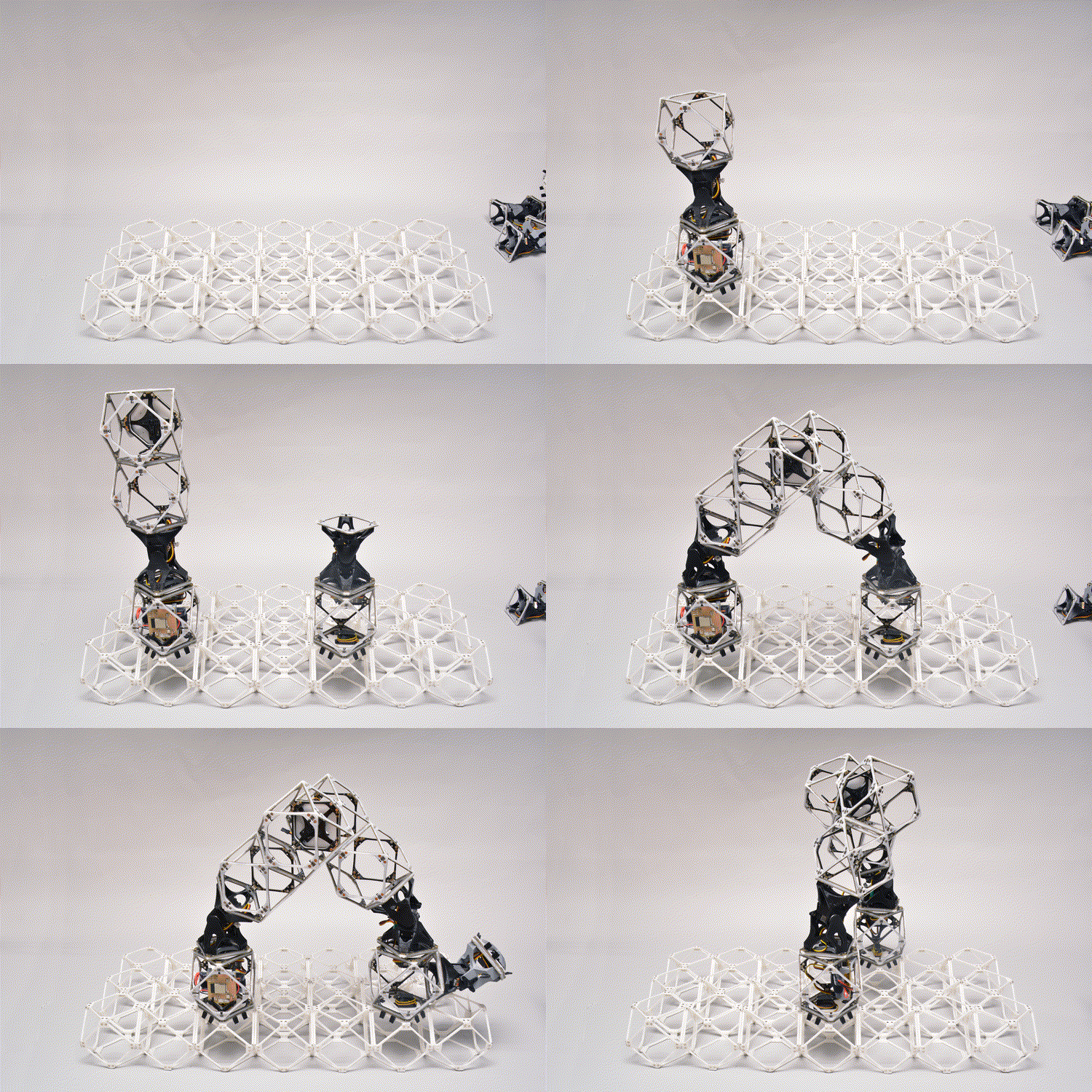
“Our approach challenges the convention that large machines are required to build large structures,” the researchers noted in a project-related article published in Nature Communications Engineering.
They say the proposed method could be applied in areas that today either require substantial capital investment in stationary infrastructure, or are altogether impractical.
The researchers added that developing the appropriate level of intelligence for such systems remains a major obstacle. Among other things, the robots must determine how and where to build, when to start constructing a new installation, and how to avoid accidental ‘collisions’ in the process.
In addition, the team is trying to create sturdier connectors so that voxels do not break apart and stay together.
The researchers believe that using robots to determine the optimal assembly will save engineers a great deal of time spent on prototyping.
NASA and the U.S. Army Research Laboratory helped fund the MIT project.
In August, researchers at the University of Montpellier created a DNA nanobot. The device, about the size of a human cell, will help study viruses and pathogens at the microscopic level.
In December 2021, researchers, using AI, created ‘living’ robots capable of reproduction. They consume single-celled organisms and recreate themselves.
Subscribe to ForkLog news on Telegram: ForkLog AI — all the news from the world of AI!
Рассылки ForkLog: держите руку на пульсе биткоин-индустрии!