



Keone Hon, the founder of Monad Labs, addressed comments made by BitMEX co-founder Arthur Hayes regarding the new L1 blockchain. The developer elaborated on the project’s technical features and responded to the crypto expert’s skepticism.
Dear @CryptoHayes , I respect what you have built for the industry. Perps are an amazing innovation that I believe will continue to grow rapidly. You’ve had a big effect on our industry.
I have seen you commenting on Monad a lot for the past few days. While I’m sure some… https://t.co/TpoC7M7KYP
— Keone Hon (@keoneHD) November 29, 2025
Hayes’s Criticism
On November 29, during the Altcoin Daily podcast, Hayes described Monad as a “typical venture token with an inflated FDV.” The analyst predicted a 99% crash for MON.

The BitMEX co-founder explained that projects with a large gap between FDV and circulating supply typically experience a short-lived speculative pump, followed by a crash when tokens are unlocked for founders and funds.
“This is another ‘bearish’ blockchain. Initial hype does not guarantee the formation of a sustainable ecosystem,” Hayes stated.
According to him, historical data indicates a low survival rate for new L1 solutions. In the long term, only a few remain relevant, including Bitcoin, Ethereum, Solana, and Zcash, he noted.
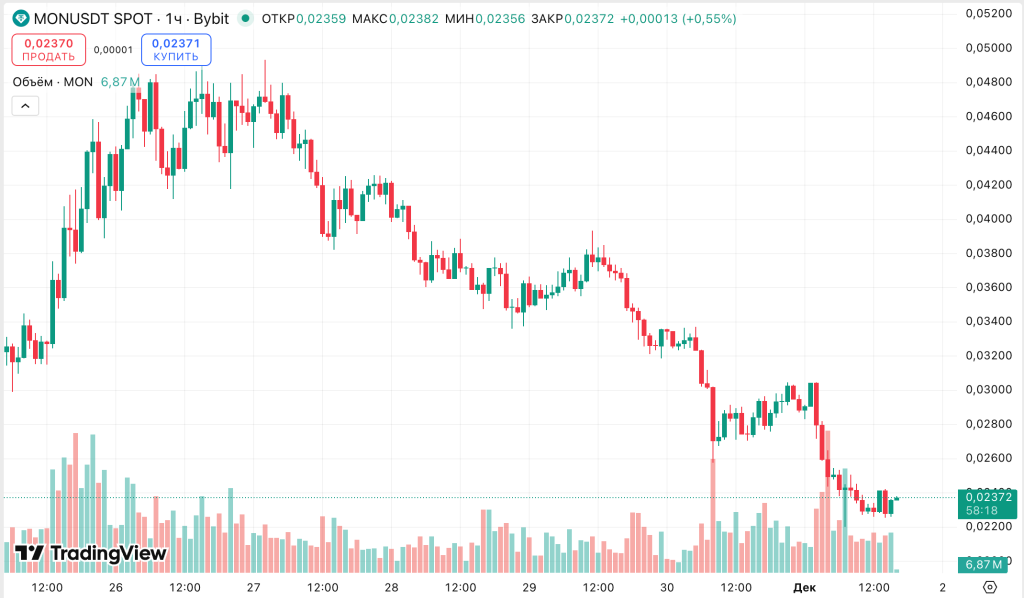
At the time of writing, MON is trading at $0.02, 52% below its peak of $0.04 reached on November 26.


Monad’s Response
Hon emphasized his respect for Hayes’s contribution to the industry but considered his recent comments to be taken out of context. According to the project leader, Monad is not just another first-level blockchain but a technologically new architecture.
Hon cited speed as the network’s key advantage. Withdrawing funds from Coinbase and displaying them in a wallet takes only one to two seconds.
The Monad founder highlighted several important aspects:
- Decentralization: The network is supported by 170 validators distributed worldwide, distinguishing the project from centralized chains dependent on a single sequencer;
- New stack: The code is written from scratch in C++ and Rust — fully open and audited;
- MonadBFT consensus: This mechanism addresses the “tail forking” issue. It allows for pipelining the block creation process without the risk of chain reorganization and MEV attacks;
- Asynchronous execution: Consensus and transaction execution are separated into different threads to enhance efficiency. A similar approach is currently being attempted by Ethereum.
Hon also mentioned the launch of the MON token. The asset became the first on Coinbase’s token sale platform. The team used a “fill from the bottom” distribution model to prevent large players from buying up the entire issuance.
In conclusion, the developer invited Hayes to personally test the network and expressed his willingness to send him MON tokens for transactions.
Earlier in November, attackers began making fake ERC-20 token transfers on the Monad network.