




What are monolithic blockchains?
As the name implies, a monolithic blockchain is a distributed system with a single, unified structure. Its nodes handle consensus, transaction execution and data availability.
Unlike modular designs, in monolithic blockchains all these tasks are carried out on one layer or within a tightly coupled group of chains (also operating on one layer).
Most blockchains in today’s crypto ecosystem are monolithic. Examples include Bitcoin, Solana and, in its early stages, Ethereum.
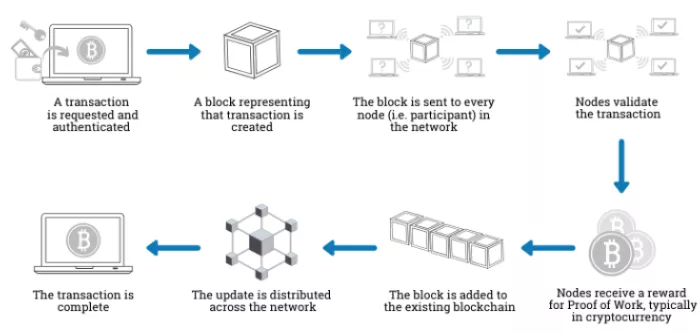
Consider how a monolithic blockchain works using Bitcoin as an example:
- A Bitcoin node receives a transaction from another participant, verifies the signature and checks the data against the consensus rules.
- If the transaction is valid, the node adds it to the mempool (or rejects it).
- A miner pulls the transaction from the mempool and adds it to a candidate block.
- If the miner finds a valid nonce for the candidate block (as required by Proof-of-Work), the block can be broadcast to other nodes. Those peers also validate the transactions and, if everything checks out, append the new block to the chain.


Nodes in a monolithic blockchain provide:
- Data availability. Each node stores a copy of the entire blockchain, retaining every transaction. Any peer can request data from another peer.
- Execution. All nodes validate transactions against the consensus rules. In account-based blockchains (which typically support smart contracts), nodes execute transactions to compute the network’s new state.
- Consensus. Nodes agree among themselves on which transactions are processed into new blocks and in what order.
- Settlement or dispute resolution (settlement). This function guarantees the irreversibility of confirmed transactions and provides arbitration if their validity is contested.
A monolithic architecture assumes nodes perform all these functions. In modular systems, execution is separated from settlement, consensus and data availability.
What are modular blockchains?
A modular approach marks a sharp shift in how blockchains are built. It is about specialisation: one blockchain focuses on executing transactions, another on maintaining consensus.
A modular blockchain therefore concentrates on a subset of tasks, offloading the rest to one or more separate layers. Think of the components as Lego bricks that can be combined into different constructions.


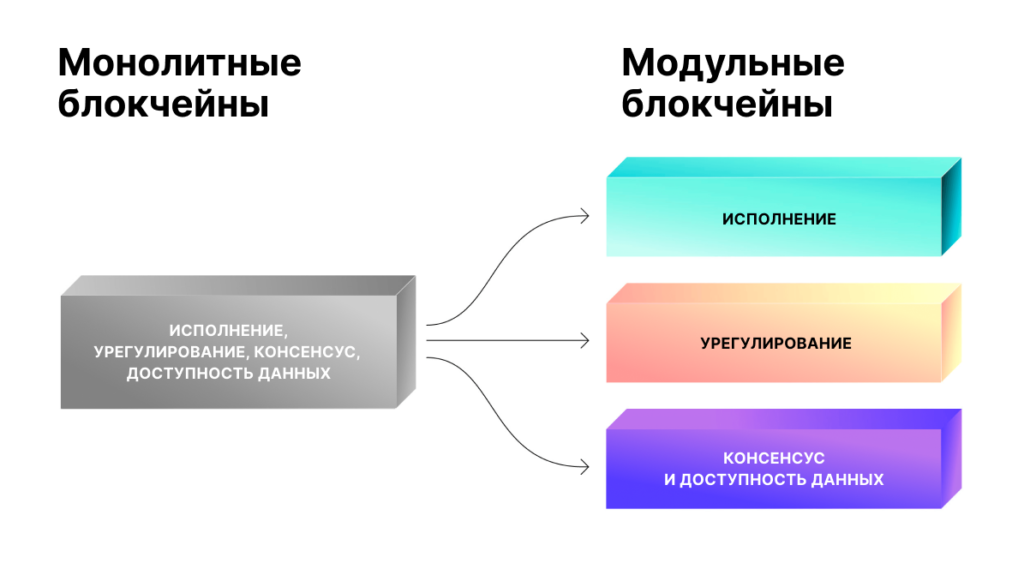
Modular blockchains are plug-in modules, each of which can be swapped or combined with another depending on the use case.
Example modules include rollups. These scaling solutions specialise in processing transactions (execution). The parent chain handles consensus, data availability and settlement.
How do modular blockchains work?
Consider Ethereum through the modular lens. Like Bitcoin and many first-generation blockchains, the network of the second-largest cryptoasset by market value was initially designed as a monolithic system. To address the scalability trilemma, Ethereum is evolving into a modular architecture.
A key milestone is sharding. The idea is to move away from a model in which every node computes every operation, towards parallelism, in which nodes process only specific computations. That allows many transactions to be processed at once.
Sharding splits the blockchain into multiple subnets, each handling a slice of network activity. By dividing functions across components, the system achieves greater efficiency and throughput than if every part worked on the same tasks.
Ethereum’s developers are introducing a system of 64 components (shards) that run in parallel. Nodes manage only the ledger segment they are assigned to (execute processes and confirm transactions), rather than maintaining the entire ledger.


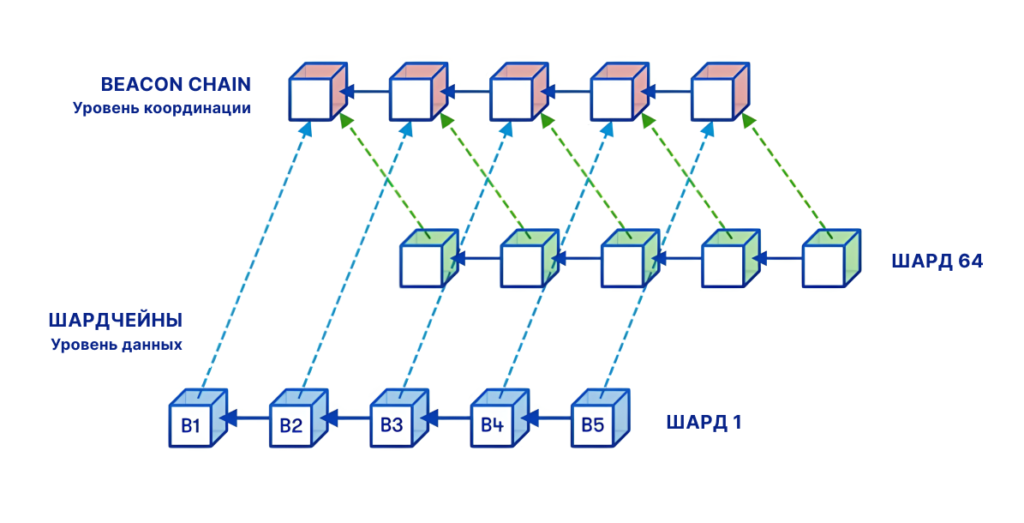
In a modular design, shard chains store different parts of Ethereum’s data. Segmenting execution lets each of the 64 components process its own set of transactions. This approach increases the system’s throughput and speeds up operations.
Some developers advocate a rollup-centric path to improving Ethereum’s performance.
Unlike other (more centralised) scaling schemes such as sidechains, rollups are tightly coupled to the parent chain. They serve as an extension that improves the system’s capacity.
With rollups, the Ethereum blockchain outsources computation, focusing on settlement, consensus and data availability.
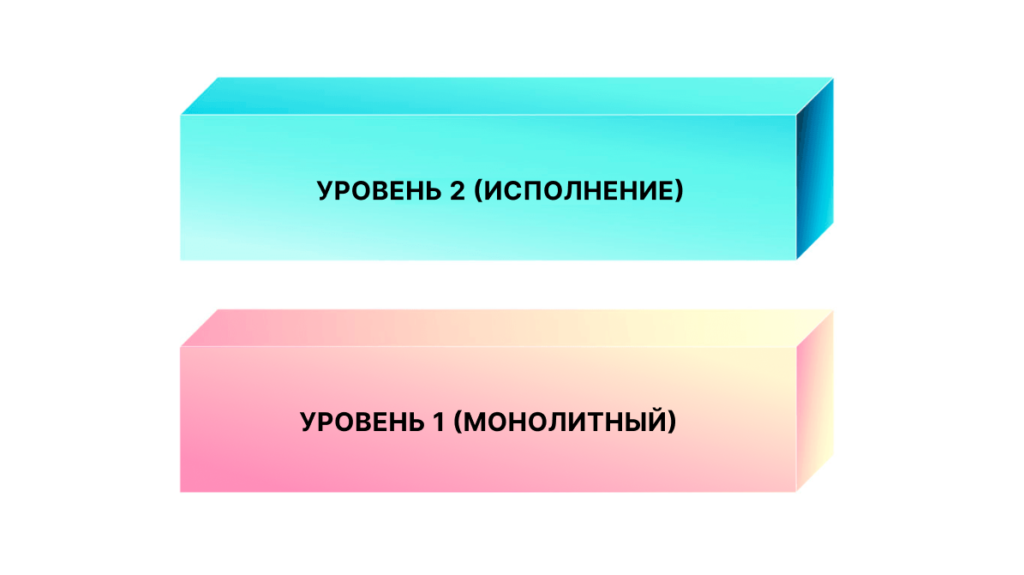
L2 solutions can radically optimise transaction processing without sacrificing security or decentralisation.
What are the advantages and disadvantages of monolithic blockchains?
Monolithic blockchains were the first way to build distributed systems. But scaling them is hard without giving up security or decentralisation.
The chief advantage of monolithic blockchains is simplicity. With a single-layer design there are fewer moving parts to build and maintain. The approach is also easier for newcomers trying to understand the technology. The main drawbacks are:
- low throughput, which undermines efficiency. To boost performance, developers may shorten block intervals and increase block size. That raises hardware requirements for nodes. As a result, fewer nodes can validate the chain, risking centralisation and the hazards that come with it;
- limited flexibility. Implementing changes and improvements in monolithic blockchains can be difficult—optimising one dimension often forces trade-offs elsewhere. Such rigidity makes it harder for a network to adapt to emerging needs and technological advances;
- continuous growth in blockchain size over time, because all transactional data must be stored. Hardware demands rise, creating risks for decentralisation;
- limited control. Applications must follow the network’s preset rules where they are deployed: the programming paradigm, the feasibility of hard forks, community culture, and so on;
- potential difficulty attracting miners or validators, on whom the network’s security depends.
“The overhead of deploying monolithic blockchains is high. Worse, security is fragmented, since every chain has the task of creating its own validator set. If we want an internet of blockchains, we cannot have each of them providing its own security,” — note Celestia’s representatives.
In their view, fragmentation stemming from the relative closedness of monolithic chains can hinder interoperability, complicate life for developers and harm the user experience.
What are the advantages and disadvantages of modular blockchains?
The advantages of modular blockchains include:
- scalability — because transaction processing and other resource-hungry tasks are pushed to L2 networks. These can handle large volumes of on-chain operations without compromising security or decentralisation;
- high security and decentralisation, provided by the base layer;
- flexibility and compatibility with other L1 and L2 systems, allowing developers to launch diverse networks and virtual machines, including EVM;
- a good user experience. In particular, modular design enables high interoperability. This lets developers build universal applications, lower entry barriers for newcomers and simplify interactions for existing blockchain users;
- future-proofing. Modular blockchains are more adaptable to changes and improvements. By offloading specific functions to other layers, chains are easier to upgrade without materially affecting the whole system;
- an even distribution of security across networks in the modular system.
- sovereignty. Applications on monolithic blockchains are tied to a predefined rule set (technical choices, the smart-contract programming language, social consensus, etc). In modular systems, developers can freely alter the technology stack—for example, to create a more efficient execution environment or change how transactions are processed.
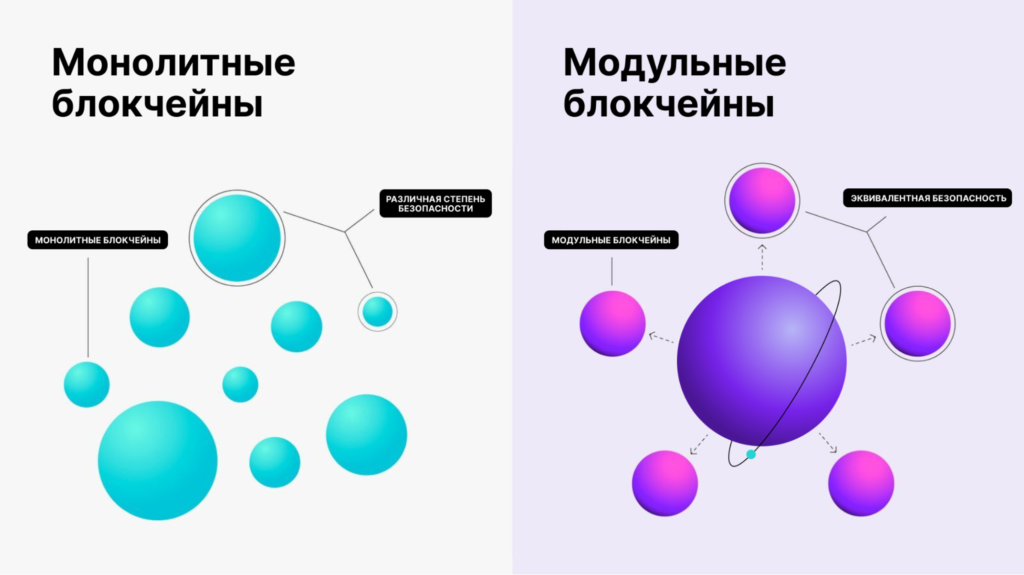
Drawbacks and risks of modular blockchains:
- complexity. Developing and maintaining a multi-layer architecture can be challenging. The complexity of such systems is also a potential barrier for newcomers still getting to grips with the technology;
- a shorter track record than monolithic blockchains. Many modular systems still have to prove their viability;
- security risks. If the layer responsible for consensus and data availability is ineffective, the modular system can fail;
- potentially weak demand for the cryptoassets of some modular blockchains because of limited utility. For example, a layer responsible for consensus and data availability is likely to see less usage of its own utility token than an execution layer.
What are some examples of modular blockchains?
Celestia and Polygon Avail
Celestia is one of the best-known modular blockchains. In October 2022 the project raised $55m in a round led by Bain Capital Crypto and Polychain Capital.
The blockchain allows rollups and other modular chains to use Celestia for data availability and consensus. Nodes can attest to data availability without downloading the entire data set for a given block.
Celestia’s architecture is designed so that its nodes can reach consensus across different networks while transactions execute off-chain.
A clear separation between the consensus and execution layers lets Celestia focus on an organised, systematic approach to data storage, leaving transaction execution to separate chains.
In March 2023 the company spun out the Rollkit modular framework for supporting rollups on the Bitcoin blockchain into a separate line of business.
In autumn 2023 Celestia’s developers launched the Lemon Mint mainnet, and the TIA token began trading on several major exchanges.
The Polygon project is building a similar modular solution — Avail. It is designed to reduce load on blockchains by offloading data and scaling “in all directions”.
Avail is positioned as a data-availability layer for Optimism, Validium and other solutions based on zero-knowledge proofs that will run on top of it. The technology enables posting and verifying data availability off-chain, acting as a key component of a modular network architecture.
“Avail specialises in ordering transactions and keeping them available, without performing validation, as happens in typical blockchains,” — explained Polygon co-founder Anurag Arjun.
The solution makes it possible to build arbitrary blockchains with any execution environment (EVM, wasm and others) without compromising decentralisation or security.
Rollups
As noted, rollups operate within a modular approach. Optimistic rollups use the Optimistic Virtual Machine, and ZK-rollups use a zkEVM, as the execution layer (smart contracts and transaction processing).
Both types of rollup rely on Ethereum for other critical functions:
- data availability and consensus. Rollups publish transaction data to the main network as CALLDATA;
- settlement. All bundled transactions are finalised on Ethereum. In the case of ZK-rollups this happens after verification of a zero-knowledge proof. In Optimistic rollups, transaction batches are assumed valid by default and are checked only if someone challenges them.
Validium
The scaling technology known as Validium has much in common with ZK-rollups. Its hallmark is that transactions are executed off-chain. The system then sends data in batches to the parent chain together with a validity proof.
Such platforms can use a structure like a “data availability committee” (DAC) or a separate network based on Proof-of-Stake, as in Celestia.
Thus, a Validium modular stack consists of the following elements:
- an execution layer;
- a settlement and security layer (the parent chain);
- a data-availability and consensus layer (a DAC or a separate PoS network).
Examples of Validium-based systems (according to L2BEAT): Immutable X, ZKFair, ApeX, rhino.fi, Sorare.