




The international rating agency Moody’s has released a set of criteria for determining the credit rating of fiat-pegged “stablecoins.”
Until January 26, 2026, the company will gather feedback from market participants on the proposed framework.
“We will assess the creditworthiness and assign ratings to obligations backed by stablecoins,” Moody’s stated.
The first step involves examining the quality of each reserve asset. The second step in the analysis will address their market value, considering type and maturity.
Additionally, Moody’s plans to consider liquidity risks associated with stablecoins, operational and technological threats, storage conditions, transparency of operations, and other factors.
Tether in the Spotlight?
In November, the agency S&P Global Ratings downgraded the stability rating of USDT from Tether to the fifth level—the lowest on its scale.
Analysts explained the decision by citing the increased share of risky assets in the coin’s backing. In their view, the current capital buffer may be insufficient to cover losses if the bitcoin price falls.
Tether CEO Paolo Ardoino criticized S&P Global, accusing the agency of spreading FUD regarding USDT. According to him, Tether’s total assets at the end of the third quarter of 2025 amounted to about $215 billion, while obligations for issued tokens were $184.5 billion. The agency’s specialists did not account for $7 billion in excess capital beyond reserves and $23 billion in retained earnings.
The provisions of the adopted GENIUS Act in the US require full backing of coins with liquid assets and annual audits for issuers with a market capitalization exceeding $50 billion.
In October, Ardoino confirmed that Tether would enter the US market with a specially created token, USAT, by the end of this year.
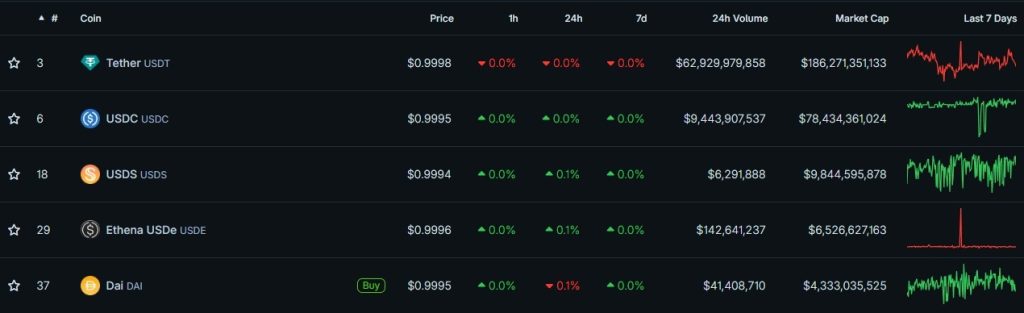
The total supply of USDT exceeds $186 billion. The main competitor, USDC, has a supply of $78.4 billion. Circle’s stablecoin fully complies with the GENIUS Act standards.


In May, Ardoino, commenting on the possibility of creating a stablecoin for the US market, once again emphasized Tether’s focus on emerging economies.
Moody’s believes that the expansion of stablecoin use in such countries poses risks to monetary sovereignty and financial stability.
The IMF confirmed that tokens pegged to the US dollar could accelerate the dollarization process in high-inflation economies and undermine central banks’ control over capital flows.