


Neuralink to test brain-computer interface on humans within six months
Billionaire Elon Musk, at the Show and Tell event, said that within the next six months Neuralink will launch clinical trials of the brain-computer interface (BCI) on humans.
According to the entrepreneur, he himself would have such a device implanted in his brain in the future.
Musk said the company had supplied most of the documents required by the U.S. Food and Drug Administration for testing the system. Earlier he had forecast the start of human testing in 2020, and later in 2022.
Neuralink’s aim is to create a device that allows controlling a computer by thought. As early as 2019, the company announced the start of BCI testing on primates, and later — on pigs.
In 2021, Musk demonstrated how a monkey, with a brain-implanted neural interface, played ping-pong.
Now Neuralink demonstrated the ability for “telepathic text printing” — the primate wrote “Welcome to Show and Tell” by thought. The device converted neural impulses into data for interpretation by a computer.
The monkey tracked keys highlighted in yellow by developers on the screen. The implanted N1 chip recorded brain activity to control the cursor movements.
Later, researchers showed a pig with a BCI on a treadmill. According to them, the experiment will help study approaches to address mobility problems in people.
Neuralink’s highly invasive, compact neural interfaces feature several flexible microelectrodes that must be integrated into brain tissue.
“It’s like replacing part of your skull with smart watches, for lack of a better analogy,”
According to co-founder Dongjin Seo, a robotic system can implant 64 such “threads” in 15 minutes. He also demonstrated the implantation process on a mannequin.
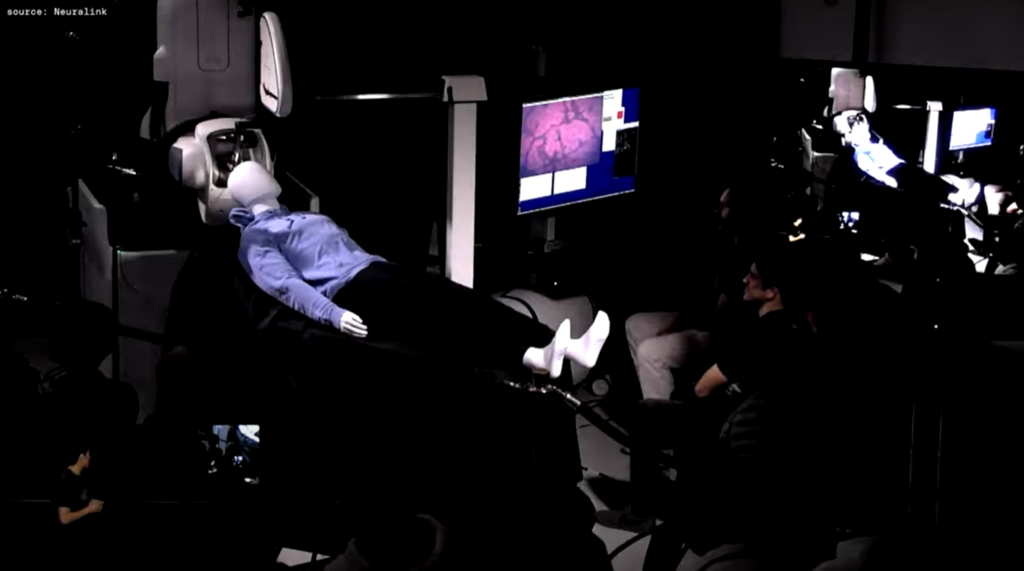
The reason for employing a robotic surgeon lies in the “minuteness” of the microelectrodes.
“Imagine taking hairs from your head and inserting them into a jelly covered in packaging film, doing all of this with precision and depth, 64 times in a row, and in a reasonable time,”
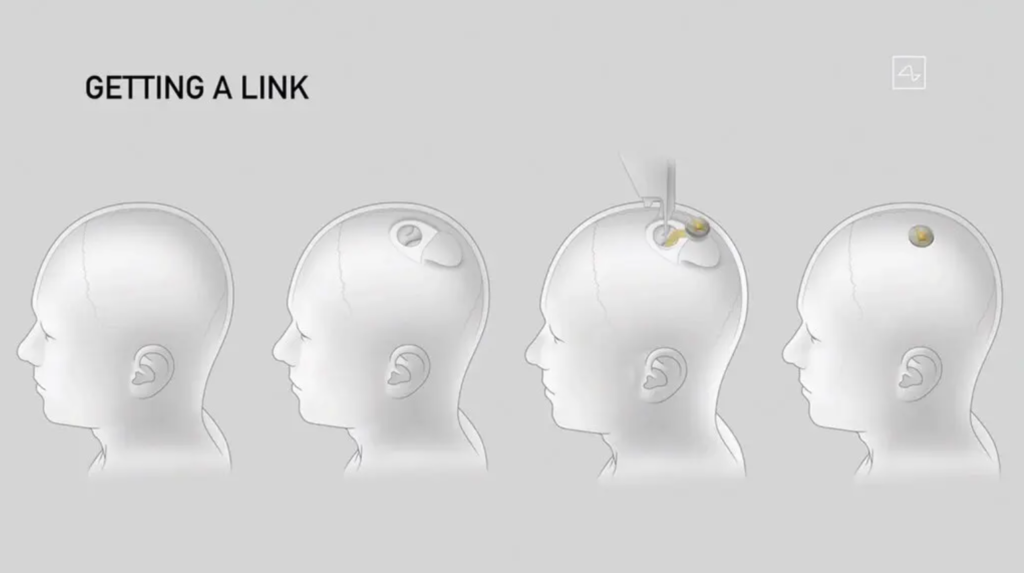
According to Musk, implantation will in the future be effectively an outpatient procedure. However, he also said it should be easy to update the system.
“I’m fairly sure you wouldn’t want to have iPhone 1 in your head when the iPhone 14 is available,”
Additionally, researchers are working on implants to restore sight and on devices that could restore mobility to patients with spinal cord injuries.
Earlier in February, animal-rights groups accused Neuralink of causing «severe suffering» to primates. In May, Elon Musk invited experts in smart watches and smartphones to join Neuralink to work on neural interfaces.
Subscribe to ForkLog’s Telegram news: ForkLog AI — all the news from the world of AI!
Рассылки ForkLog: держите руку на пульсе биткоин-индустрии!