


New Scaling Technology Brings Ethereum Closer to 10,000 TPS
Pico Prism will enable network nodes to run on smartphones.
The Ethereum scaling project Brevis has unveiled a new zkEVM technology called Pico Prism. It verifies network operations almost instantaneously using gaming graphics cards.
Announcing Pico Prism, the state-of-the-art zkVM for Ethereum real-time proving. 99.6% of blocks proven under 12 seconds, 6.9s average with 64 RTX 5090 GPUs.
This marks a major step toward scaling Ethereum by 100x and a future where you can validate the chain from a phone. pic.twitter.com/nroP8A8Q9H
— Brevis (@brevis_zk) October 15, 2025
In one of the tests, Pico Prism verified 99.6% of blocks in less than 12 seconds. 96.8% met the Ethereum Foundation standard of 10 seconds. The average proof time was 6.9 seconds for blocks with a gas limit of 45 million units.
“Ethereum will be 100 times faster, and soon even your phone will be able to become a full network node,” noted Brevis.
In the network of the second-largest cryptocurrency by market capitalization, each validator is required to duplicate computational work—re-executing all block transactions for verification. This approach demands enormous and ever-growing computational power from each participant.
Pico Prism allows just one node to generate ZK-proofs of block correctness. All others can verify this proof in fractions of a second without repeating the computations themselves.
Brevis developers used a cluster of 64 Nvidia RTX 5090 graphics cards with a total cost of $128,000. This is nearly half the price of the SP1 Hypercube system from Succinct at $256,000, which was considered the best solution for verifying transactions in the blockchain of the second-largest cryptocurrency by market capitalization.
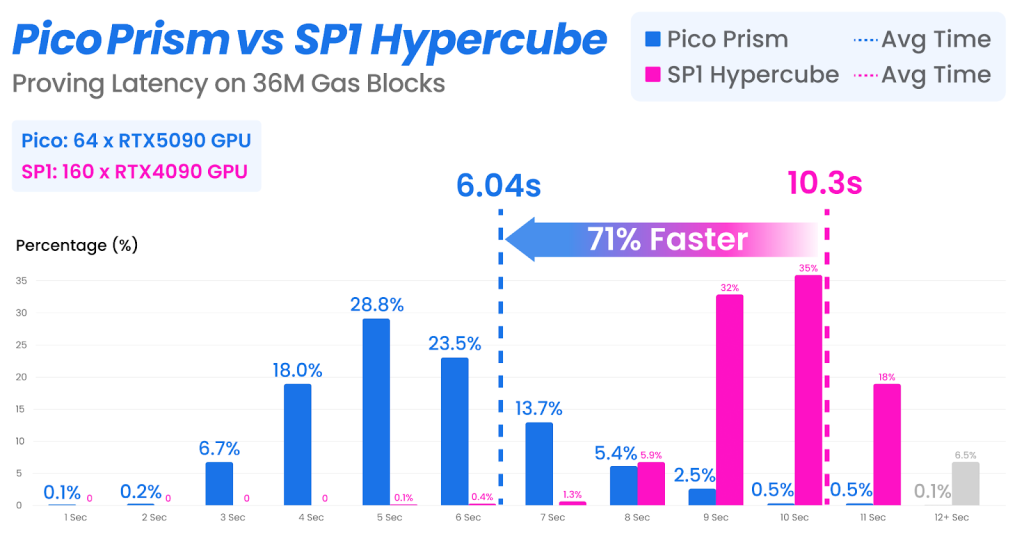
In the coming months, the project plans to achieve similar block verification metrics using 16 RTX 5090 graphics cards.
Representatives of the Ethereum Foundation called the development a “significant achievement.”
“Technologies like Pico Prism will allow the network to scale in line with global demand while maintaining decentralization and security,” they added.
The Path to 10,000 TPS
Ethereum’s development plan envisions a gradual transition for validators from re-executing transactions to simply verifying ZK-proofs. This will enable the network’s base layer to reach 10,000 TPS.
Ryan Sean Adams from Bankless expects that maintaining the current pace of development, a threefold annual increase in throughput will allow reaching the target by 2029.
At 3x per year scaling Ethereum L1 would reach 10k TPS by april 2029.
Aggressive but possible in our zkEVM world.
h/t @mteamisloading https://t.co/3s1oQpPpya pic.twitter.com/9hgKsEPxST
— RYAN SΞAN ADAMS — rsa.eth 🦄 (@RyanSAdams) October 16, 2025
“Aggressive but possible in our zkEVM world,” he commented.
The Fusaka update, scheduled for December, is expected to simplify the block verification process thanks to EIP-7825. The proposal will set a gas limit of 30 million per transaction, enhancing network reliability and reducing the risk of Ethereum overload due to resource-intensive operations.
Adams emphasized that the network of the second-largest cryptocurrency by market capitalization is transforming into a ZK-blockchain: the base layer will serve global DeFi with large blocks and nodes on smartphones, while the second layer will handle all other operations.
“No other blockchain follows this strategy—using ZK technologies to achieve maximum scalability and decentralization. Bitcoin remains conservative with first-generation cryptography. Ethereum is actively transitioning to second-generation cryptography. Others scale using nodes that require data centers,” he concluded.
Vitalik Buterin described the PeerDAS technology—a part of Fusaka—as a key element for scaling the network.
Рассылки ForkLog: держите руку на пульсе биткоин-индустрии!