


2.9×10^50 years to crack: A review of Blender Wallet, a non-custodial wallet with an integrated Bitcoin mixer
According to the Chain.info portal, almost 15% of available bitcoins are held on five centralized exchanges. If anything happens to exchange servers or key holders, users would lose access to their cryptocurrency. This happened with OKEx: the crypto exchange paused withdrawals when it could not reach one of the private-key holders.
Here is a safer way to store cryptocurrency — Blender Wallet, a non-custodial wallet with an integrated Bitcoin mixer.
Hardware, custodial and non-custodial wallets: how they work
Crypto holders use three kinds of wallets: hardware, custodial and non-custodial.
Hardware wallets are electronic devices that store private keys in encrypted form. To access a Bitcoin address, you connect the hardware wallet to a computer and enter a password.
Custodial wallets store private keys on servers. The user enters a username and password, and the wallet locates their key and provides access to the Bitcoin address.
Non-custodial wallets do not store private keys; they generate them at each login from a mnemonic phrase. One such wallet is Blender Wallet from the creators of the Bitcoin mixer Blender.io.
A mnemonic phrase (seed) is a sequence of words from the BIP39 dictionary, in which each word corresponds to a number from 1 to 2048.
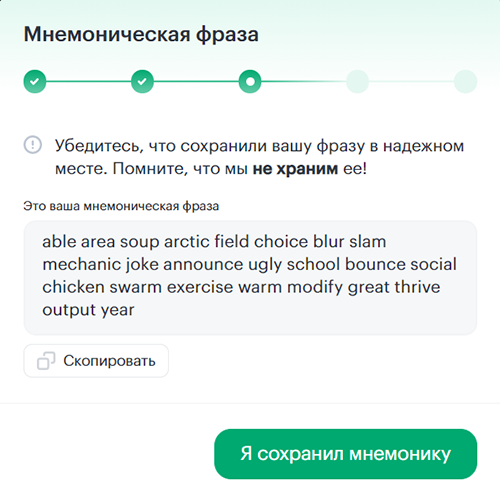
The Blender Wallet mnemonic phrase consists of 24 words. It is the longest variant of the BIP39 standard.
Blender Wallet uses the mnemonic phrase as follows:
- replaces each word of the phrase with a binary number. For example, the word «abandon» becomes 00000000000, and «bamboo» becomes 00010010001;
- concatenates the resulting numbers into a string;
- substitutes the string into the private key generation formula in place of a random variable k. The outcome depends on this variable: using the same k twice yields the same keys.
The mnemonic phrase cannot be recovered, so during registration Blender Wallet checks that the user has written it down. To do this, the wallet requests several words at different indices.
Why Blender Wallet cannot be hacked: phrase, password, and authentication
The resilience of a mnemonic phrase to cracking depends on its length and the size of the dictionary.
We calculated how long Bitcoin miners would take to crack Blender Wallet’s phrase. To do this we computed the number of 24-word combinations and divided by the network’s hash rate. It turns out that brute-forcing by miners would require 2.9×10^50 years.
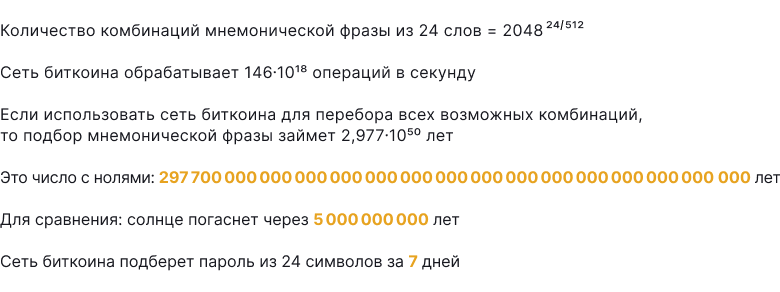
The Bitcoin network would crack a 24-character password in a week, while cracking Blender Wallet would take 2.9×10^50 years.
In Blender Wallet you can use additional security measures:
- set a password for wallet login. Blender Wallet adds it to the mnemonic phrase: this increases the cracking time by 2048 times;
- enable two-factor authentication. Blender Wallet uses Google Authenticator to confirm wallet logins and transactions.
The user sets a password when creating the wallet. It cannot be added or changed after the mnemonic phrase is generated. Two-factor authentication can be enabled or disabled at any time.
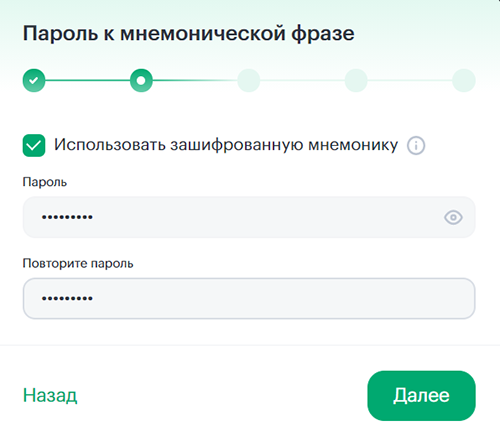
Password cannot be added after mnemonic generation: the pair “phrase-key” is formed at wallet creation.
Security of funds on a non-custodial wallet depends on how the user stores the mnemonic phrase. It should not be sent to oneself in a messaging app or uploaded to the cloud.
Wallet features: labels, selection and freezing addresses
Addresses and transactions on the blockchain are represented by strings of characters that are hard to remember and distinguish. Blender Wallet simplified handling of transactions with labels, freezing, and selecting multiple addresses. Users can:
- assign labels to transactions and addresses for quick search and accounting;
- freeze addresses to control spending;
- select one or more addresses when sending funds.
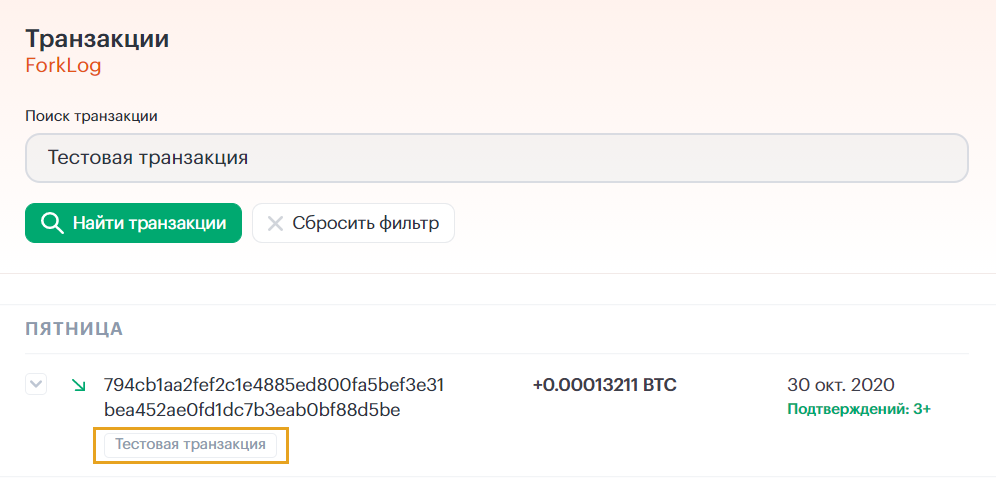
Now a transaction can be found by the label “Test transaction.”
Blender Wallet conducts anonymous transactions using the built-in Bitcoin mixer: it mixes the user’s coins with bitcoins from other network participants. This makes it impossible to trace the true sender. The cost of mixing ranges from 0.5% to 2% of the transaction amount.
In addition, Blender Wallet supports hierarchical deterministic addresses (HD Wallet). Hierarchical deterministic derivation is a way of managing multiple Bitcoin addresses with a single private key. A wallet with HD derivation generates private keys for the child addresses using the mnemonic phrase of the parent address.
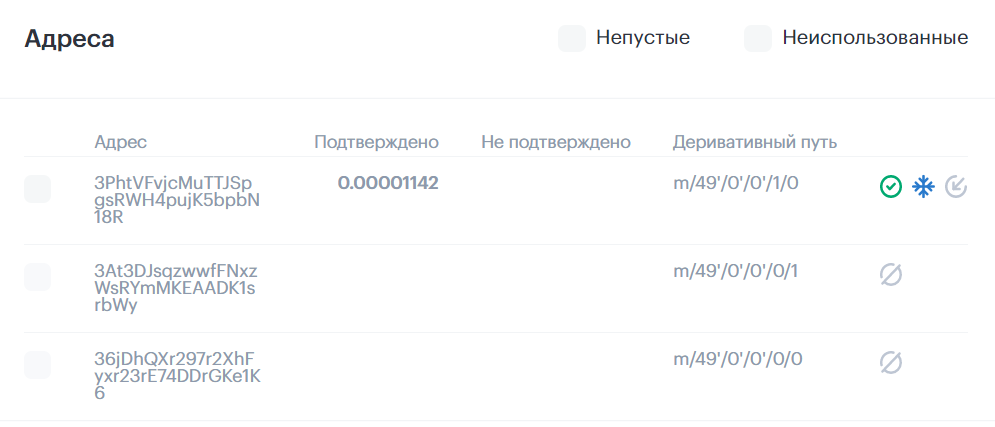
In the center are generated addresses. The Derivative Path column shows the address’ index in the derivation path.
HD addresses are useful for those who care about anonymity. Blender Wallet allows generating several clean child addresses and receiving transactions to them.
To access the parent and child addresses, the same mnemonic phrase is used. At the same time, the private keys of child addresses can be exported and used in other wallets.
Testing Blender Wallet: tagging transactions and reviewing login statistics
Blender Wallet does not allow importing private keys or mnemonic phrases from other wallets, so we created a new wallet with a password and two-factor authentication.
First we transferred $1.5 to it, labeled the transaction, and found it by the label. Then we froze the address and tried to send a transaction — Blender Wallet rejected it.
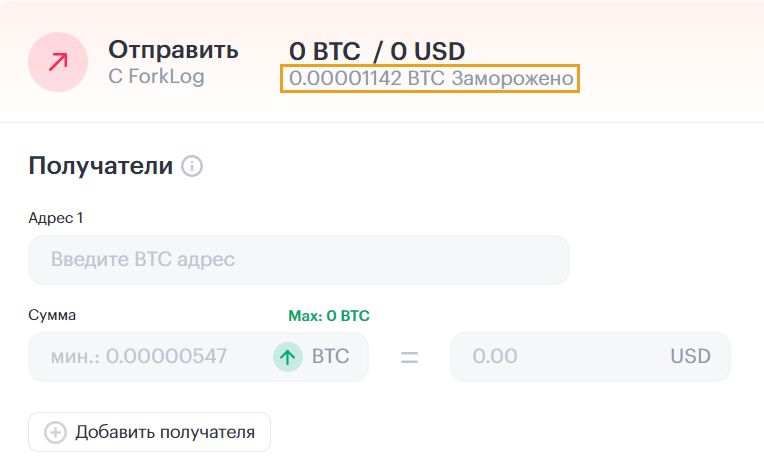
Blender Wallet reports that funds on the address are frozen.
The mixer was not used: there were not enough funds to pay fees due to network activity.
Blender Wallet keeps wallet login statistics and logs failed attempts. If an attacker gains access to the mnemonic phrase, you will notice a hacking attempt and have time to withdraw funds.
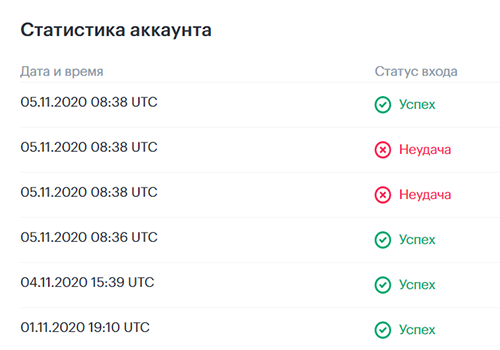
Several incorrect Google Authenticator codes were entered. Blender Wallet logged failed login attempts.
We also note the Russian-language interface and a fully translated FAQ. The documentation contains the following information:
- guidance on Bitcoin and crypto wallets for beginners;
- a list of protocols Blender Wallet supports;
- description of Blender Wallet features.
During testing, a wallet flaw was found: Blender Wallet does not allow setting a transaction fee size. The wallet offers choosing it from available options.
Conclusions
Blender Wallet is suitable for crypto investors who prioritise anonymity. They can mix transactions using the mixer and receive bitcoins at clean hierarchical addresses.
The labeling and freezing system will prove useful for handling large numbers of addresses and sorting transactions. Labels will be visible only in Blender Wallet.
Blender Wallet does not support importing keys from other wallets. You will have to create a new wallet, but there are benefits: you can enable additional protection in the form of authentication and a password.
Follow ForkLog news on Twitter!
Рассылки ForkLog: держите руку на пульсе биткоин-индустрии!